Beyond New Airplanes: Will Modern Fleets Truly Close the Gap Between Our Islands?
Beyond corporate updates, how will new aircraft models change the way ordinary Filipinos travel across our islands? Let's take a closer look.
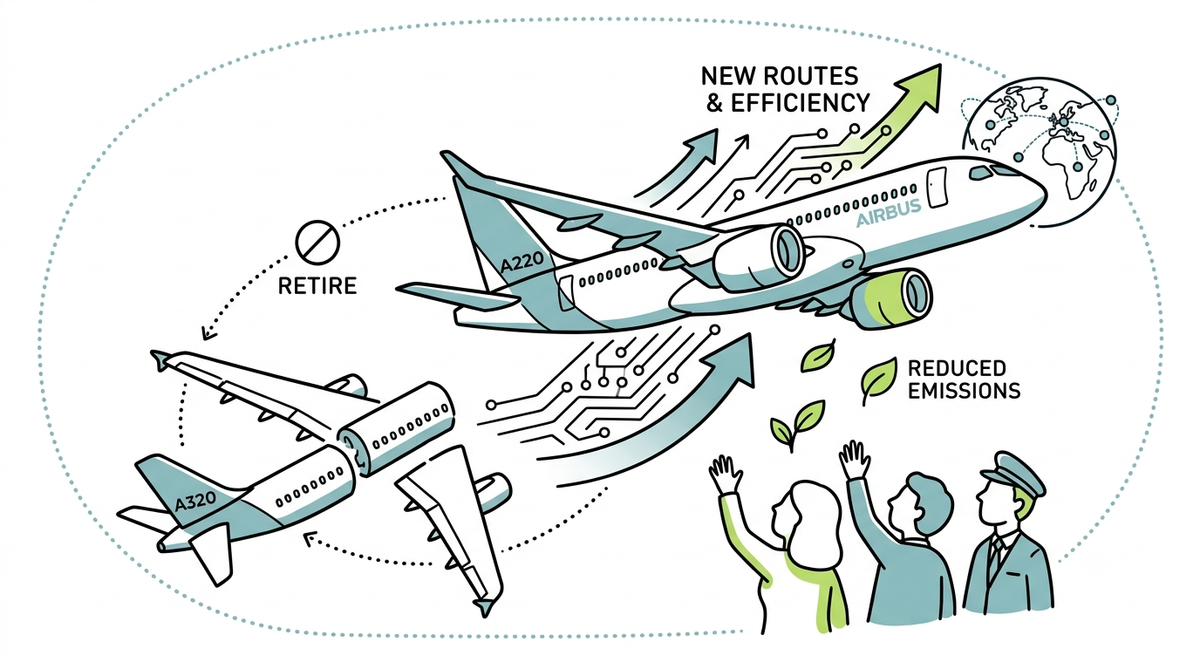
The introduction of the Airbus A220 to the Philippine aviation market could reshape regional travel and accessibility for ordinary commuters, moving beyond mere corporate upgrades.
For millions of Filipinos, booking a plane ticket is rarely an impulse choice or a luxury vacation plan. Instead, it is a carefully calculated family mathematical equation. It is the Overseas Filipino Worker (OFW) counting down the days until a brief annual homecoming, computing how many hours will be wasted in transit before finally hugging their children. It is the small trader from an island province trying to bring local goods to a larger market, weighing the cost of air freight against the risk of agricultural spoilage on a slow ferry.
In an archipelagic nation separated by vast waters and mountain ranges, aviation is not just an industry—it is a lifeline.
When a major budget airline like AirAsia Philippines announces that it is overhaulings its fleet, retiring its familiar Airbus A320 aircraft to make way for the newer Airbus A220, the news is easily buried under the business or corporate sections of the morning papers. On the surface, it sounds like an issue intended only for corporate shareholders, aviation enthusiasts, or financial analysts.
Yet, beneath the technical jargon of fuel burn efficiencies, seat configurations, and fleet retirement schedules lies a deeply human story about how we move, how much it costs us to see our loved ones, and whether our smaller, overlooked provincial communities will finally be brought closer to the rest of the country.
The Issue Explainer: What is Changing in the Sky?
To understand why this development matters to an ordinary commuter, we must first unpack what is actually happening to the aircraft flying above us.
AirAsia Philippines has revealed plans to introduce the Airbus A220 to its domestic and regional operations, gradually phasing out its older fleet of A320s. For decades, the standard single-aisle aircraft used by budget carriers across the developing world has been a workhorse designed for high-density, mid-range routes.
The incoming aircraft, however, represents a different philosophy in aviation design. It is a smaller, lighter, yet highly modern jetliner that fills a unique gap in the market.
- Wider Seating and Comfort: Despite having a slightly smaller overall passenger capacity than the largest single-aisle jets, its interior cabin configuration allows for wider seats and broader aisles, aiming to reduce the cramped conditions long associated with budget travel.
- Enhanced Fuel Efficiency: The newer design incorporates advanced aerodynamics and next-generation engines, resulting in significantly lower fuel consumption and a reduction in carbon emissions compared to older generation models.
- Short-Runway Capability: Unlike larger commercial aircraft that require massive, expansive runways to land safely, this model is specifically engineered to operate efficiently out of smaller, constrained secondary airports.
This industrial shift creates a ripple effect. As older planes are retired, local aircraft maintenance, repair, and overhaul industries must rapidly retrain workers and update facilities to handle entirely new mechanical systems, creating both anxieties and adjustments within the local technical workforce.
What This Really Means: Breaking the Urban Monopoly
The real significance of this fleet transition does not live in the corporate boardrooms of Manila; it lives in the geographical reality of the Philippine map.
For generations, air travel in the Philippines has suffered from an intense urban monopoly. Because major commercial jets require long, heavy-duty runways, air traffic has been funnelled through a handful of massive hubs—most notably the heavily congested Ninoy Aquino International Airport (NAIA) in Manila, alongside Cebu and Clark.
If you live in a smaller province or a remote island, your journey home often looks like a grueling multi-stage triathlon:
- A commercial flight to a major city hub.
- Hours spent waiting in heavy city traffic to reach a bus terminal.
- A multi-hour provincial bus ride to a port.
- A turbulent ferry ride to your final destination.
Because the incoming aircraft can take off and land on shorter runways that were previously inaccessible to standard low-cost carrier fleets, the structural dynamics of regional travel could begin to shift. Smaller provincial airports, which have historically been limited to tiny, expensive turboprop planes or left entirely empty, may soon be able to accommodate direct regional flights.
When an aircraft can bypass major congested hubs and fly directly from a smaller regional city to another province or even a neighboring Asian country, it chips away at the historical isolation of our rural communities. The busy parent or the tired worker saves something far more valuable than money: they save time.
The Human Impact: Fares, Livelihoods, and Everyday Survival
Whenever an airline announces an upgrade to its fleet, the immediate, collective question asked by the riding public is simple and predictable: Will ticket prices finally go down?
In a country where inflation has consistently squeezed the monthly budgets of ordinary households, the cost of transportation remains a heavy burden. The airline industry frequently points out that fuel efficiency is the single greatest factor in keeping operation costs low, which theoretically allows them to offer lower fares. When an aircraft burns significantly less fuel per seat, the overhead cost of operating a flight drops.
However, ordinary consumers know that corporate cost savings do not always translate automatically into cheaper tickets at the consumer counter. Market demand, airport taxes, and seasonal inflation often absorb those savings. The public benefit of these more efficient planes will be measured not by the press releases of airline executives, but by whether a minimum-wage worker can afford a ticket home during emergencies without having to borrow money from informal lenders.
Beyond the immediate ticket cost, the introduction of more flexible aircraft impacts local livelihoods in profound ways. Consider the small-scale tourism operator in an emerging province—the family running a modest homestay, the local tricycle drivers' association, or the community tour guides. When transport infrastructure limits arrivals to small, irregular flights, these local eco-systems remain precarious and vulnerable. Direct, reliable, and accessible air connections can provide a stable stream of economic opportunity to areas that have long been excluded from the national economic narrative.
Furthermore, there is an environmental dimension that directly touches the lives of ordinary citizens. The Philippines is among the most vulnerable countries in the world to the devastating impacts of climate change. Increased typhoons, erratic weather patterns, and rising sea levels regularly disrupt coastal communities and agricultural sectors. The aviation industry is a major contributor to global carbon emissions. A systemic transition toward aircraft that verifiably lower carbon output is not a corporate trend—it is an absolute necessity for the long-term survival of the very communities these airlines serve.
Looking Toward a Connected Horizon
True development in a nation as geographically fragmented as ours cannot be achieved when progress remains concentrated in premier urban centers while the rest of the archipelago is left to navigate outdated, difficult transport networks. A country cannot truly move forward if its people remain disconnected from one another by prohibitive costs and inaccessible infrastructure.
The introduction of new aircraft models to Philippine skies is a small piece of a much larger, ongoing puzzle. It serves as a reminder that technological and corporate advancements should ultimately be judged by their utility to the public good.
As these new wings begin to appear in our skies, the true measure of their success will not be found in corporate profit margins or market share data. It will be found in the ease with which an OFW can return to their hometown, the viability of a small provincial business, and the dignity of an ordinary Filipino traveler who no longer has to sacrifice days of their life just to cross the sea and come home.
Lahat tayo masaya kapag may balita tungkol sa mga bagong eroplano at mas mabilis na biyahe sa bansa. Pero para sa ordinaryong Pilipinong nag-iipon para makauwi sa probinsya, laging may mas malalim na tanong: Bababa ba talaga ang pamasahe, at magiging mas madali ba ang koneksyon sa mga maliliit na paliparan? O mananatili itong pangarap para sa marami?

Power Our Mission, Shape the Future
We empower single parents, PWDs, youths, seniors, and stay-at-home parents through digital livelihood.
Help us build resilient communities.
BUKLURAN remains open to partnerships, sponsorships, and collaborative initiatives that create meaningful community impact.
Whether through funding, in-kind support, volunteerism, or shared services, your organization can help strengthen programs that serve underserved communities.
Do you want to take part in our free livelihood programs, scholarship assistance, and community resource pooling initiatives? Membership is completely free.
Join BUKLURAN!
Register, volunteer, and become a member today.