Beyond the Billion-Peso Milestones: What Reaching "Upper-Middle Income" Actually Changes at Home
The headlines say the Philippines is now an upper-middle income nation. But what changes on the ground for a local carinderia?

While the Philippines celebrates its official climb to upper-middle income status, the true measure of economic progress lies in making formal business systems accessible and supportive for ordinary grassroots entrepreneurs.
Every morning before dawn breaks, Aling Elena opens the metal shutters of her small eatery in a busy corner of a barangay in Metro Manila. She counts her starting capital, sets aside money for the day’s wet market run, and logs her expenses in a worn-out spiral notebook. To economists, Aling Elena is part of the vast, bustling network of micro, small, and medium enterprises (MSMEs) that make up over 99% of all businesses in the Philippines. To her neighbors, she is simply the woman whose affordable meals keep the local tricycle drivers, laborers, and sales clerks fed.
Recently, a wave of optimistic news swept through television screens and social media feeds. The World Bank officially declared that the Philippines has crossed a historic threshold, graduating from a lower-middle income nation to an upper-middle income country (UMIC). The report highlights that our Gross National Income (GNI) per capita has reached $4,850, surpassing the international benchmark. On paper, it is a massive victory—a sign of macroeconomic resilience, steady post-pandemic recovery, and an average annual growth rate of 5.8% over the last five years.
Yet, if you ask Aling Elena or the drivers eating at her wooden benches whether they feel "upper-middle income," you are likely to be met with a wry smile or a shrug. For millions of ordinary Filipinos, international economic labels feel distant from the immediate, daily pressures of high utility bills, fluctuating vegetable prices, and the grueling hustle to make ends meet. It raises a foundational question: How does a milestone celebrated in high-tech boardroom meetings translate into tangible changes for families striving on the ground?
The News Behind the Numbers: The SEC’s New Push
Following the World Bank's announcement, economic agencies have begun laying out their next steps to sustain this momentum. Chief among them is the Securities and Exchange Commission (SEC), led by Chairperson Francis Lim. Recognizing that a country cannot truly remain a middle-income success story if its institutions remain rigid, the SEC has pledged a series of institutional reforms designed to deepen the country's financial markets and improve the ease of doing business.
For a long time, the word "SEC" evoked images of massive conglomerates, high-flying stockbrokers, and complex corporate litigations. However, the agency's latest policy directions are deliberately pointing downward—toward the grassroots. Over the past five years, the regulator has processed 232,524 new company registrations, capturing over P618 billion in capital investments. To keep this momentum going, the SEC is focusing on several key shifts:
- Accelerated Digitalization: Replacing slow, paper-heavy processing lines with online tracking and automated registration platforms.
- Targeted Fee Discounts: Dropping registration and compliance fees specifically for MSMEs, yielding over P139.6 million in direct savings for smaller enterprises so far.
- Stricter Processing Timelines: Enforcing hard deadlines on government staff to eliminate bureaucratic backlogs and hidden costs.
These measures are intended to encourage informal businesses—the unregistered stalls, home-based online sellers, and community initiatives—to step into the formal economy. By doing so, the government hopes these small ventures can secure safer investments, build institutional credit, expand their operations, and eventually create more stable, local jobs that pay dignified wages.
What This Really Means for the Everyday Hustle
To understand why this institutional shift matters, we have to look at the invisible barriers that keep a small business from growing. In the Philippines, running an informal business is a survival strategy. It is highly flexible, but it is also deeply vulnerable.
When a local entrepreneur remains unregistered, they are effectively locked out of the secure financial system. If Aling Elena wants to buy a bigger refrigerator or open a second branch, she cannot easily walk into a commercial bank to secure a low-interest business loan. Without formal corporate papers or audited financial records, traditional banks view her as too high of a risk.
As a result, many small business owners are forced to turn to informal lenders—frequently falling prey to high-interest "5-6" loan sharks or predatory online lending apps. These high-interest cycles end up consuming their daily profits, ensuring that the business merely survives rather than scales.
The True Barrier to Entry: For a small business owner, the biggest cost of government compliance isn't just the official fee; it is the lost time spent commuting to regional offices, standing in long lines, and navigating confusing legal jargon.
By cutting down these procedural hurdles, reducing fees by half for data and documentation requests, and digitizing the process, the structural reform attempts to remove this penalty on smallness. The goal is to make formalizing a business so straightforward that an entrepreneur chooses to do it because it genuinely protects and grows their livelihood, rather than doing it out of fear of municipal penalties.
Connecting the Macro to the Micro
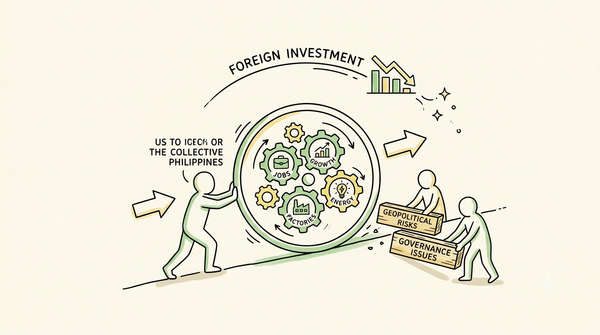
When an economy achieves an upper-middle income status, it experiences a structural shift. The country's credit ratings improve, making it cheaper for the government and large local companies to borrow money internationally. This influx of capital ideally funds massive infrastructure projects—better roads, modern ports, and updated digital networks.
For the ordinary Filipino family, the real value of these macro developments lies in their long-term ripple effects:
For Workers and Breadwinners
An economy that is easier to navigate attracts diverse investments. Instead of relying solely on a few centralized industries, a simplified business environment allows domestic firms to expand into the provinces. This creates local, diverse job opportunities, giving parents and young graduates the chance to find productive, stable work close to home, rather than being forced to migrate to overcrowded urban centers or take the difficult path of working overseas.
For Students and the Youth
A growing economy demands updated skills. As capital markets deepen and new asset classes emerge, the jobs of tomorrow will require higher digital literacy and technical capabilities. Ensuring that the regulatory environment is modern means the businesses employing these young professionals are globally competitive, offering better career trajectories and safer working conditions.
The Value of Grounded, Community-First Systems
This national transition underscores why localized, community-led initiatives are so vital in bridging the gap between national policy and everyday realities. High-level institutional updates from the SEC are excellent, but they only work if ordinary people have the awareness and confidence to navigate them.
This gap reflects why community-based efforts around financial literacy and cooperative capacity building matter so deeply. Across various provinces, grassroots organizations and local associations serve as the vital translating layer for national reforms. When a community has a localized support system—such as a neighborhood cooperative or a community-led livelihood network—unregistered entrepreneurs do not have to face intimidating regulatory frameworks alone.
Through localized workshops, peer-to-peer mentoring, and cooperative capital pools, ordinary citizens can learn how to manage micro-investments, understand the basics of legal protection, and gradually transition into the formal market safely. These community structures ensure that when the government opens a digital door, the most vulnerable sectors are not left standing outside simply because they lack a smartphone or a stable internet connection.
Beyond the Rest Piece: A Launchpad for True Progress
An upper-middle income designation by global financial bodies is undoubtedly a milestone worth acknowledging. It proves that the collective hard work, adaptability, and grit of the Filipino workforce are moving the national needle forward.
However, macroeconomics must never lose sight of the individual. A rising average income can easily hide persistent wealth gaps if the growth remains concentrated at the top. True economic development is not achieved when a country merely hits a statistical target; it is achieved when the structural floor is lifted so high that the most vulnerable households no longer slip through the cracks.
As the country navigates this new economic chapter, the real test of our progress will not be found in the updated charts of the World Bank or the rising figures of the Philippine Stock Exchange. It will be found in whether Aling Elena can easily protect her shop, whether a tricycle driver's child can access quality employment without leaving their hometown, and whether our public institutions feel like accessible partners rather than imposing gatekeepers. The numbers give us a goal, but it is the people who give that goal its meaning.
Lahat tayo masaya kapag naririnig sa balita na "upper-middle income nation" na daw ang Pilipinas. Pero bakit ba parang hindi ito ramdam ng ordinaryong pamilya sa presyo ng bilihin at sa araw-araw na kayod? Ano nga ba ang totoong epekto ng mga bagong pagbabago sa gobyerno para sa mga maliliit na negosyo at simpleng manggagawa?

Power Our Mission, Shape the Future
We empower single parents, PWDs, youths, seniors, and stay-at-home parents through digital livelihood.
Help us build resilient communities.
BUKLURAN remains open to partnerships, sponsorships, and collaborative initiatives that create meaningful community impact.
Whether through funding, in-kind support, volunteerism, or shared services, your organization can help strengthen programs that serve underserved communities.
Do you want to take part in our free livelihood programs, scholarship assistance, and community resource pooling initiatives? Membership is completely free.
Join BUKLURAN!
Register, volunteer, and become a member today.