Beyond the New Status: Why an Economic Promotion Doesn't Automatically Fill the Dinner Table
The Philippines is officially an 'upper-middle-income' country. Explore what this massive economic shift means for your family and community.
While the Philippines reaching upper-middle-income status marks a significant macroeconomic achievement, its real success will be measured by whether ordinary families feel the benefits through stable jobs, lower prices, and better public services.
The View from the Kitchen Table
Every morning, before the sun completely clears the horizon, thousands of small retailers across the Philippines slide open their metal grates. Jeepney drivers pump their accelerators, and parents carefully count out exact change for their children’s school allowance. In these quiet, routine moments of everyday life, the primary concern is rarely the shifting tides of global finance. Instead, the daily conversation revolves around more immediate realities: the current price of a kilo of rice, the rising cost of a jeepney fare, and whether the monthly paycheck will stretch far enough to cover the electricity bill.
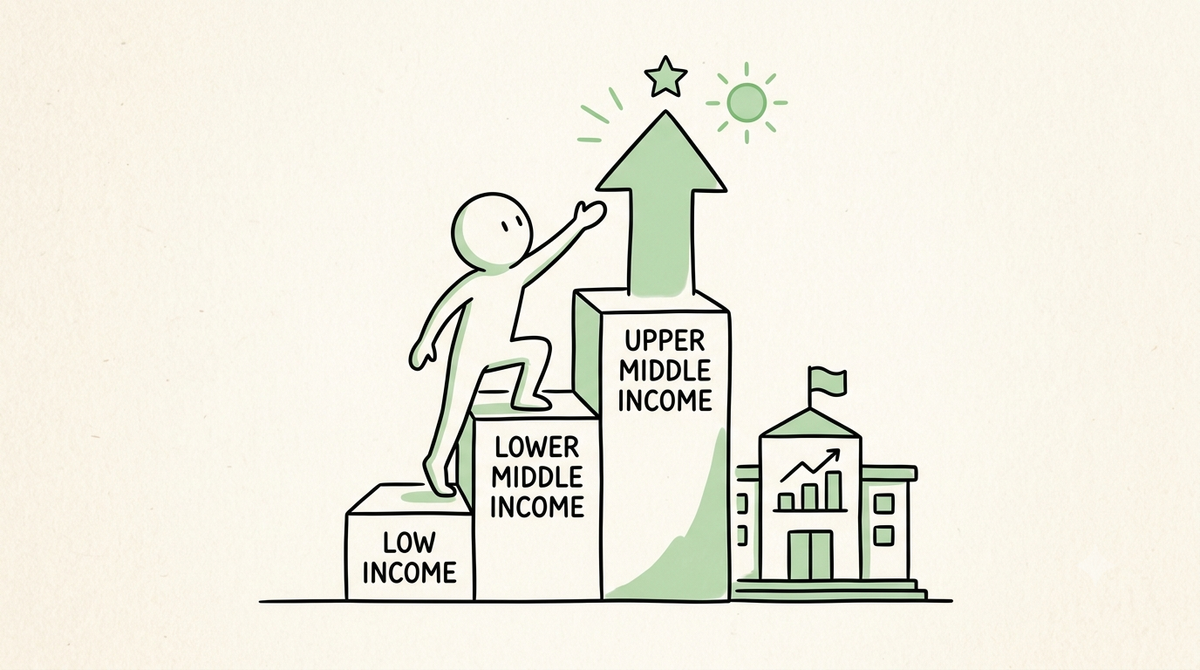
Yet, a major announcement from Washington D.C. has placed the Philippines at the center of international economic discussions. The World Bank officially reclassified the country, moving it from a "lower-middle-income" economy to an "upper-middle-income" economy. For economists, policymakers, and international investors, this is a moment of celebration—a validation of national growth and a sign that the country is moving up the global ladder.
But for the ordinary Filipino commuting through heavy traffic or budgeting for a family dinner, announcements like this can feel incredibly distant. It raises an immediate, vital question that goes straight to the heart of our national development: Why should an ordinary family care about a change in an international economic classification? What does a higher macroeconomic ranking actually mean when the view from the kitchen table remains largely unchanged?
The Facts Behind the Labels
To understand this development, it helps to strip away the complex financial jargon and look directly at what these numbers represent. Every year on July 1, the World Bank updates its economic classifications for countries around the world. This grouping is determined by a metric known as Gross National Income (GNI) per capita. Essentially, GNI takes the entire economic output of a nation—including the money earned by citizens and businesses working abroad, such as our overseas Filipino workers (OFWs)—and divides it by the total population.
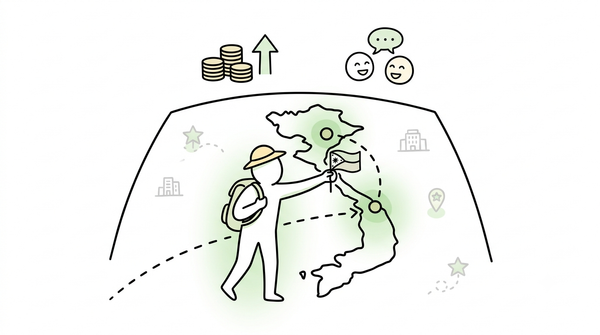
According to the latest figures, the Philippines saw its GNI per capita climb to a record $4,850. This improvement moves the country into the upper-middle-income tier, which the World Bank defines as economies with a GNI per capita between $4,636 and $14,375. The Philippines shares this new classification with several other advancing nations, including Vietnam, Jordan, and Sri Lanka, all of which made the upward transition.
On paper, this is an undeniable institutional milestone. It indicates that the total economic engine of the Philippines is producing more wealth than it ever has before. For the national government, this newly attained status serves as a financial badge of honor. It signals to international markets that the country is a more stable, mature environment for foreign investments. It can lead to better credit ratings, making it easier for the government to secure large-scale funding for major infrastructure projects, public transit systems, and national development initiatives.
The Disconnect Between Metrics and Daily Life
While these macroeconomic indicators are essential for international trade and national policy, they often fail to capture the granular realities of community life. The fundamental limitation of any "per capita" average is that it assumes the nation’s wealth is distributed completely evenly across every single citizen. If you take the wealth of the wealthiest conglomerates and average it with the earnings of a farmer in Bukidnon or a casual laborer in Tondo, the resulting number looks comfortable on a spreadsheet.
However, averages do not pay rent, nor do they cover medical expenses. The reality of an upper-middle-income country can coexist with widespread economic vulnerability. While the national economic engine grows larger, the daily experience of the working class can remain an uphill battle against inflation and underemployment.
When an economy transitions to a higher tier, it also faces a shifting set of global rules. For instance, as an upper-middle-income nation, the Philippines may no longer qualify for certain types of highly concessional foreign aid or low-interest developmental loans that are strictly reserved for poorer nations. International trade agreements might shift, requiring local industries to adapt to fewer protections. If our national costs rise without a corresponding increase in the purchasing power of ordinary citizens, the gap between official statistics and household realities can actually widen.
What This Change Looks Like in Our Neighborhoods
To truly evaluate the impact of this status change, we have to look past the halls of international banks and focus on the places where Filipinos live and work. True economic development is not merely about reaching a specific statistical threshold; it is about building resilience within our communities.
Consider the reality of a modern Filipino household. A higher national income tier does not automatically translate into lower consumer prices at the local market. Over the past few years, global supply chain disruptions and local agricultural challenges have kept the costs of basic commodities high. For a family earning a minimum wage, the fact that the country’s GNI per capita has grown offers little comfort when a significant portion of their daily earnings is spent entirely on food.
Furthermore, this economic promotion highlights the urgent need for structural improvements in employment quality. While employment statistics may show high numbers of people working, a deeper look reveals that many are underemployed or rely on informal, insecure livelihoods. A booming national economy needs to generate high-quality, stable jobs that provide health benefits, social security, and pathways for long-term career growth. Without these structural foundations, a macroeconomic upgrade remains a theoretical victory rather than a felt reality.
+------------------------------------+------------------------------------+
| Macroeconomic Metric (Institutional| Community Reality (Everyday Human  |
|              Context)              |            Perspective)            |
+------------------------------------+------------------------------------+
| GNI per capita rises to $4,850     | Families balance rising food costs |
|                                    | against fixed daily wages          |
+------------------------------------+------------------------------------+
| Improved access to international   | Local neighborhoods still require  |
| investment funds                   | basic infrastructure upgrades      |
+------------------------------------+------------------------------------+
| Reclassification to Upper-Middle   | Workers seek stable employment with|
| Income status                      | security and healthcare benefits   |
+------------------------------------+------------------------------------+
Looking Forward: Redefining True Progress
The reclassification of the Philippines by the World Bank should be viewed neither as a complete victory nor as a meaningless statistic. It is best understood as a transition point—a moment that highlights both the progress our society has made and the significant distance we still need to travel. It reminds us that economic growth is a means to an end, not the end itself. The true purpose of generating national wealth is to foster an environment where every family can live with dignity, security, and hope for the future.
As the country navigates this new economic status, the focus of public policy and community action must center on closing the gap between macroeconomic data and the lived experiences of everyday citizens. True progress is visible when public hospitals are fully equipped and accessible, when public transportation systems respect the time and dignity of commuters, and when public schools provide every child with the tools to succeed in a digital world.
Ultimately, the strength of the Philippines has never been defined by the classifications assigned to us by international institutions. It is found in the resilience, ingenuity, and cooperation of our communities. As we move forward into this new chapter, our collective goal should be to ensure that the wealth reflected in global reports is felt directly in the lives, homes, and futures of ordinary Filipino families.
Bakit nga ba kahit sinasabing "upper-middle-income" na ang ekonomiya ng Pilipinas ay marami pa ring pamilya ang nahihirapang magbudget araw-araw? Ano nga ba ang totoong kahulugan ng bagong World Bank status na ito para sa simpleng manggagawa, sa presyo ng mga bilihin, at sa kinabukasan ng iyong komunidad? Huwag nang magpahuli sa usapan.

Power Our Mission, Shape the Future
We empower single parents, PWDs, youths, seniors, and stay-at-home parents through digital livelihood.
Help us build resilient communities.
BUKLURAN remains open to partnerships, sponsorships, and collaborative initiatives that create meaningful community impact.
Whether through funding, in-kind support, volunteerism, or shared services, your organization can help strengthen programs that serve underserved communities.
Do you want to take part in our free livelihood programs, scholarship assistance, and community resource pooling initiatives? Membership is completely free.
Join BUKLURAN!
Register, volunteer, and become a member today.