Beyond the Screen: The Hidden Cost of a Cashless Pocket
Over half of retail payments are now digital. But as the country rushes toward a cashless future, what happens to those who rely on paper bills?
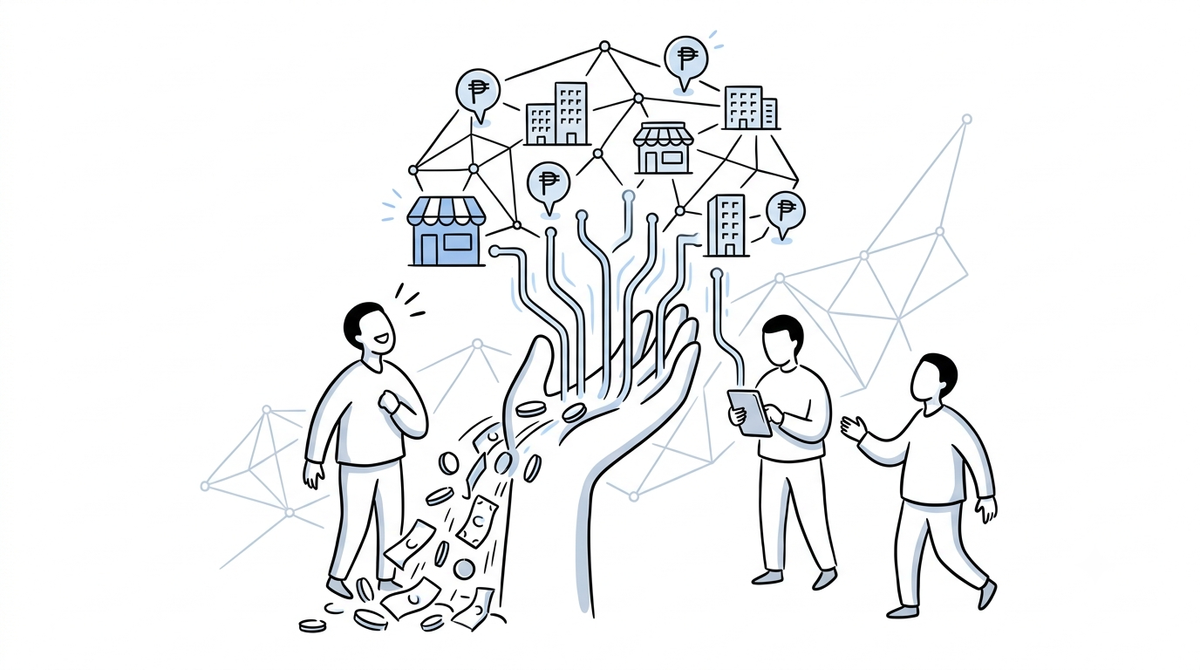
While the rapid rise of InstaPay and PESONet signals technological progress, it risks widening the economic divide for cash-reliant Filipinos.
Step into any local public market early in the morning, and you will hear a familiar symphony: the rustle of plastic bags, the chopping of meat, and the clink of loose change passing from a buyer’s palm to a vendor’s wooden cash box. For generations, this physical exchange of paper bills and coins has been the lifeblood of community commerce. It is a system built on immediacy, tangibility, and a deep sense of mutual trust. You hand over the money; you take home the food.
Yet, over the last few years, a quiet transformation has been sweeping through our jeepneys, sari-sari stores, and commercial districts. More and more often, that familiar clink of coins is being replaced by the sharp chime of a smartphone notification. A quick scan of a printed QR code or a few taps on a mobile screen now settles the bill.
According to data from the Bangko Sentral ng Pilipinas (BSP), digital payments now account for over 57% of all retail transactions in the country, completely overtaking traditional automated teller machine (ATM) withdrawals in both volume and value. Combined transactions through InstaPay and PESONet have soared into the tens of trillions of pesos. On paper, this is a massive milestone—a sign of modernization, efficiency, and a rapidly developing digital economy. But behind these dizzying macroeconomic figures lies a much more grounded, human question: As the country pushes rapidly toward a digital future, what happens to the millions of Filipinos who still live entirely in a physical cash world?
To understand the weight of this shift, we have to look at the mechanics of our everyday systems. The rise of real-time electronic fund transfers like InstaPay has undeniably thrown a lifeline to thousands of micro, small, and medium enterprises (MSMEs). For a small home baker or a neighborhood retail shop, being able to receive payments instantly without handling physical money reduces the risk of theft, eliminates the daily headache of finding change (barya), and expands their customer base beyond their immediate physical neighborhood. Similarly, PESONet has allowed larger operations to retire the slow, paper-heavy process of writing and clearing physical checks.
This digital transition originally gained momentum out of sheer survival during the 2020 pandemic lockdowns, when touching paper money felt like a health risk. Six years later, what began as an emergency alternative has solidified into the default infrastructure of modern Philippine life.
However, technology never rolls out evenly. For a middle-class professional with stable home Wi-Fi and a postpaid mobile plan, the convenience of a cashless lifestyle is a luxury. For a significant portion of our population, however, the digital economy looks less like a convenience and more like an exclusive club with a steep entry fee.
Consider the barriers that an ordinary vendor, a construction worker, or a rural farmer faces when trying to participate in this new ecosystem. The first barrier is not lack of interest, but infrastructure. Digital banking requires a steady, reliable internet connection. In many provinces and low-income urban communities, mobile data remains erratic and expensive. When a transaction "loops" or fails mid-transfer due to a dropped signal, it is not just an inconvenience—it is a financial emergency. If a consumer’s account is debited but the merchant does not receive the confirmation, a minimum-wage earner cannot afford to wait three to five banking days for a bank reconciliation. They need that money to buy food today.
The second barrier is financial literacy and digital trust. For decades, the tangible nature of cash provided a sense of security. You could count it, hide it, and know exactly how much you had left to spend until the next payday. Shifting to digital finance requires a leap of faith into an abstract world where your hard-earned money exists only as numbers on a screen. This vulnerability is worsened by the persistent threat of digital scams, phishing text messages, and unauthorized account deductions that dominate daily headlines. Without robust digital literacy programs that teach people how to navigate online security, many Filipinos understandably view digital wallets not as tools of empowerment, but as platforms of risk.
Furthermore, entering the digital financial stream requires documentation. While digital wallets have lowered the barrier to entry compared to traditional banks, full verification still demands valid government identification cards—something that millions of marginalized Filipinos, particularly those in informal sectors or remote rural areas, still struggle to obtain.
When we look closely at these systemic hurdles, we begin to see that a cashless society runs the risk of becoming an exclusionary society. If public utilities, transport systems, and basic service providers eventually phase out cash acceptance in favor of digital-only channels, we risk systematically shutting out the unbanked and the underserved from the civic life of their own country.
This growing digital divide highlights exactly why community-based efforts around basic economic literacy and grassroots financial inclusion are so critical today. True development cannot be measured solely by how many trillions of pesos move through digital networks; it must also be measured by how securely the most vulnerable members of our society can navigate these shifting economic tides. If communities are left to figure out digital systems entirely on their own, without localized support, the gap between the digitally connected and the financially isolated will only widen.
The rise of InstaPay and PESONet proves that the Philippines possesses an incredible capacity for technological adaptation. Filipinos are quick to learn and eager to find ways to make life easier for their families. But as we celebrate the convenience of moving trillions of pesos with the tap of a finger, we must remember that progress is only genuine when it carries everyone along.
We must ask ourselves: In our hurry to build a streamlined, cashless future, are we designing systems that serve the people, or are we expecting the most vulnerable people to bend themselves to fit the systems? The ultimate goal of financial technology should not be to eradicate cash entirely, but to ensure that whether a Filipino holds a smartphone or a crumpled twenty-peso bill, their purchasing power, dignity, and access to basic needs remain completely intact.
Lahat tayo masaya kapag mabilis at convenient ang magbayad gamit ang telepono. Pero alam mo ba na higit sa kalahati ng mga transaksyon sa Pilipinas ay digital na ngayon? Sa kabila ng pag-unlad na ito, paano naman ang mga kababayan nating walang smartphone, walang internet, o umaasa lang sa barya araw-araw? Sila ba ay tuluyan nang maiiwan?

Power Our Mission, Shape the Future
We empower single parents, PWDs, youths, seniors, and stay-at-home parents through digital livelihood.
Help us build resilient communities.
BUKLURAN remains open to partnerships, sponsorships, and collaborative initiatives that create meaningful community impact.
Whether through funding, in-kind support, volunteerism, or shared services, your organization can help strengthen programs that serve underserved communities.
Do you want to take part in our free livelihood programs, scholarship assistance, and community resource pooling initiatives? Membership is completely free.
Join BUKLURAN!
Register, volunteer, and become a member today.