Beyond the Trillions: What Corporate Revenue Looks Like on the Filipino Table
Trillions of pesos sound like numbers from another world. But what do corporate billions actually look like on your dining table?
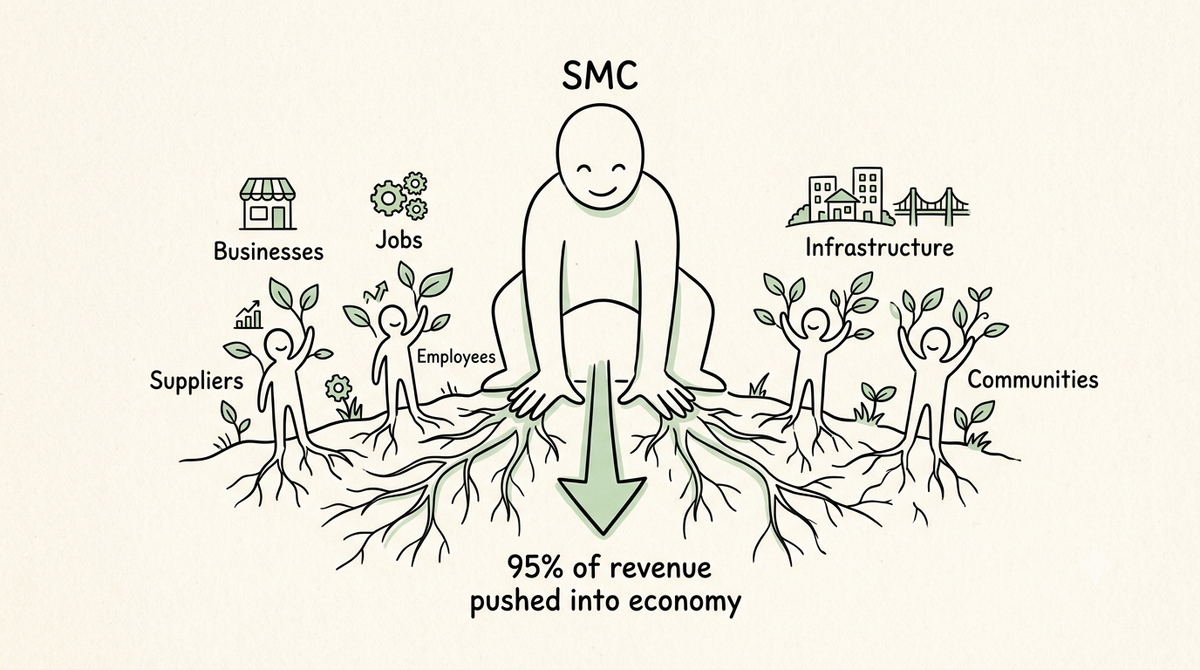
The article analyzes how the multi-trillion-peso revenue of massive corporations like San Miguel Corporation trickles down into the daily lives, livelihoods, and public services of ordinary Filipinos.
Imagine waking up at four o'clock in the morning to the sound of a roaring diesel engine. For Mang Tomas, a small-scale corn farmer in Isabela, that sound represents a lifeline. The corn he harvests isn't just feed; it is part of a massive supply chain that ultimately finds its way into the poultry products, beverages, and livestock feeds sold across the entire archipelago. Mang Tomas doesn't read the financial pages of national broadsheets. He does not know what a "diversified conglomerate" means in boardroom terms. What he knows is that when the big buyers come to town, his family eats three times a day, his daughter stays in college, and the local tractor driver gets paid.
Recently, financial headlines reported that San Miguel Corporation (SMC) disbursed approximately P1.43 trillion out of its P1.5 trillion total revenues back into various sectors of the economy. To the average citizen commuting through heavy traffic or budgeting a dwindling monthly salary, a number like "P1.43 trillion" feels completely abstract. It sounds like monopoly money—numbers with too many zeros to mean anything to someone trying to afford a kilo of rice or a tank of cooking gas.
But behind these staggering boardroom figures lies a deeply human story about how money flows through our society, who it reaches, and why the financial health of massive institutions impacts the ordinary Filipino who may never own a single share of stock.
Breaking Down the Giant Pie
To understand why this matters to everyday life, we have to look at where these astronomical sums actually go. Out of the P1.5 trillion generated, P995 billion was directed toward suppliers and operating expenses. This is not just a line item on a spreadsheet. That P995 billion represents the lifeblood of thousands of small and medium enterprises, independent logistics providers, agricultural cooperatives, and local contractors across the provinces.
When a massive corporate entity purchases raw materials, it triggers a chain reaction:
- The Provincial Supplier: Local agricultural distributors can afford to buy crops from independent farmers at predictable rates.
- The Logistics Network: Trucking companies, fuel stations along national highways, and maintenance shops keep mechanics employed.
- The Manufacturing Ecosystem: Small packaging factories and security agencies maintain their operations because their primary clients remain active.
Furthermore, P221 billion was paid in taxes and government duties. In a country where public infrastructure, health centers, and public school teachers' salaries depend heavily on the national treasury, corporate tax contributions form a significant pillar of public funding. When large entities contribute their share to the state, it directly expands the national budget available for social welfare programs, regional hospitals, and public school assistance.
Meanwhile, P58 billion was allotted for the salaries and benefits of 59,117 employees. What makes this number particularly meaningful is its geographical distribution: nearly 64% of these workers are located outside Metro Manila.
Decentralizing Opportunities Beyond the Capital
For decades, the standard narrative of economic survival for young Filipinos has been economic migration. To find a stable job with decent benefits, provincial youth felt compelled to pack their bags, leave their hometowns, and crowd into Metro Manila. This concentration of talent and labor created an overpopulated capital while leaving regional economies starved for skilled workers.
When major industries expand their operating footprints into the regions—maintaining manufacturing plants, refineries, and logistics hubs in places like Bataan, Pangasinan, Cebu, and Davao—the social landscape shifts. A young mechanical engineer from Batangas or an accountant from Cagayan de Oro no longer has to rent a cramped room in Manila just to build a career. They can remain close to their families, care for aging parents, and spend their salaries in their local grocery stores and public markets.
This regional distribution of payroll funds acts as a local economic multiplier. When a worker earns a stable wage in the province, that money is immediately re-spent locally. The tricycle driver outside the plant gates gets a regular passenger; the nearby carinderia serves dozens of lunches daily; the local sari-sari store experiences a steady turnover of goods. Economic dignity is decentralized, moving from the skyscrapers of central business districts into the communities where it is needed most.
The Hidden Infrastructure of Everyday Necessities
Most Filipinos interact with large-scale corporate operations without even realizing it. When you flip a light switch in Luzon, cook a meal using processed fuel, ride a bus along a provincial expressway, or pass by a construction site for a new public school, you are interacting with heavy industry.
Consider the operational backbone that keeps the country moving:
- Energy Capacity: Managing thousands of megawatts of power ensures that local businesses, hospitals, and households avoid the crippling brownouts that devastated previous generations.
- Transport Networks: Hundreds of kilometers of expressways cut down travel times for agricultural goods moving from northern and southern farms to urban centers, reducing food spoilage and lowering transport costs.
- Industrial Production: Millions of metric tons of domestic cement production mean that local infrastructure projects—from flood control dikes to barangay health centers—do not have to rely solely on expensive, volatile foreign imports.
When these large networks run smoothly, life for the ordinary citizen becomes marginally more predictable. Conversely, when these systems fail, it is the poorest households that bear the heaviest burden through inflation, power outages, and stranded commutes.
The Critical Balance Between Profit and Public Welfare
While these large numbers paint a picture of economic movement, they also invite a deeper reflection on the nature of wealth distribution in a developing nation. A core net income of P79.6 billion and a community investment allocation of P560 million show that while vast sums return to operations, public services, and labor, a substantial amount remains concentrated at the top as profit and returns for capital providers.
This reality highlights the ongoing conversation that ordinary citizens must have with both corporate leaders and government regulators. Large corporate footprints must always be matched by an equally large sense of social responsibility. It is not enough to simply exist as an economic engine; the quality of the jobs created, the environmental safety of manufacturing sites, and the fair treatment of small-scale agricultural partners are just as critical as the total amount of pesos distributed.
True development is measured not just by how much wealth a country generates, but by how securely that wealth anchors the lives of the most vulnerable. When massive enterprises operate transparently and responsibly, they help build a buffer against global economic shocks. But when corporate growth happens at the expense of local environments or through precarious labor practices, the social cost eventually outweighs the economic benefit.
Moving Beyond the Headlines
The next time we see a headline detailing trillions of pesos in corporate revenue, we should look past the overwhelming rows of zeros. Instead, we must look at our own communities and look for the tangible connections.
We must ask ourselves: Is the local stream near the factory still clean? Are the workers in our neighborhood receiving wages that allow them to save for the future, or are they merely surviving from one cutoff to the next? Are the taxes collected from these massive enterprises being efficiently transformed into better public hospitals, smoother roads, and reliable public schools for our children?
Economic data should never be used to silence the lived realities of ordinary citizens. Rather, data should serve as a tool to help us understand how deeply interconnected we all are. The tricycle driver, the corporate executive, the provincial farmer, and the factory worker all share the same economic ecosystem. When that ecosystem is fair, balanced, and focused on genuine human development, the entire nation moves forward together—ensuring that prosperity is not just an abstract number celebrated in boardrooms, but a felt reality on every Filipino table.
Lahat tayo naririnig ang balita tungkol sa bilyon-bilyon o trilyong pisong kita ng mga dambuhalang kumpanya sa Pilipinas. Pero kapag ba lumalaki ang kita ng mga nasa itaas, may nagbabago nga ba sa ulam sa lamesa ng isang ordinaryong pamilya? Paano nga ba umaabot ang perang ito sa mga probinsya, sa mga lokal na magsasaka, at sa mga pampublikong proyekto? Alamin ang totoong kwento sa likod ng mga numero.

Power Our Mission, Shape the Future
We empower single parents, PWDs, youths, seniors, and stay-at-home parents through digital livelihood.
Help us build resilient communities.
BUKLURAN remains open to partnerships, sponsorships, and collaborative initiatives that create meaningful community impact.
Whether through funding, in-kind support, volunteerism, or shared services, your organization can help strengthen programs that serve underserved communities.
Do you want to take part in our free livelihood programs, scholarship assistance, and community resource pooling initiatives? Membership is completely free.
Join BUKLURAN!
Register, volunteer, and become a member today.