Building Stronger Communities Through Clean Financial Frameworks
Discover how transforming your organization's financial backbone can streamline reporting and build lasting funder trust.
This article explores the vital role that a clean, well-structured chart of accounts plays in nonprofit health and transparency. Drawing from key industry insights, it highlights practical ways organizations can transition from messy data structures to clear, impact-driven financial frameworks.
In the world of public service and social impact, the passion to drive change is often what captures the spotlight. Dedicated teams work tirelessly to implement food security initiatives, launch educational programs, and build local resilience. Yet, behind every successful community program lies an invisible infrastructure that either fuels its growth or quietly holds it back: financial systems.
For many nonprofits, managing financial data is seen merely as a back-office necessity—something to deal with during tax season or when an auditor knocks on the door. However, the reality of community development is that good intentions require structural backing. When financial frameworks are muddled, disorganized, or overly complex, it creates a ripple effect that touches every part of an organization. Program managers struggle to see which initiatives are truly cost-effective, executive directors find themselves unable to make swift strategic decisions, and development teams face hurdles when trying to prove their financial health to external partners.
True sustainability in public service is built on clarity. When organizations treat financial health not as a hurdle, but as a core capability, they unlock a deeper capacity to serve. Streamlining the way data is categorized transforms raw numbers into a clear, compelling story of community impact and responsibility.
Why This Topic Matters
The broader nonprofit ecosystem is navigating an era that demands unprecedented accountability. Donors, grantmakers, and community stakeholders are no longer looking just at the emotional outcomes of a project; they are looking closely at how resources are shepherded. A messy financial framework creates fog, making it incredibly difficult to track how a specific dollar travels from an initial grant down to a tangible local resource.
For the organizations themselves, a disorganized system introduces operational risk. If an international funder requests a highly specific program report, and the internal data is tangled across generic categories, staff must spend dozens of hours manually untangling spreadsheets. This administrative burden pulls valuable human resources away from what matters most—direct community action and frontline public service.
More importantly, this issue directly impacts communities. When a nonprofit cannot clearly demonstrate where its funds are going, it risks losing the trust of institutional partners and local stakeholders. A lack of financial transparency can lead to delayed funding, missed grant renewals, or smaller resource allocations. Ultimately, the people who pay the price for these internal back-office inefficiencies are the very community members who rely on these vital programs to thrive.
Event Objectives
To address these exact foundational challenges, the learning session was designed to equip participants with the structural insights needed to modernize their internal architectures. The core goals focused on breaking down complex financial concepts into actionable organizational habits:
- Demystify the Backbone of Financial Reporting: Explain the foundational role of a structured chart of accounts (COA) in creating reliable internal and external financial statements.
- Identify Common Architectural Flaws: Highlight the common structural errors that lead to inaccurate tracking, redundant categories, and confusing reports.
- Provide Actionable Blueprints: Offer practical, real-world examples of clean account structures that balance simplicity with the granular tracking needs of modern programs.
- Guide the Transition Process: Walk participants through a clear, stress-free pathway to update, clean, and transition their current messy accounting structures into streamlined frameworks.
Key Insights and Takeaways
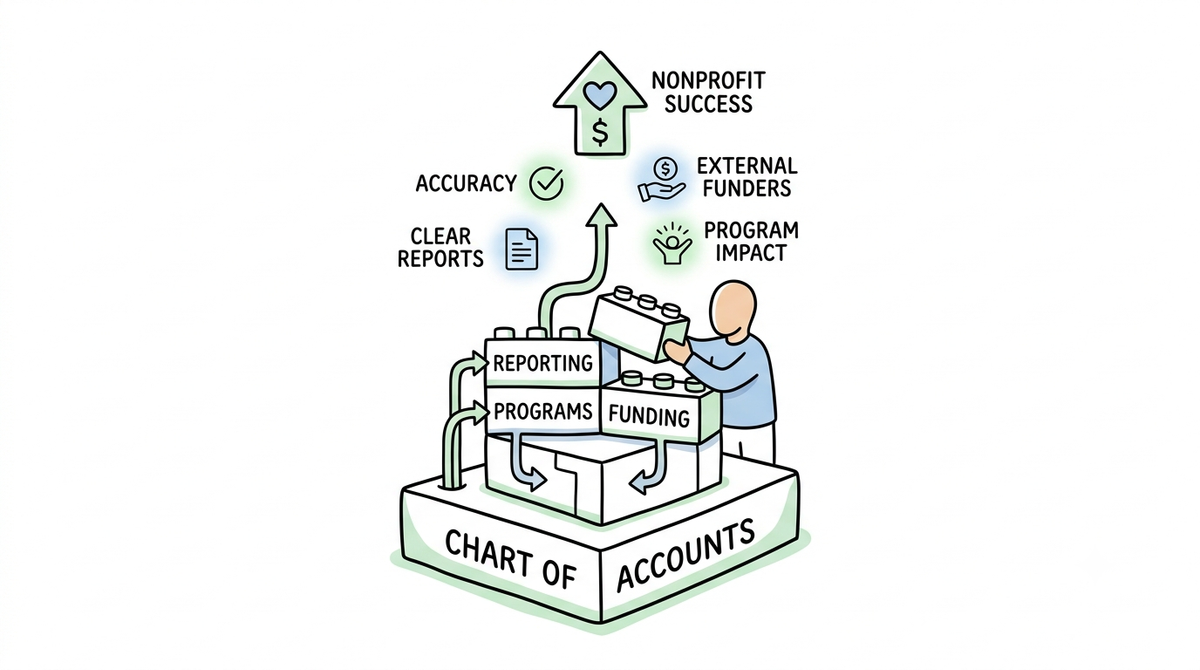
One of the most profound takeaways from the session is that a chart of accounts is not merely a static list of numbers and labels—it is the literal backbone of an organization's internal tracking, external reporting, and program management. The way a nonprofit builds this architecture determines how easily internal leaders can read the health of the organization and how accurately external funders can evaluate its stability.
The Cost of an Over-Complicated System
A common pitfall for growing nonprofits is the temptation to create a new line item or account code for every single new expense or micro-grant. Over time, this leads to an bloated, unmanageable matrix. When a system is cluttered with hundreds of hyperspecific accounts, human error skyrockets during data entry. A clean framework utilizes a lean, modular structure. Instead of creating five different accounts for "Office Supplies" across five different projects, a smart system uses a single, clean account code paired with separate, flexible dimensions or tags to track specific programs.
Balancing Internal Nuance with External Clarity
A healthy financial framework must serve two distinct masters: internal decision-makers and external evaluators. Internally, managers need enough detail to monitor project-specific budgets and prevent overspending. Externally, funders demand clear, scannable summaries that prove compliance and efficiency. The session emphasized that a well-designed chart of accounts achieves both without duplicating work. By structuring accounts logically from the start, a nonprofit can seamlessly generate high-level summaries for a board meeting or drill down into granular lines for a program audit, all from the exact same data set.
Accuracy as a Driver of Trust
Accuracy is not just about avoiding mathematical errors; it is about consistency in definitions. If "travel expenses" are coded under programmatic costs one month and administrative costs the next, the resulting financial reports become deeply skewed. Establishing crystal-clear, concise definitions for every account category removes the guesswork for the operations team. This consistency ensures that any report pulled at any moment reflects the genuine reality of the organization, forming a rock-solid foundation for strategic planning and organizational learning.
Event Snapshot
The deep exploration of these concepts took place during a specialized virtual session tailored for organizational development. The event provided a dedicated space for nonprofit professionals to pause, reflect on their current internal workflows, and learn from structural experts.
- Event Title: The Foundation for Nonprofit Accounting
- Host: TechSoup
- Event Date: July 1, 2026
- Venue/Platform: Virtual (Cloud)
The session brought together an array of public interest advocates, administrative leaders, and operations managers from across the sector, all united by a shared goal: strengthening the operational health of their respective institutions to better champion the public good.
From Learning to Community Impact
Moving from theoretical understanding to on-the-ground application is where the true value of capacity building comes to life. In public service, organizational growth is never an end in itself; it is a vehicle for broader community empowerment. When a nonprofit invests time into optimizing its internal financial architectures, it is directly investing in its long-term ability to deliver high-impact services.
Consider a local initiative focused on sustainable community development. If its financial backbone is clean, the leadership team can view their program metrics in real time. They can instantly see if a specific community workshop is running over budget, allowing them to adjust resources dynamically rather than realizing the error six months down the road when the grant has run dry. This agility ensures that community resources are maximized and never wasted on avoidable administrative frictions.
Furthermore, strengthening internal capacity builds an organization's overall resilience. In an environment where community needs are constantly shifting, public service entities must be prepared to scale their operations quickly. A robust, clean, and scalable financial framework allows an organization to absorb new grants, onboard new partners, and launch new community interventions smoothly, without breaking under the weight of administrative confusion.
Looking Ahead
As we look to the future of the nonprofit sector, the importance of continuous organizational learning cannot be overstated. The environments in which we work are fluid, and the challenges facing our communities are increasingly complex. To remain responsive, responsible, and effective, social impact organizations must commit to constant internal refinement.
True innovation in public service is not just about designing flashy new apps or launching high-profile public campaigns; it is also about the quiet, disciplined work of modernizing our core systems. Embracing cleaner frameworks, refining internal standards, and cultivating data literacy are deeply impactful forms of leadership. By building strong, orderly, and highly transparent internal foundations today, we ensure that our organizations remain steady, sustainable, and ready to meet the community needs of tomorrow.
Join the Conversation
Every meaningful change begins with learning, reflection, and conversation. As communities continue to navigate new challenges and opportunities, the exchange of knowledge remains one of our most valuable tools for collective growth.
We invite our readers, fellow advocates, nonprofit professionals, and community members to share their perspectives. How has your organization approached the challenge of balancing internal data tracking with clear, transparent public reporting? What strategies have helped your teams turn financial clarity into stronger community trust? Let us keep exploring the ideas, structures, and systems that strengthen public service, empower local initiatives, and help build a more informed, resilient, and equitable society.
The Foundation for Nonprofit Accounting
July 01, 2026
Virtual
Organizational Development

This initiative was independently funded by the BUKLURAN Officers through personal contributions.
We gratefully acknowledge the groups and individuals who shared resources, services, venues, supplies, and other forms of community support.
• TechSoup
BUKLURAN remains open to partnerships, sponsorships, and collaborative initiatives that create meaningful community impact.
Whether through funding, in-kind support, volunteerism, or shared services, your organization can help strengthen programs that serve underserved communities.