From Farms to Front Doors: Why Global Trade Pacts Matter at the Dinner Table
When global leaders talk about tariffs and trade pacts, the real impact lands straight on the grocery lists and wallets of regular households.
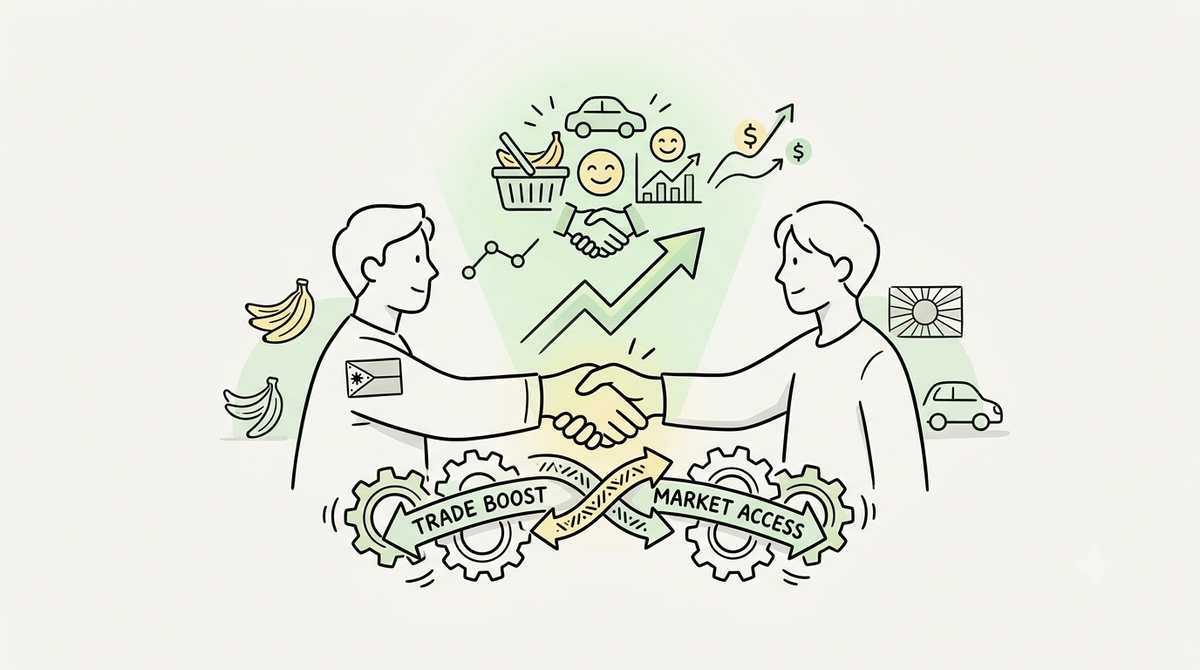
The modernization of the Philippines-Japan Economic Partnership Agreement highlighting tariffs on bananas and cars demonstrates how international trade deals directly shape the daily purchasing power and livelihood options of ordinary Filipino families.
Walk into any local market early in the morning, and you will hear a familiar chorus of calculations. A mother stands before a stall, weighing the price of a kilo of rice against the cost of a few pieces of fruit for her children’s school lunch. In another part of the city, a tricycle driver counts his morning fares, wondering if a sudden breakdown will cost him more than his vehicle is worth to repair. These are the quiet, daily negotiations of survival and stability that define the Filipino household.
Rarely do these everyday conversations touch on international diplomacy, bilateral treaties, or macroscopic economic policies. When news breaks about major state agreements, it often feels like a remote broadcast from a different world—one populated by corporate executives, diplomats, and high-ranking officials speaking in a language of percentages, concessions, and legal frameworks.
Yet, international trade is never truly distant. The invisible threads of global agreements stretch directly into our local wet markets, neighborhood sari-sari stores, and backyard workshops. What happens in negotiation rooms thousands of miles away eventually dictates the price of the food we serve, the availability of the tools we use for work, and the stability of the jobs our communities rely upon.
Recently, the Department of Trade and Industry announced that the Philippines is targeting the completion of the review for the Philippines-Japan Economic Partnership Agreement (PJEPA) by November 2026. First signed nearly two decades ago, this bilateral treaty acts as the economic bridge between Manila and Tokyo, governing how goods, services, and investments flow between the two nations. The current review aims to modernize the pact, introducing new trade concessions and adjusting tariff structures to reflect contemporary economic realities.
For the average citizen, the text of such an agreement can look like an impenetrable wall of jargon. But strip away the diplomatic phrasing, and the core of the PJEPA review focuses heavily on two highly recognizable items: bananas and cars.
Currently, Filipino banana exports entering Japan face steep seasonal tariffs—ranging from eight percent during certain months to as high as eighteen percent in others. The Philippine government is pushing to lower or completely eliminate these duties to make local produce more competitive. Conversely, Japan is seeking better market access for its automobiles, which currently face a twenty percent tariff on motor vehicles with an engine displacement of three liters and below.
To understand why this matters at home, one must look past the aggregate dollar values and examine the human infrastructure behind these commodities.
Consider the local banana industry. The Philippines is one of the world's leading exporters of bananas, an industry that does not exist in a vacuum of corporate balance sheets. It is sustained by thousands of small-scale farmers, agricultural laborers, packers, and transport drivers across the provinces. When an eighteen percent tariff is levied on a box of Filipino bananas abroad, it makes our produce more expensive for Japanese consumers compared to cheaper alternatives from Latin America or other Southeast Asian neighbors.
When international demand drops because our products are priced out, the consequences cascade backward. A drop in export volumes means fewer days of work for agricultural laborers, tighter margins for smallholder farmers, and reduced economic activity in rural communities. Conversely, securing a lower tariff means more predictable orders, stable rural employment, and a steadier flow of income into countryside households. When a farmer secures a fair, stable return on his harvest, that money is immediately re-spent locally—at the neighborhood store, the town pharmacy, and the local transport loop.
On the flip side of the agreement lies the automotive sector. For many Filipinos, a vehicle is not a luxury item; it is an indispensable economic tool. Delivery riders, logistics workers, small business owners distributing garments or processed food, and independent transport operators all depend heavily on vehicles and their corresponding spare parts to maintain their livelihoods. High tariffs on imported vehicles and components elevate the baseline cost of starting or maintaining a transport-reliant business.
When mechanical repairs or fleet expansions become prohibitively expensive, small businesses face a difficult choice: absorb the losses and reduce their take-home pay, or pass the expenses onto the consumer. This friction ripples outward, gradually increasing the cost of moving local goods from farms to front doors, which ultimately elevates the retail prices that ordinary families pay for everyday essentials. Modernizing a trade pact to lower these barriers can, over time, ease the systemic costs of transport and logistics, creating a subtle but meaningful relief valve for the local economy.
However, international trade is always a balancing act of compromises. A concession given in one area requires a concession accepted in another. While cheaper access to imported goods can benefit consumers, it can also pressure domestic industries to compete with global manufacturing giants. The challenge of governance is ensuring that these macro-level trade balances translate into real, tangible protections and opportunities for the most vulnerable sectors of our society.
This systemic connection between broader economic shifts and household-level vulnerability reflects why community-based efforts around organized cooperation and livelihood participation matter so deeply. When global markets fluctuate or trade policies shift, the impact is felt most acutely by those who lack an economic cushion—such as solo parents, stay-at-home mothers, and low-income workers trying to manage rising household expenses.
While international treaties take years to negotiate and trickle down, communities often have to find immediate, localized ways to insulate themselves from price pressures. This is where grassroots frameworks, such as the cooperative purchasing mechanisms found within the BUKLURAN HUB program, become highly relevant. By pooling resources to source basic commodities collectively, community members learn to navigate cost variations and build local economic resilience, showing that structural challenges are best met with structured, cooperative local responses.
Ultimately, the true measure of any trade agreement is not found in the elegance of its legal prose or the grand totals celebrated in press conferences. The real test happens quietly, away from the spotlight, in the small, daily calculations of ordinary citizens. It is measured by whether an agricultural worker in the province can afford a stable education for their children, whether a local enterprise can expand without being crushed by logistical costs, and whether a family can sit down to dinner with a sense of security about tomorrow. As the November deadline for the PJEPA review approaches, the hope remains that the decisions made by high-level negotiators will pave the way for a more inclusive economy—one where international progress genuinely serves the well-being of the Filipino home.
Talaga bang nakakaapekto ang mga international trade deal sa simpleng ulam ng pamilyang Pilipino? Kapag pinag-uusapan ang mga kasunduan sa pagitan ng Pilipinas at ibang bansa, madalas nating akalaing pang-negosyante lang ito. Pero ang totoo, ang presyo ng bilihin at katatagan ng trabaho sa ating komunidad ay nakatali sa mga pirma ng mga diplomat. Paano nga ba binabago ng pandaigdigang polisiya ang takbo ng ating bulsa?

Power Our Mission, Shape the Future
We empower single parents, PWDs, youths, seniors, and stay-at-home parents through digital livelihood.
Help us build resilient communities.
BUKLURAN remains open to partnerships, sponsorships, and collaborative initiatives that create meaningful community impact.
Whether through funding, in-kind support, volunteerism, or shared services, your organization can help strengthen programs that serve underserved communities.
Do you want to take part in our free livelihood programs, scholarship assistance, and community resource pooling initiatives? Membership is completely free.
Join BUKLURAN!
Register, volunteer, and become a member today.