The Cautious Factory: Why a Rising Economic Index Doesn't Instantly Change Everyday Life
Factories are buying raw materials again, but what does a rising manufacturing index actually mean for your family's budget?
While the latest manufacturing index points to a modest economic recovery, ordinary Filipino workers continue to navigate a cautious labor market where stability has returned but massive job growth remains out of reach.
The View from the Shift Change
Every afternoon around four o'clock, the side streets of our industrial zones come alive with a specific kind of energy. Thousands of workers move in a synchronized dance—those finishing the day shift head toward the jeepney terminals, while the night shift workers arrive, plastic container lunches tucked under their arms. For a family relying on a factory wage, life is measured not in fiscal quarters, but in the regularity of these shifts.
When global conflicts flare up or supply chains choke, the shockwaves travel fast. They arrive at the dining table in the form of missing overtime pay, sudden "forced leaves," or the quiet anxiety that the factory gates might close altogether. For months, many Filipino households have been living with this exact undercurrent of worry, watching prices rise while wondering if their primary source of income remains secure.
Recently, economic headlines brought a bit of good news: the country's manufacturing sector is showing signs of steady improvement. On paper, things are looking up. But for the parent walking into that four o'clock shift or the young graduate looking for a stable regular job, an abstract economic report can feel entirely disconnected from reality. To understand whether this news changes anything for the average household, we have to look past the technical jargon and see what is actually happening on the factory floor.
Breaking Down the Economic Thermometer
To make sense of where our livelihoods are heading, it helps to understand the tool economists use to measure the health of our industries. The recent positive news centers on something called the Purchasing Managers’ Index, or PMI.
Think of the PMI as an economic thermometer for the manufacturing sector. Every month, researchers ask the people who buy raw materials for factories—the purchasing managers—whether their business is doing better, worse, or staying the same compared to the previous month. They look at new orders, production levels, employment, and how fast suppliers are delivering goods.
The math behind it is straightforward:
- A score above 50 means the sector is expanding and growing.
- A score below 50 means it is shrinking or deteriorating.
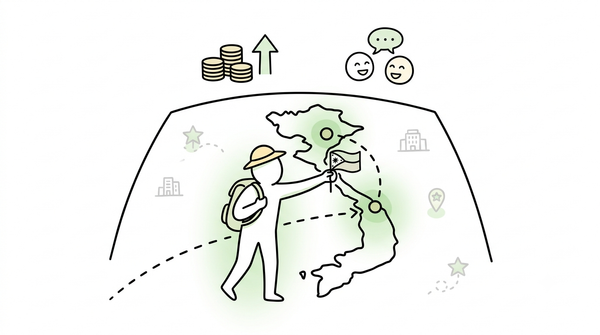
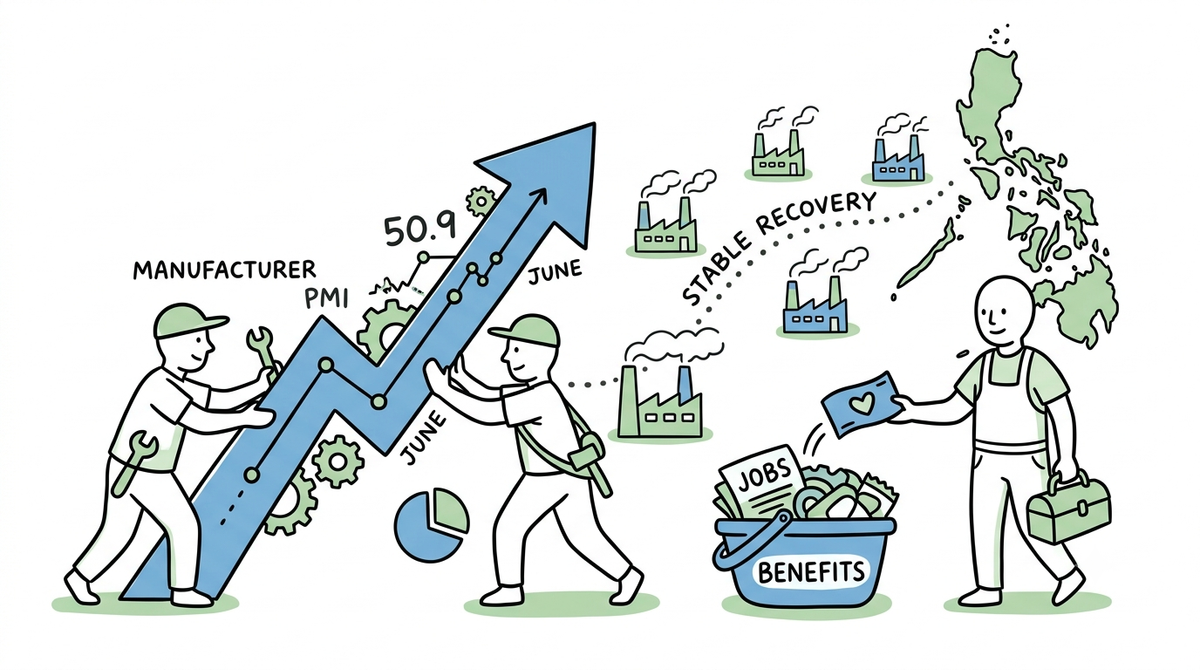
In June 2026, the Philippines’ manufacturing PMI edged up to 50.9, a slight increase from 50.8 in May. This marks the second month in a row that the sector has stayed above the 50-point baseline. It also means our local factories are performing slightly better than the regional average across Southeast Asia, which sat at 50.5. In fact, the Philippines secured the third-best manufacturing performance in the region for the month, trailing only behind Vietnam and Thailand.
This tells us that the severe disruptions caused by recent geopolitical tensions and conflicts in the Middle East are beginning to ease. Factories are finally regaining their footing. They are starting to buy additional raw materials and semi-finished items for the first time in four months, allowing businesses to rebuild their depleted stockrooms.
What This Really Means: The Slow Burn of Recovery
While a jump from 50.8 to 50.9 is a step in the right direction, it is vital to look at what this growth actually looks like under a microscope. It is not an industrial boom; it is a cautious, marginal crawl forward.
The data reveals a fascinating tug-of-war happening inside our local industries. On one hand, new orders from buyers have strengthened slightly. Customers want to buy more goods. On the other hand, actual production growth eased up during the same month.
Why would factories hesitate to ramp up production if orders are coming in? The answer lies in the deep caution that now defines modern business. After years of unpredictable inflation, fluctuating fuel costs, and global instability, factory owners are terrified of overextending themselves. Rebuilding inventory and purchasing raw materials is a slow, calculated process. Nobody wants to fill a warehouse with expensive goods only to have the market collapse next month.
For the ordinary citizen, this means that while the economic engine is warming up, it is not running at full speed yet. The recovery is a slow burn. We are seeing a stabilization of the status quo rather than a sudden influx of wealth or opportunity.
The Human Impact: The Meaning of "Unchanged"
The most critical part of any economic update is how it translates into human lives, specifically when it comes to employment. The June report highlighted a major detail: the employment picture in the Philippine manufacturing sector remained "unchanged" compared to May.
In economic terms, unchanged staffing levels can be viewed as a positive sign of stability. It means that the wave of layoffs has stopped. It means that the workers currently holding factory jobs can breathe a small sigh of relief because their positions are relatively secure for now. For a family paying off a housing loan or trying to keep kids in school, a stable job is everything.
However, from a community perspective, "unchanged" also carries a heavier truth. It means factories are maintaining their current workforce, but they are not actively expanding it.
[Factory Status: June 2026]
├── New Customer Orders: Increasing (Slightly)
├── Raw Material Purchases: Rebuilding (Marginally)
├── Factory Floor Production: Cautious / Easing
└── Total Staffing Levels: Unchanged (No layoffs, no mass hiring)
For the thousands of young Filipinos graduating from technical schools or universities this year, an unchanged job market means the hunt for work remains intensely competitive. It means that while the floor isn't collapsing beneath our feet, the ceiling isn't lifting high enough to let new people in just yet. The pressure on breadwinners remains high, as they must maintain their current positions without expecting a sudden surge in promotions or widespread salary increases across the industry.
Beyond the Factory Gates
When we look at communities that surround our major industrial hubs—whether in Laguna, Cavite, or parts of Metro Manila—the health of the local factory dictates the health of the entire local economy.
When factories are stable, the micro-economies around them thrive. The carinderia outside the gate sells out of its morning ulam. The tricycle drivers have a steady stream of passengers during shift changes. The small sari-sari stores can afford to offer short-term credit to regular customers because they know a paycheck is coming on the 15th and 30th.
The fact that our manufacturing sector is staying afloat and even outperforming several neighboring countries is a testament to the resilience of our workforce. It proves that despite global economic headwinds that are entirely out of our control, our local systems are finding ways to adapt and survive.
But survival should only ever be the baseline, not the ultimate goal. True economic recovery isn't achieved when an index hits 50.9; it is achieved when the security felt by factory managers matches the security felt by the workers at the assembly line.
A Question of Real Progress
Economic indicators are useful maps, but they are not the journey itself. A fractional increase in a manufacturing index is a welcome shield against deeper poverty, but it is not yet an engine for widespread prosperity.
As we look at these numbers, we are left with a deeper question about what progress really means for our communities. If our industries are slowly finding their footing and proving their resilience on the regional stage, how do we ensure that this stability transforms into genuine opportunity for the next generation? True growth cannot just be measured by the volume of raw materials entering a warehouse—it must ultimately be measured by the peace of mind carried home by the people who build our world every day.
Lahat tayo masaya kapag sinasabing umaangat ang ekonomiya at maayos ang takbo ng mga pabrika sa bansa. Pero bakit tila marami pa rin sa ating mga kababayan ang nahihirapang maghanap ng permanenteng trabaho? Ano nga ba ang totoong hatid ng "economic recovery" sa pitaka ng ordinaryong pamilyang Pilipino? Huwag magpadala sa mga numero lang.

Power Our Mission, Shape the Future
We empower single parents, PWDs, youths, seniors, and stay-at-home parents through digital livelihood.
Help us build resilient communities.
BUKLURAN remains open to partnerships, sponsorships, and collaborative initiatives that create meaningful community impact.
Whether through funding, in-kind support, volunteerism, or shared services, your organization can help strengthen programs that serve underserved communities.
Do you want to take part in our free livelihood programs, scholarship assistance, and community resource pooling initiatives? Membership is completely free.
Join BUKLURAN!
Register, volunteer, and become a member today.