The Distance Between Global Shipping and the Filipino Dining Table
When global shipping networks expand, do local household expenses actually go down? A deeper look at what freight growth means for you.
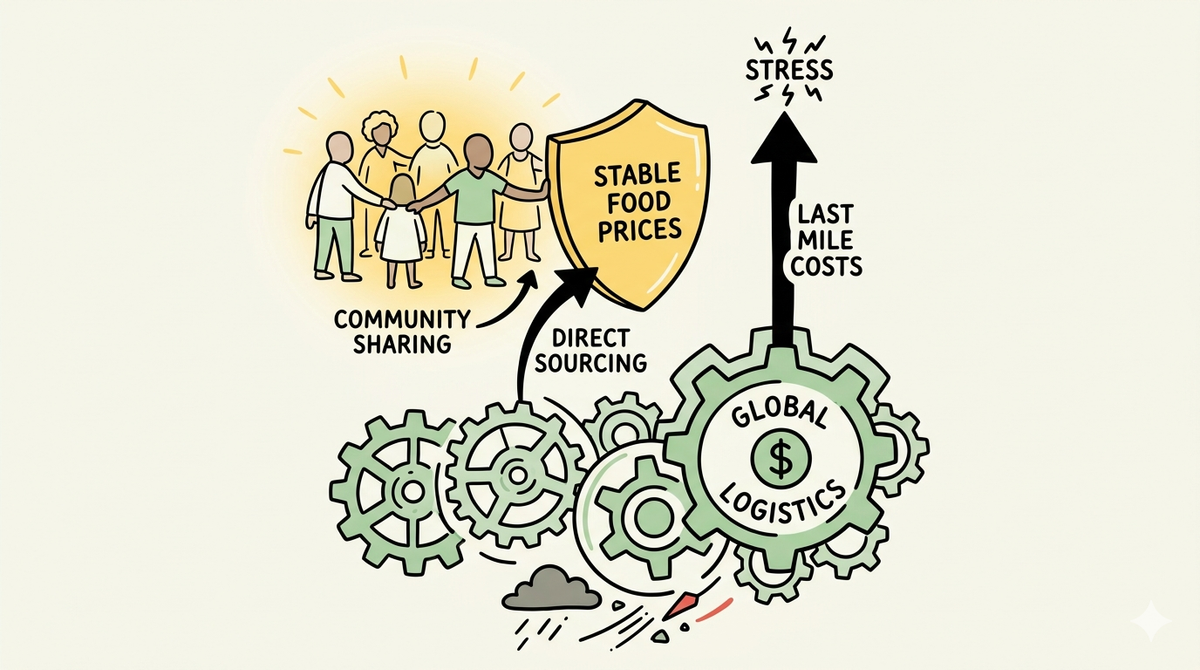
While the projected double-digit expansion of logistics giants highlights macroeconomic progress, true community economic resilience relies on transforming these supply chains into affordable localized distribution networks that shield families from rising retail costs.
When a major international cargo carrier announces its sights are set on double-digit shipment growth in the Philippines, it is easy to view the news through a lens of corporate celebration. Front-page articles paint pictures of bustling ports, roaring airplane engines, and a vibrant national economy stepping aggressively into the global spotlight. For economists, these announcements serve as vital health markers for macro-level trade, industrial activity, and cross-border commercial demand. The arrival of more packages, documents, and heavy freight is presented as undeniable proof that the country is moving forward.
Yet, for an ordinary Filipino standing in line at a neighborhood retail store or looking at the remaining balance of a weekly budget, these corporate metrics can feel remarkably distant. In households across the archipelago, the pressing daily concerns are not centered on multi-national logistics corridors or global supply chain efficiencies. Instead, the everyday reality revolves around a much simpler, more intimate set of calculations: the fluctuating price of a kilo of rice, the rising cost of basic canned goods, and the invisible inflation that chips away at the purchasing power of a hard-earned salary. When a global logistics provider expands its footprint, a silent question lingers over the community: Will this institutional boom actually make daily necessities any cheaper or life any easier for the average family?
Understanding the Modern Logistics Boom
The corporate projection of double-digit cargo growth reflects a massive shift in how products move across continents and into local markets. Logistics providers are expanding their networks because businesses are shifting models, manufacturing sectors are requiring faster turnarounds, and cross-border e-commerce continues to penetrate the domestic landscape. In simple terms, more goods are flowing through the air, across the sea, and over our highways than ever before.
For the formal economy, a robust logistics infrastructure acts as the central circulatory system. It connects localized producers to global buyers and brings foreign manufacturing tools to domestic factories. When shipping giants invest in localized facilities, delivery fleets, and technological upgrades, they improve the speed at which enterprises operate. On paper, these efficiencies are supposed to trickle down, reducing the systemic overhead costs of businesses and eventually translating into stable consumer retail prices.
The Hidden Friction in Local Distribution
However, an intelligent look beyond the optimistic corporate headlines reveals a stark disconnect between macro-level shipping efficiencies and the micro-level prices found on community store shelves. While a massive cargo vessel or international aircraft can move thousands of tons of basic goods across oceans at an incredibly low cost per unit, that efficiency often breaks down the moment the freight hits the ground.
This breakdown occurs during what logisticians call the "last mile" of delivery—the complex journey a product takes from a major commercial port or corporate warehouse to the actual retail establishment where an ordinary citizen buys it. In the Philippines, this final leg of the journey is plagued by systemic frictions: aging road infrastructure, severe urban traffic congestion, expensive provincial fuel costs, and an intricate web of commercial middlemen. By the time a basic commodity passes through national distributors, regional wholesalers, local sub-dealers, and neighborhood retail networks, the cost savings achieved by global shipping lines are completely wiped out. Instead, multiple layers of retail markups are added, forcing the end consumer to bear the financial burden of an inefficient local distribution system.
The Real Impact on Everyday Filipino Homes
For vulnerable sectors—such as solo parents balancing tight household budgets, stay-at-home mothers managing fluctuating allowances, and senior citizens living on fixed stipends—this supply-chain friction has direct, painful consequences. When global logistical expansion primarily serves premium commercial enterprises or high-end consumer imports, the structural cost of ordinary life remains stubbornly high.
Consider a typical family trying to source daily essentials like rice, cooking oil, or basic hygiene products. Even if the national supply of these commodities is stable, the traditional commercial retail network treats every purchase as an isolated transaction wrapped in profit margins. Because lower-income households cannot afford to buy in bulk, they are trapped in a cycle of purchasing small, single-use portions that carry the highest relative retail markups. The systemic reality is clear: under the current commercial framework, macro-level economic growth and booming corporate shipping volumes do not automatically build domestic food security or shield communities from economic shocks.
Why Localized Resource Pooling Matters
This persisting gap between global shipping milestones and domestic affordability highlights exactly why community-based alternatives to traditional retail distribution are becoming so critical. If top-down corporate networks cannot deliver affordable basic goods directly to underserved neighborhoods, communities must build their own structured frameworks to bridge the distance.
This structural intervention is precisely where grassroots initiatives, like the BUKLURAN HUB Livelihood and Community Enterprise Program, provide a vital alternative. Rather than functioning as a traditional profit-driven business, this non-profit community mechanism changes the distribution dynamic entirely by implementing a system known as Community Resource Pooling. Instead of individuals purchasing basic commodities through fragmented commercial channels with heavy retail markups, community members voluntarily combine their modest financial resources for organized, structured program cycles, such as a Rice Distribution Cycle or a Grocery Support Cycle.
By aggregating their purchasing intent, ordinary citizens can bypass multiple tiers of commercial middlemen and source essential household commodities directly at significantly reduced cost levels. The BUKLURAN HUB operates strictly on an allocation and participation model; it is not an investment scheme, a savings program, or a commercial storefront. The focus remains entirely on collective participation over passive financial gain. Any residual program surplus is never distributed as corporate profit, but is systematically retained to fund future distribution cycles and reinforce the community pickup center. When household finances are deeply strained, members who cannot contribute financially are even able to participate by volunteering their time to manage the physical logistics, documentation, and coordination of the distribution center. This localized approach demonstrates that true economic resilience is built not by waiting for global corporate wealth to trickle down, but by organizing resources directly where they are needed most.
Moving Toward Shared Economic Resilience
Corporate announcements of double-digit logistics growth are certainly an indicator of macroeconomic vitality, but they should never be mistaken for the ultimate goal of human and social development. A thriving nation is not measured solely by the volume of commercial freight moving through its international gateways, but by the security, dignity, and stability of the families living within its borders.
As global supply chains continue to expand and modernize, the real challenge for the future lies in how society structures its local spaces. True economic progress must involve a conscious effort to move away from purely transactional, profit-maximizing models of consumption and toward collective, community-centered structures of mutual support. Only when we find innovative ways to shorten the distance between macro-level trade efficiencies and the micro-level realities of the Filipino dining table can we say that economic growth has truly arrived home.

Power Our Mission, Shape the Future
We empower single parents, PWDs, youths, seniors, and stay-at-home parents through digital livelihood.
Help us build resilient communities.
BUKLURAN remains open to partnerships, sponsorships, and collaborative initiatives that create meaningful community impact.
Whether through funding, in-kind support, volunteerism, or shared services, your organization can help strengthen programs that serve underserved communities.
Do you want to take part in our free livelihood programs, scholarship assistance, and community resource pooling initiatives? Membership is completely free.
Join BUKLURAN!
Register, volunteer, and become a member today.