The Hidden Cost of "Cooling Down" the Economy: What the Central Bank’s Decisions Mean for Your Kitchen Table
When the central bank adjusts interest rates to fight rising food and fuel prices, what actually changes on the ground for ordinary families?
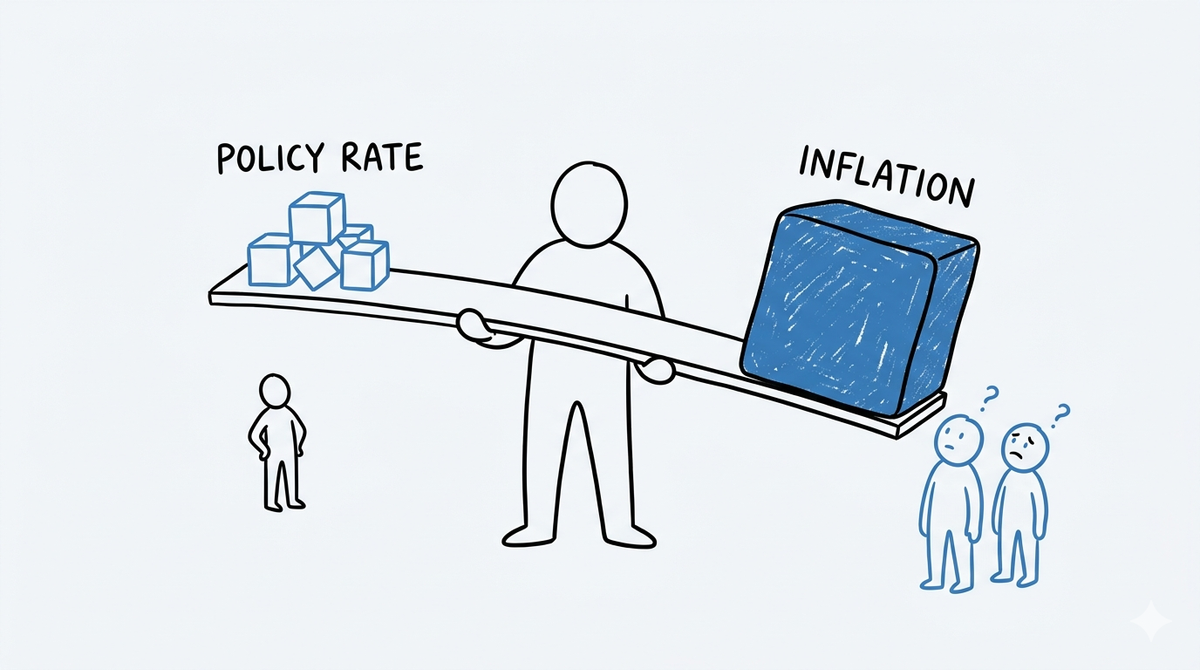
As the Bangko Sentral ng Pilipinas triggers stricter interest rate adjustments to curb soaring inflation, everyday Filipinos must navigate the double-edged sword of higher borrowing costs and rising household expenses.
Step into any wet market or local neighborhood talipapa early in the morning, and the conversation is rarely about macroeconomics. Instead, it is about the price of a kilo of red onions, the shrinking size of a bundle of local vegetables, or how far a five-hundred-peso bill can stretch today compared to last month. For the average Filipino household, economic realities are measured not in percentage points or basis points, but in the immediate, tangible choices made at the grocery counter or inside a tricycle on the way to work.
Yet, far from the daily bustle of local markets, decisions are being made in the quiet boardrooms of the Bangko Sentral ng Pilipinas (BSP) that directly shape these everyday struggles. Recently, the central bank signaled that it is prepared to take a much stronger monetary policy response—potentially implementing aggressive interest rate hikes—to counter the country’s escalating inflation. To the busy worker or parent, headline terms like "monetary policy," "policy rates," or "slowflation" can sound like abstract academic jargon. But the mechanisms behind these terms are deeply tied to whether a family can afford a housing loan, how much an micro-entrepreneur pays to stock their sari-sari store, and whether the cost of basic food items will finally stabilize.
Understanding how a central bank’s toolset affects the budget of an ordinary Filipino requires pulling back the curtain on how money moves through our economy.
The News Behind the Numbers
To understand what is happening, we have to look at the recent shifts in the economic landscape. After briefly lowering interest rates early in the year to support a sluggish economy, the BSP was forced to reverse course. In April, the Monetary Board raised its key policy rate by 25 basis points to 4.50%. Now, with headline inflation tracking between 7.1% and 7.9% due to rising food prices, currency depreciation, and global oil volatility driven by ongoing conflicts in the Middle East, monetary leaders are warning that even stronger actions may be on the horizon.
This environment has left economic analysts warning of "slowflation"—a frustrating economic condition where economic growth slows down, but the cost of living keeps accelerating. For policymakers, it is a delicate and challenging tightrope walk. For the general public, it feels like a double squeeze.
What Higher Interest Rates Actually Do
When the BSP talks about a "stronger response" or raising its benchmark interest rate, it is essentially trying to cool down the economy by making money more expensive to borrow. Think of the benchmark rate as the baseline interest rate that the central bank charges commercial banks. When that baseline goes up, commercial banks pass those costs down to everyone else.
The logic behind this approach is fairly straightforward, though it operates on a delay:
- Cooling Demand: By raising interest rates, borrowing money becomes more expensive for both businesses and everyday consumers. When credit is tight, people spend less on big-purchase items, and companies hold off on major expansions.
- Slowing Price Increases: As overall spending and demand slow down across the country, businesses lose the leverage to continuously raise prices, which theoretically helps pull inflation back down toward healthier levels.
- Defending the Currency: Higher domestic interest rates can help stabilize the Philippine peso against foreign currencies like the US dollar. A stronger peso means it becomes less expensive for our country to import vital commodities like oil and rice, reducing imported inflation.
The Real-World Impact on Filipino Families
While these policies are designed to safeguard long-term financial health, the immediate side effects are often felt acutely by ordinary citizens. The impact of a rate hike does not hit everyone equally, and it creates distinct challenges across different parts of the community.
The Small Business Owner and Everyday Borrowers
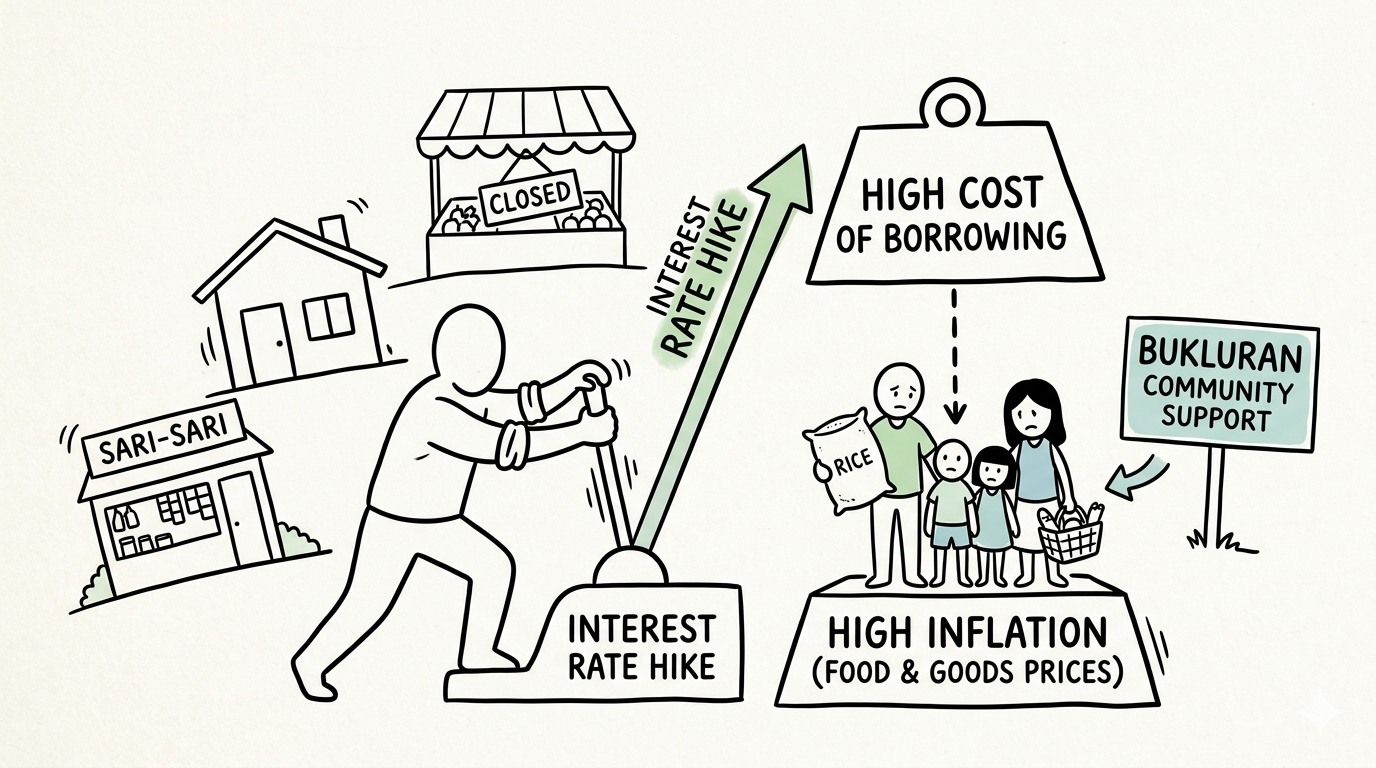
For a local entrepreneur relying on a small loan to keep inventory moving or a family trying to purchase their first home through a bank mortgage, higher interest rates mean higher monthly amortizations. When bank loans become expensive, small businesses may choose to downscale or delay hiring new workers. For families already dealing with tight margins, an increase in credit card interest or personal loan rates can mean diverting money away from health or education just to service existing debts.
The Fixed-Wage Earners and Low-Income Households
For the millions of Filipinos living on daily minimum wages or fixed salaries, inflation acts as an immediate pay cut. While the BSP's rate hikes are intended to stop prices from spinning out of control, the cooling effect takes time to filter down to the local market. In the short term, families continue to face high costs for rice, vegetables, and meat, while simultaneously dealing with a tighter job market and restricted access to affordable credit.
Balances and Barriers
The fundamental dilemma of using interest rates to fight inflation is that it primarily addresses demand, but much of the current price pressure in the Philippines is caused by supply issues. An interest rate hike cannot produce more rice, it cannot fix local agricultural supply chains, and it cannot stop geopolitical tensions from shifting global oil prices.
If the central bank raises rates too aggressively, it risks over-correcting—slowing down local businesses to the point where employment drops and economic growth grinds to a halt. However, if it acts too timidly, inflation expectations can become deeply entrenched, causing prices to spiral permanently out of reach for vulnerable communities. It is a balancing act where the stakes are human livelihoods.
The Local Context of Economic Strain
This intersection of high daily costs and economic policy highlights exactly why localized, community-level support structures are so critical during times of national strain. When macroeconomic policies take months to stabilize food prices, neighborhoods and local groups must often find immediate ways to patch the gaps.
This current economic environment reflects precisely why community-based efforts around agricultural support, local livelihoods, and consumer literacy matter. When formal banking systems become more restrictive and expensive due to rising interest rates, grass-roots initiatives—such as local cooperative networks, community-led food distribution programs, and localized spaces like the BUKLURAN Hub—become essential lifelines. These community settings provide alternative support systems, allowing families to access resources, share strategies for financial resilience, and find relief when national economic pressures bear down on the household budget.
Looking Forward Beside the Market Stalls
Economic indicators and central bank policies can often feel like a distant world governed by complex formulas and institutional statements. But at their core, these policies are about human survival and community stability. The true measure of a successful monetary policy response is not whether a chart looks better in an annual report, but whether an ordinary Filipino family can look at their weekly market budget with a sense of security rather than anxiety.
As the country navigates this period of slowflation and rising interest rates, the challenge ahead lies in ensuring that the tools used to protect the economy do not inadvertently crush the very people they are meant to defend. True economic resilience is built from the ground up—ensuring that while the central bank works to balance the macroeconomy, communities are supported, informed, and equipped to protect their well-being.
Lahat tayo nababahala kapag pataas nang pataas ang presyo ng bigas, gulay, at mga bilihin sa palengke. Ngunit alam mo ba na ang mga desisyon ng Bangko Sentral ukol sa "interest rates" ay may direktang epekto sa laman ng iyong pitaka at sa mga utang ng iyong pamilya? Bakit nga ba itinataas ang interes kapag nagmamahal ang bilihin, at ano ang ibig sabihin nito para sa mga ordinaryong Pilipino?

Power Our Mission, Shape the Future
We empower single parents, PWDs, youths, seniors, and stay-at-home parents through digital livelihood.
Help us build resilient communities.
BUKLURAN remains open to partnerships, sponsorships, and collaborative initiatives that create meaningful community impact.
Whether through funding, in-kind support, volunteerism, or shared services, your organization can help strengthen programs that serve underserved communities.
Do you want to take part in our free livelihood programs, scholarship assistance, and community resource pooling initiatives? Membership is completely free.
Join BUKLURAN!
Register, volunteer, and become a member today.