The Hidden Price of Cooling Prices: What Higher Interest Rates Mean at Home
Beyond the technical jargon of central banks, higher interest rates directly impact your family loans, grocery budget, and local livelihood.
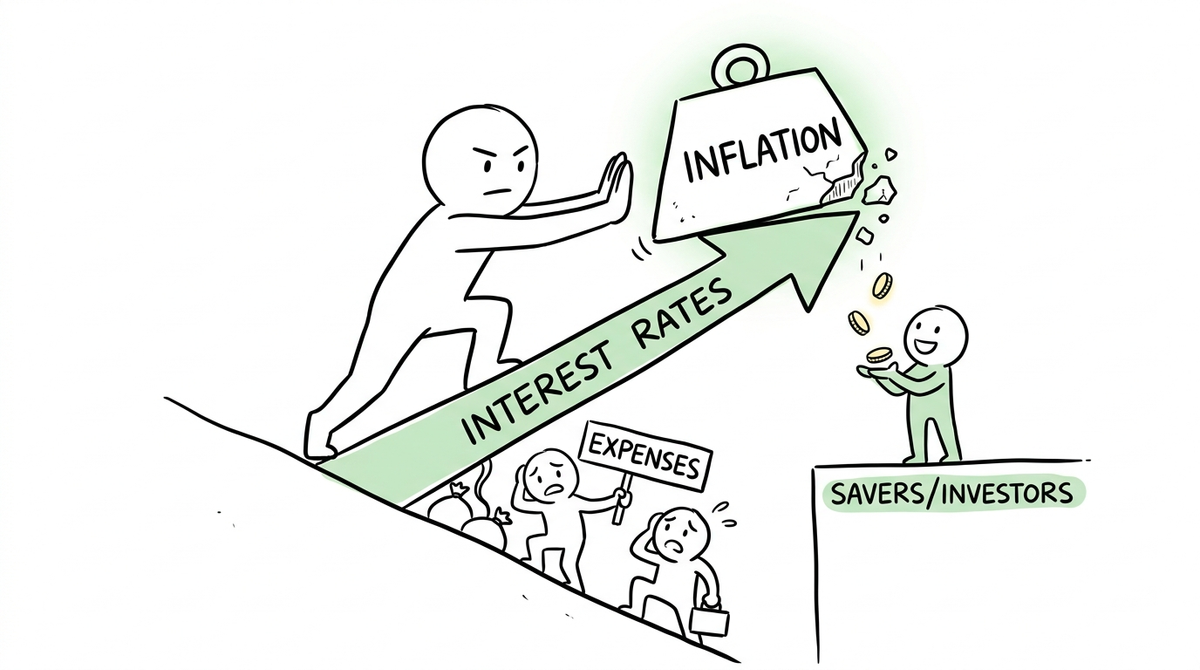
As the Bangko Sentral ng Pilipinas continues to raise interest rates to combat inflation, ordinary Filipinos face a delicate balancing act between rising borrowing costs and stabilizing commodity prices.
Every morning, long before the sun rises over Manila, Aling Teresa adjusts the handwritten price tags on her small carinderia's display counter. A peso more for a bowl of sinigang here, two pesos more for a plate of adobo there. For months, her daily routine has been defined by a quiet, persistent anxiety: the price of cooking oil, onions, and pork keeps shifting. She does not read international financial tickers, nor does she closely track global geopolitical standoffs. But when the cost of ingredients spikes, she feels it immediately in the palms of her hands and the thinness of her daily earnings.
Millions of Filipinos share this exact vantage point. Whether it is a commuter noticing the rising cost of a jeepney fare, a young professional recalculating their monthly grocery budget, or a farmer tracking the price of fertilizer, macroeconomic shifts are rarely experienced as abstract statistics. Instead, they land directly on the kitchen table.
Recently, financial headlines have been dominated by discussions surrounding the Bangko Sentral ng Pilipinas (BSP) and its ongoing cycle of interest rate hikes. To the average citizen, phrases like "benchmark interest rates," "basis points," and "monetary tightening" sound like a foreign language spoken by bureaucrats in distant glass towers. However, the decisions made behind those closed doors carry a profound weight that directly influences how much it costs to feed a family, sustain a small shop, or pay off a housing loan.
The Explainer: What is the Central Bank Doing?
To understand why this matters, we have to look at the tools the central bank uses to steady the economy. Think of the country’s economy as an engine. When it runs too fast, it overheats, causing the prices of everyday goods to skyrocket—a phenomenon we know as inflation. To cool this engine down, the BSP steps on the financial brakes by raising its benchmark interest rate. Most recently, policymakers implemented another quarter-point hike, pushing the benchmark rate up to 4.75 percent.
The rationale behind this move is straightforward yet delicate. By making it more expensive for commercial banks to borrow money from the central bank, those commercial banks in turn raise interest rates for businesses and everyday consumers. When borrowing money becomes expensive, people and corporations tend to spend less. They hold off on buying new cars, postponing house renovations, or delaying factory expansions. As spending cools down across the entire country, the demand for goods drops, which theoretically forces the prices of everyday items back down to earth.
Central banks are currently operating in a highly volatile global climate. Even as some international pressures—such as long-term oil supply concerns stemming from Middle Eastern geopolitical tensions—show tentative signs of stability, local policymakers remain deeply cautious. International economic think tanks observe that the primary debate is no longer about whether interest rates will go up, but rather how much further they need to climb to effectively anchor prices without accidentally causing the economy to stall.
Moving Beyond the Headline: The Invisible Trade-Off
For an ordinary Filipino family, this strategy creates a bittersweet reality. On one hand, everyone wants lower prices at the wet market. If the BSP’s rate hikes successfully tame inflation, the rapid erosion of the peso's purchasing power slows down. Your money stretches a little further, and the anxiety of unpredictable weekly price shifts begins to fade.
On the other hand, cooling down the economy comes with a tangible cost that lands heavily on specific sectors of society.
- The Burden on Borrowers: Anyone with an outstanding loan, a flexible-rate mortgage, or an active credit card balance will feel the pinch. When benchmark rates rise, the cost of servicing existing debts often climbs along with them. A family that stretched their budget to buy a modest home may find their monthly amortization payments increasing, leaving less breathing room for tuition fees or health emergencies.
- The Stalling of Small Businesses: For micro, small, and medium enterprises (MSMEs)—which make up the vast majority of businesses in the Philippines—credit is a vital lifeline. A local garment shop owner might rely on a short-term bank loan to purchase raw materials before the school season begins. When interest rates hover at higher levels, taking out that loan becomes a risky proposition. If the business owner decides the interest is too high to afford, they might opt not to expand, choose not to hire additional staff, or even scale back operations entirely.
- The Slowdown in Construction and Housing: Sectors like real estate development and construction are incredibly sensitive to borrowing costs. High interest rates can cause developers to delay new residential developments or infrastructure projects. For a construction worker paid by the day, a paused project means immediate unemployment. For a young couple dreaming of buying their first condominium or house, higher borrowing rates can push homeownership out of reach for another few years.
A Closer Look at the Human Balance Sheet
When we analyze the economic landscape through a purely human lens, we find that these policies do not affect everyone equally. The impact splits down distinct socio-economic lines, creating different realities for different households.
For stability-conscious investors, retirees living off fixed-income instruments, or families fortunate enough to hold significant savings accounts, higher interest rates offer a silver lining. Their capital yields higher returns in time deposits and government bonds, offering a reliable shield against the eroding effects of inflation.
But for the vast majority of working-class Filipinos, savings are a luxury they cannot afford. When daily income is entirely consumed by immediate survival, the benefit of higher savings yields remains entirely theoretical. Instead, the reality of high borrowing costs represents a concrete barrier to upward mobility.
Consider a tricycle driver who dreams of upgrading to a small passenger van to start a localized delivery service. Under a low-interest regime, securing a vehicle loan is a manageable stepping stone. Under a high-interest regime, the accumulated interest over a five-year loan can add tens of thousands of pesos to the total cost, rendering the dream financially non-viable. In this manner, high interest rates can unintentionally lock people into their current economic strata, making it incredibly difficult to invest in a better future.
Grounding the Macroeconomic Perspective
This delicate economic friction highlights exactly why community resilience and localized awareness matter so deeply. While ordinary citizens cannot control global oil supply chains or change the monetary policies dictated by the central bank, understanding these mechanisms empowers communities to make more informed decisions.
When credit is expensive, financial literacy becomes a vital survival tool. Communities that cultivate collaborative savings systems, support localized supply chains, and build consumer awareness are better equipped to weather periods of monetary tightening. Recognizing that borrowing costs are high allows families to avoid predatory lending practices and manage household debts with greater strategic caution. Economic survival is rarely just about waiting for national indicators to improve; it is about how neighborhoods, cooperatives, and families adapt to the environment handed to them.
Facing the Future with Informed Caution
As the central bank navigates this economic tightrope, the ultimate goal remains a return to a stable, predictable marketplace where a hard-earned peso maintains its value from one month to the next. Policymakers face the monumental challenge of curbing inflation without accidentally suffocating the economic growth that creates jobs and fuels development.
For the families watching from the sidelines, the path forward requires a mix of pragmatism and careful planning. The era of cheap, easily accessible credit has temporarily receded, replaced by a period where financial discipline and careful resource allocation are paramount. While the numbers on the central bank's charts will continue to fluctuate, the true measure of our economic health will always be found in whether Aling Teresa can confidently price her menu, keep her small business open, and provide a secure future for her family without fear of the next economic wave.
Bakit nga ba kahit humuhupa ang krisis sa langis, patuloy pa ring itinataas ng central bank ang interest rates sa bansa? Ano ang kinalaman ng 4.75% benchmark rate sa pang-araw-araw na badyet, mga utang, at kabuhayan ng ordinaryong pamilyang Pilipino? May magandang balita nga ba para sa mga bilihin, o mas mabigat na pasanin para sa mga naghahanapbuhay?

Power Our Mission, Shape the Future
We empower single parents, PWDs, youths, seniors, and stay-at-home parents through digital livelihood.
Help us build resilient communities.
BUKLURAN remains open to partnerships, sponsorships, and collaborative initiatives that create meaningful community impact.
Whether through funding, in-kind support, volunteerism, or shared services, your organization can help strengthen programs that serve underserved communities.
Do you want to take part in our free livelihood programs, scholarship assistance, and community resource pooling initiatives? Membership is completely free.
Join BUKLURAN!
Register, volunteer, and become a member today.