The Missing Percentages: Why Lower Economic Targets Matter at the Dinner Table
When economic targets drop, it’s not just numbers on a screen—it’s about your grocery budget, job security, and community. Here is why it matters.
The government’s decision to lower the 2026 economic growth target highlights an impending economic slowdown that will directly impact everyday jobs, market prices, and family financial stability across the Philippines.
Every evening across the Philippines, millions of families engage in a quiet, deeply personal ritual. It happens at the kitchen table, illuminated by a single overhead bulb, or over a calculators’ app on a cheap smartphone. It is the art of the household budget. A mother looks at the receipts from the local palengke (wet market) and notes how twenty pesos doesn't seem to buy a handful of calamansi anymore. A father calculates his motorcycle taxi or jeepney earnings, subtracting the ever-climbing cost of fuel, wondering if he can delay repairing his worn-out tires for just one more month.
In these quiet moments, ordinary Filipinos are not thinking about macroeconomic indicators, gross domestic product (GDP), or international fiscal policies. They are thinking about survival, the next tuition payment, and keeping food on the table. Yet, a recent announcement from the air-conditioned halls of government governance directly connects to these kitchen-table struggles, threatening to reshape the economic landscape for the rest of the year.
The News From the Top: Breaking Down the Numbers
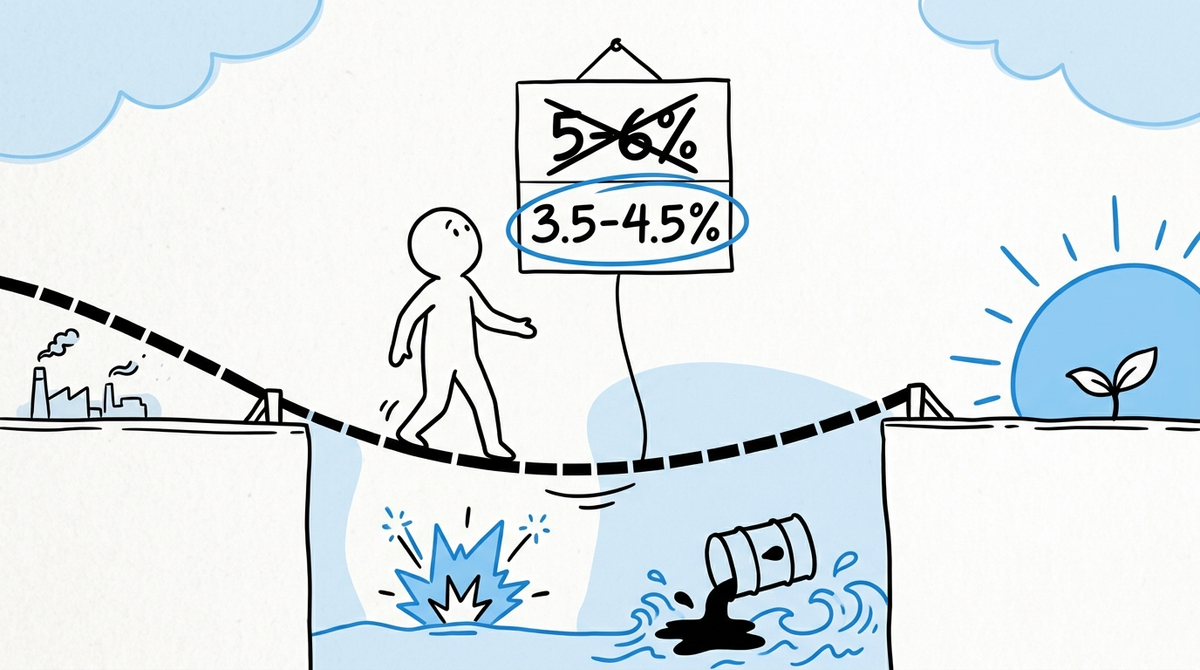
The Development Budget Coordination Committee (DBCC)—the group of government economic managers tasked with steering our nation’s financial game plan—recently adjusted its expectations for the country. They officially revised the Philippines' economic growth target for 2026, slashing it from an optimistic 5% to 6% down to a more modest 3.5% to 4.5%.
To the average person, a drop of one or two percentage points sounds like a minor technical detail, the kind of boring data reserved for financial news networks or academic textbooks. However, in an economy responsible for the livelihoods of over 110 million people, that missing fraction represents billions of pesos in economic activity that simply will not happen.
The economic managers pointed to a tough first quarter in 2026 as the primary culprit for this downgrade. A combination of global instability—specifically the ongoing Middle East conflict and the resulting oil shocks—has combined with a sharp slowdown in local government spending. When the state spends less on public works, and when global energy prices spike, the entire economic engine slows down. Despite hopes that things might look up in the latter half of the year, the decision to lower the official target signals that the hurdles we face are deeply rooted and likely to stay with us for a while.
What This Really Means for Everyday Life
To truly understand why an ordinary Filipino should care about this development, we have to look past the institutional jargon. When an economy grows slower than expected, it means the overall "economic pie" isn't expanding fast enough to comfortably accommodate everyone.
Think of economic growth as the current of a river. When the current is strong, it naturally pushes boats forward, making it easier for businesses to grow, hire, and increase wages. When the current slows down to a crawl, every inch of progress requires immense, exhausting effort.
1. The Chilling Effect on Employment and Wages
First, a lower growth target directly impacts job security and employment opportunities. Companies do not operate in a vacuum; they watch these government forecasts closely to plan their next moves. When large corporations and medium-sized enterprises see a growth downgrade, they tend to adopt a defensive posture.
- Hiring Freezes: Instead of expanding or opening new branches, businesses choose to play it safe, freezing new job openings.
- Delayed Promotions: Plans to give workers raises or promotions are frequently put on hold to preserve company cash reserves.
- Contractual Vulnerability: For seasonal, contractual, or informal workers, a sluggish economy means less bargaining power and a higher risk of sudden layoffs.
2. The Inflation Connection and the Oil Shock
The DBCC explicitly mentioned the Middle East conflict and oil shocks as primary drivers of this slowdown. For the Philippines, which relies heavily on imported petroleum, an oil shock acts as an immediate tax on every single citizen.
Higher fuel costs don’t just stay at the gasoline pump. They crawl into the supply chain, raising the cost of transporting rice from Nueva Ecija to Manila, or fish from coastal ports to landlocked provincial towns. Combined with a slower economy, families may find themselves caught in a painful double squeeze: their incomes are stagnating or at risk, while the basic goods they need to survive continue to grow more expensive.
3. Reduced Government Spending and Public Services
One of the most concerning aspects of the DBCC report is that a decrease in government spending actually contributed to the slowdown. A lingering graft probe and regulatory constraints have made government agencies hesitant or slow to release funds for vital public works.
When public spending stalls, infrastructure projects like regional roads, bridge repairs, mass transit improvements, and public hospital expansions get delayed. These projects are not just conveniences; they are massive sources of local employment. A construction worker in a rural province relies on a local government infrastructure project to feed his family. If that project is paused due to budget bottlenecks, that household loses its primary lifeline.
The Human Impact: Beyond the Ledger
To see the true cost of a 3.5% economic growth target, you have to look into our neighborhoods. Consider the small-scale retail ecosystem of the Philippines—the sari-sari store. A neighborhood store relies entirely on the daily spare change of the community. If the local factory freezes hiring or cuts overtime hours, the factory workers spend less. They buy fewer snacks, opt for smaller packets of basic necessities, or ask to buy items on credit (listahan). The sari-sari store owner, in turn, sees their small daily profit margins dry up, making it harder to restock or pay for their own household utilities.
"Macroeconomic policy can seem incredibly distant until a family has to choose between paying for a teenager's college tuition or keeping the electricity running."
For the millions of young Filipinos graduating from high school and college in 2026, a lower economic growth rate changes their immediate future. A vibrant, fast-growing economy naturally absorbs new talent, creating competitive spaces where young professionals can build careers. A cooled-down economy means a highly saturated job market, forcing many overqualified youth into underpaid, precarious positions, or driving them to look for opportunities overseas, separating more families in the process.
A Grassroots View of Economic Shifts
When macro-level economic strategies hit road bumps, the burden invariably shifts downward to local communities. Historically, Filipinos have filled these institutional gaps through sheer grit and deep-seated community cooperation (bayanihan). This current economic slowdown reflects exactly why community-based efforts around local livelihood resilience and micro-resource sharing matter so deeply.
When formal employment systems tighten up and corporate hiring slows down, it is the neighborhood cooperatives, community savings groups, and small-scale agricultural associations that keep local economies breathing. Investing in community-level resilience ensures that when the national economic tide recedes, local households aren't completely left stranded on the rocks. True economic stability isn't just built from top-down policy directives; it is anchored by strengthening the financial safety nets of our most vulnerable neighborhoods.
Moving Forward with Shared Reflection
A lower economic growth target is an undeniable warning sign, but it is not a sentence of absolute despair. It is a call for a profound shift in priorities. It reminds us that our true economic health shouldn't just be measured by how fast our total output expands, but by how securely our most vulnerable citizens are protected during times of global and local turbulence.
As our national leaders work to restore trust in public policy, untangle the bureaucratic knots holding back public funds, and navigate global oil fluctuations, ordinary citizens are left with an essential question to ponder. How can we shift our national conversations away from mere percentage points and abstract targets, and focus instead on building an economy where a family's dinner table is insulated from the volatile shocks of the outside world?
Lahat tayo masaya kapag sinasabing umuunlad ang ekonomiya, pero ano ang ibig sabihin kapag biglang binaba ng pamahalaan ang economic growth target ng Pilipinas para sa taong ito?
Hindi lang ito simpleng numero sa balita. Ang pagbagal na ito ay may direktang epekto sa iyong budget sa palengke, sa tsansa mong makakuha ng trabaho, at sa sweldo ng mga ordinaryong manggagawa. Bakit nga ba ito nangyayari at paano nito maaapektuhan ang iyong pamilya?

Power Our Mission, Shape the Future
We empower single parents, PWDs, youths, seniors, and stay-at-home parents through digital livelihood.
Help us build resilient communities.
BUKLURAN remains open to partnerships, sponsorships, and collaborative initiatives that create meaningful community impact.
Whether through funding, in-kind support, volunteerism, or shared services, your organization can help strengthen programs that serve underserved communities.
Do you want to take part in our free livelihood programs, scholarship assistance, and community resource pooling initiatives? Membership is completely free.
Join BUKLURAN!
Register, volunteer, and become a member today.