The Price at the Gate: Why Easing Factory Costs Don't Instantly Fix the Family Budget
Slower growth in manufacturing prices sounds like good economic news. But why hasn't your grocery bill dropped yet? Let's find out.
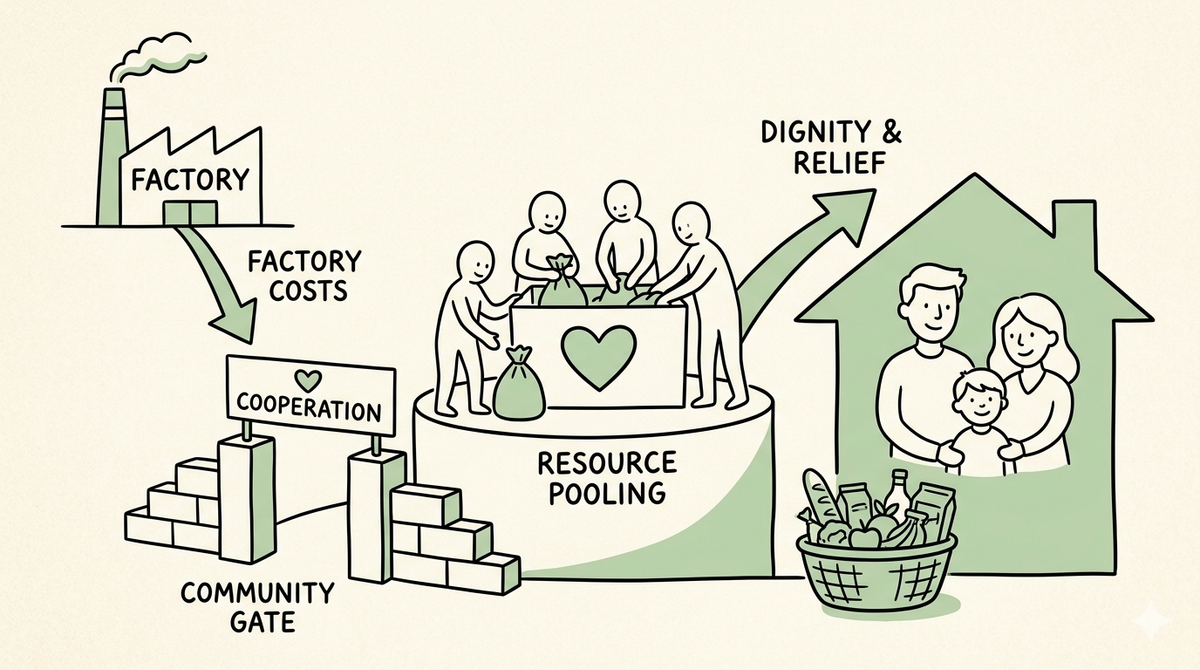
While a slowdown in factory gate prices indicates easing industrial cost pressures that could eventually stabilize consumer prices, its immediate impact highlights the deeper structural need for community-driven resource pooling to shield ordinary Filipino households from stubborn retail inflation.
Every morning across the Philippines, the day begins with a quiet calculation. Parents stand in front of neighborhood sari-sari stores or walk down the aisles of local public markets, performing mental math with whatever cash is left in their pockets. They notice the subtle shifts immediately: a two-peso increase in a can of sardines, a shrinking pack of instant noodles, or the way a thousand pesos seems to vanish before the market basket is even half full. In the economic reality of ordinary Filipino households, prices are not mere lines on a chart—they dictate whether a child brings a complete meal to school or whether a worker skips lunch to save on jeepney fare.
When reports emerge from government agencies and financial news outlets regarding shifts in industrial data, they often feel entirely disconnected from this daily struggle. A clear example is the recent performance of the manufacturing sector’s Producer Price Index (PPI), which measures the average change in prices that domestic manufacturers charge at their factory gates before goods ever enter the commercial supply chain. In April 2026, growth in these factory gate prices slowed to a 2.4 percent uptick, down slightly from the 2.6 percent annual increase recorded in March. To an economist, this deceleration—largely driven by slower price hikes in refined petroleum, electronic products, and basic metals—signals a minor cooling trend, a stabilization of production costs that could theoretically ease long-term pressures on the wider economy.
Yet, for the average consumer buying a kilo of rice or a bottle of cooking oil, an immediate question arises: If it is becoming less expensive or stabilizing for factories to produce these goods, why does the grocery receipt still feel so heavy? Why do the prices at the local market remain stubbornly high while the prices at the "gate" are slowing down? Understanding this disconnect requires looking past the macroeconomic headlines and examining the long, complex journey a product takes from the factory floor to the kitchen table.
To bridge the gap between factory gates and household budgets, one must first realize that a slowdown in price growth is not the same as a price drop. When the PPI grows at 2.4 percent instead of 2.6 percent, it means that production costs are still rising—they are simply doing so at a slightly less aggressive pace. The factory is still spending more to create goods than it did a year ago, meaning there is no immediate reason for them to slash wholesale prices. Furthermore, manufacturers themselves are often caught in a tight balancing act. For enterprises operating in volatile sectors like refined petroleum or basic metals, reduced growth in factory gate prices can squeeze profit margins if their raw material or operational overhead costs remain high. When factory profit margins shrink, industrial expansion cools, which can indirectly affect employment stability and wage growth for manufacturing workers.
More importantly, the price an ordinary citizen pays at retail is separated from the factory gate by a gauntlet of intermediaries. Before a commercial product reaches a neighborhood vendor, it passes through an intricate web of primary distributors, regional wholesalers, logistics providers, and local retailers. Each stop along this journey adds its own layers of cost. Logistics in the Philippines remain notoriously expensive due to fragmented infrastructure, volatile local pump prices, and the geographical reality of an archipelago. Wholesalers and supermarket chains must also account for their own rising overheads, including electricity, commercial leases, and labor costs. Consequently, even if a factory manages to stabilize its production costs, those savings are frequently swallowed up by the logistics and distribution chain long before the product ever lands on a supermarket shelf. Retail prices are historically "sticky"—they rise rapidly when production shocks occur, but they take a remarkably long time to drift downward when industrial pressures ease.
The human impact of this economic friction falls squarest on underserved families, solo parents, senior citizens, and low-income earners. When consumer prices remain high despite cooling industrial metrics, household budgets are forced into a state of structural compromise. Food security becomes a game of dietary substitution, where nutrient-dense options like fresh fish, vegetables, and meat are systematically replaced by cheaper, calorie-dense alternatives like processed canned goods and instant meals. Education also suffers an indirect blow; when a family must allocate an unexpected share of their daily earnings toward basic nourishment, the funds available for a child's school transport, pocket money, or learning supplies are severely restricted. The psychological toll on stay-at-home parents and breadwinners is immense, transforming the routine task of market shopping into a source of persistent financial anxiety.
This profound gap between industrial price adjustments and retail realities highlights exactly why grassroots, community-based mechanisms are becoming essential for survival. When traditional market supply chains fail to pass down cost stabilities to ordinary consumers, local communities are forced to find alternative structures to bypass the expensive networks of middle-tier commerce.
This systemic mismatch is precisely why community-based models, such as the BUKLURAN HUB’s Livelihood and Community Enterprise Program, have a direct relevance to contemporary economic challenges. Rather than waiting for retail market prices to adjust to easing factory gate trends, a structured community enterprise program allows ordinary citizens to aggregate their collective purchasing power. Through mechanisms like community resource pooling, members can voluntarily combine their modest financial resources to buy essential commodities, such as rice or basic groceries, directly from larger suppliers or closer to the source of production.
By operating a non-profit, activity-based cycle where resources are pooled purely for collective procurement and distributed directly through a local community pickup center, neighborhoods can effectively eliminate the multi-layered markups imposed by commercial distribution networks. Any operational surplus generated through these cycles does not turn into corporate profit; instead, it is retained entirely within the system to sustain future community cycles or support social safety nets. Such structures demonstrate that when macroeconomic metrics slow down at the institutional level, the most reliable way to translate that stabilization into tangible relief at home is through active, organized community cooperation rather than passive reliance on retail market forces.
Ultimately, economic data like the Producer Price Index should serve as a reminder that financial systems are deeply interconnected, yet inherently uneven. A fraction of a percentage drop in industrial price growth might look like a positive indicator on a corporate dashboard, but it does not automatically put food on a family's table or reduce the cost of living in the barrios. True economic resilience is not built by merely observing trends from afar; it is forged when communities understand these dynamics and build local, collaborative systems to protect their own well-being. As the country navigates shifting global and domestic economic tides, the enduring challenge remains: how to build an economy where the stability achieved at the gates of production finally reflects as dignity, relief, and security in the daily lives of every Filipino family.
Lahat tayo masaya kapag naririnig sa balita na bumabagal ang pagtaas ng presyo sa mga pabrika. Pero bakit pagdating sa lokal na palengke at sari-sari store, parang hindi naman ramdam ang bawas-presyo? Bakit nananatiling mabigat sa bulsa ang mga pangunahing bilihin ng pamilya? Ano ang totoong dahilan sa likod ng agwat ng presyo sa pabrika at retail market?

Power Our Mission, Shape the Future
We empower single parents, PWDs, youths, seniors, and stay-at-home parents through digital livelihood.
Help us build resilient communities.
BUKLURAN remains open to partnerships, sponsorships, and collaborative initiatives that create meaningful community impact.
Whether through funding, in-kind support, volunteerism, or shared services, your organization can help strengthen programs that serve underserved communities.
Do you want to take part in our free livelihood programs, scholarship assistance, and community resource pooling initiatives? Membership is completely free.
Join BUKLURAN!
Register, volunteer, and become a member today.