The Quiet Tax Shift on Your Electric Bill: Why Pesos Matter More Than Percentages
A new tax memo targets specific charges on your power bill. Will it actually bring down your monthly electricity expenses? Let’s find out.
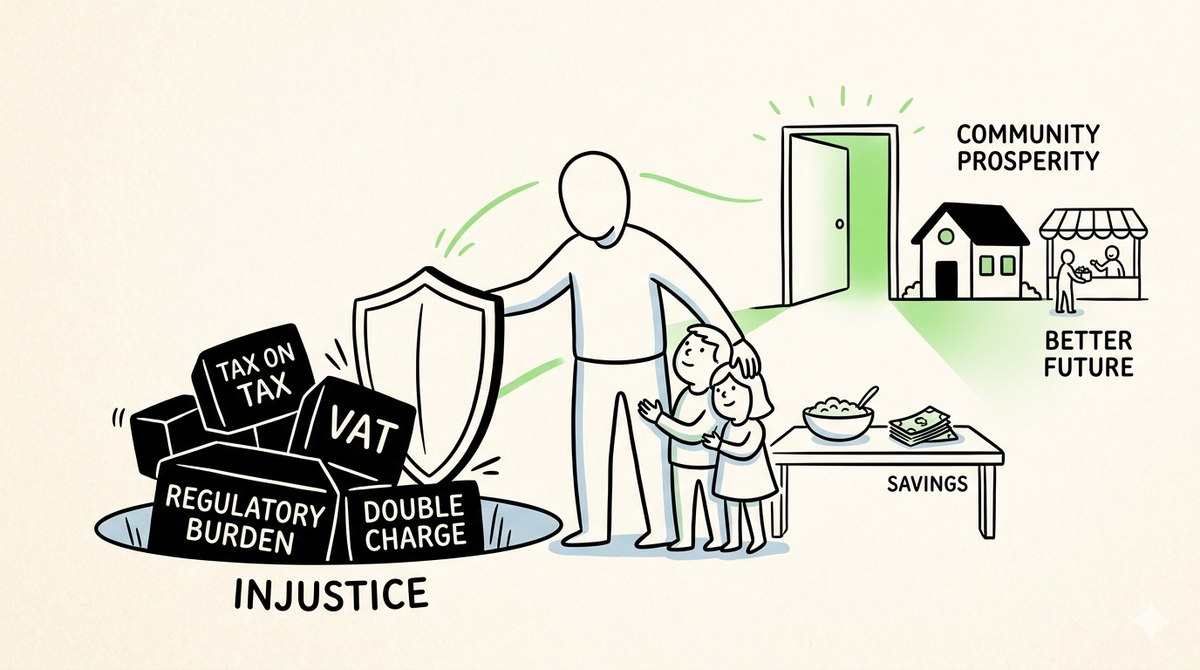
Revenue Memorandum Circular No. 60-2026 protects ordinary consumers from unfair double taxation on electricity pass-through charges, offering vital breathing room for household budgets.
Every month, the arrival of the electric bill triggers a familiar, collective ritual in millions of Filipino households. Someone sits at the kitchen table under a dimming light, smoothing out the paper receipt, squinting at the long, dense rows of breakdowns. We look at the generation charge, the transmission cost, and the subtotal. Then, inevitably, our eyes drift to the taxes. It often feels like we are paying a premium just for the basic right to keep our rice cookers running and our electric fans spinning through humid tropical nights. For a family living on daily minimum wages, an unexpected 100-peso increase in that bill isn't a minor calculation error—it means choosing between buying an extra kilo of rice or purchasing local medicine for a child's cough.
When structural changes happen in government offices, they rarely come with loud announcements. Instead, they arrive as technical documents. On June 4, 2026, the Bureau of Internal Revenue (BIR) released Revenue Memorandum Circular (RMC) No. 60-2026. To a busy citizen, the title sounds like absolute jargon: “Amendment of Revenue Memorandum Circular No. 116-2024 re: Inclusion of Lifeline Subsidy and Green Energy Auction Allowance as Government Mandated Charges Not Subject to Output Tax and Creditable Withholding Tax on VAT and Income.”
Behind that wall of institutional words lies a deeply practical reality that directly impacts how much hard-earned money is drained from your pockets every time you pay for power. It is a decision that puts the public interest first by addressing a fundamental flaw in how our monthly utility bills are computed.
Breaking Down the Bureaucracy: What is RMC 60-2026?
To understand why this development matters, we have to look at how electricity pricing actually works in the Philippines. Your monthly bill from distribution utilities, like Meralco, or local electric cooperatives in the provinces, is not just a direct charge for the power you consumed. It is a collection bucket for various players in the energy sector.
Some of these charges are "pass-through" costs. The distribution utility simply acts as a middleman, collecting money from you to hand it over to someone else. Two specific pass-through items have been at the center of recent discussions:
- The Lifeline Subsidy: This is a socialized pricing mechanism designed to protect low-income, marginalized households—including beneficiaries of the Pantawid Pamilyang Pilipino Program (4Ps). Households that consume very little electricity receive a substantial discount on their bills, and that discount is subsidized by a tiny fraction collected from everyone else.
- The Green Energy Auction Allowance (GEA-All): This is a regulatory charge implemented to support the transition to renewable energy sources, helping fund clean projects like solar and wind power to secure our long-term energy grid.
Historically, these charges were lumped into the total gross sales or revenues of power companies when taxes were calculated. Because they were counted as part of the utility's revenue, an automatic 12% Value-Added Tax (VAT) was slapped on top of them. This created an unfair phenomenon known as a "tax on tax." Consumers were being taxed on a subsidy meant to help the poor, and taxed again on a fund meant to build cleaner power plants.
RMC 60-2026 puts a permanent halt to this practice. It explicitly clarifies that because the Lifeline Subsidy and the GEA-All are government-mandated, regulatory charges that do not belong to the utilities’ actual profits, they must be excluded from output VAT and creditable withholding taxes.
What This Really Means for Your Household Budget
This is not the government handing out a brand-new tax exemption or a piece of charity. It is an act of structural correction. By removing these charges from the taxable base, the state is preventing the unnecessary bloating of consumer bills.
Old System:
[Base Energy Cost + Subsidy/Pass-Through Charges] × 12% VAT = Bloated Consumer Bill

New System (RMC 60-2026):
[Base Energy Cost × 12% VAT] + [Tax-Free Pass-Through Charges] = Lower Consumer Bill
In isolation, the reduction might seem small. It might save a regular household a few dozen pesos a month. But looking at economics through percentages ignores how the poor experience survival. In an environment where food prices remain volatile, a small saving across millions of consumers aggregates into substantial community relief. It prevents the slow, invisible leak of household wealth back into the state treasury through unfair double taxation.
Furthermore, this reform aligns closely with the objectives of the Ease of Paying Taxes (EOPT) Act. It simplifies how utility providers account for their income, ensuring that the private sector cannot pass the burden of their institutional tax compliance onto ordinary end-users. It brings clarity to an area of governance that has long been opaque to the average person.
The Human Impact: Beyond the Decimals
To truly measure the weight of RMC 60-2026, we have to leave the boardrooms of the BIR and look into the daily realities of residential communities. Consider a public school teacher or a tricycle driver trying to balance a tight monthly budget. For them, structural stability matters far more than sudden, temporary subsidies. A temporary discount provides relief for thirty days; a permanent systemic adjustment ensures that their bills are protected from artificial inflation forever.
When household utilities become cheaper, the social benefits cascade downward:
- For Parents: The money saved can mean an extra week of tricycle fares for children traveling to school or more fresh vegetables in the market basket.
- For Micro-Entrepreneurs: Small sari-sari stores, neighborhood bakeries, and home-based sewing shops rely heavily on electricity. For these micro-enterprises, lower utility overhead directly protects their small profit margins, keeping their businesses afloat.
- For Marginalized Households: Knowing that social safety nets like the Lifeline Subsidy will not be burdened with extra taxes means the assistance program stays potent, clean, and directly beneficial to those who need it most.
The View from the Ground
This structural correction highlights exactly why community-level readiness and economic literacy are so critical. Institutional reforms created in offices in Quezon City or Manila only fulfill their purpose when ordinary citizens understand how to claim them, verify them, and utilize the breathing room they provide.
This issue reflects why community-based efforts around the BUKLURAN Hub network matter so deeply. In these local spaces, families gather not just to receive aid, but to participate in systemic programs. For instance, individuals transitioning through the Bagong Simula initiative face the monumental task of rebuilding their lives and local businesses from scratch. Every single peso saved from basic overhead costs like electricity can be redirected toward personal development, health, or small business capital.
Similarly, financial literacy and basic consumer rights form the core of structural empowerment. Through platforms like Kasanayan Learning, community members learn how to dissect their utility statements, spot discrepancies, and understand how national policies dictate their daily expenses. When a family knows their rights, they can ensure they are receiving the proper billing adjustments.
And for young individuals or displaced workers under the Pabaon Program, entering the labor force or embarking on technical pathways requires a stable domestic foundation. A home that doesn't constantly face the immediate threat of a power disconnection is a home where a student can study longer, acquire digital literacy, and plan a better path forward. National policy provides the framework, but it is the community structure that turns policy into genuine human progress.
Looking Forward
RMC 60-2026 serves as a powerful reminder that governance is at its best when it focuses on removing the unfair friction points that burden everyday life. It shows that public interest advocacy doesn't always have to be about grand, sweeping pieces of legislation; sometimes, it is about fixing a line item on an insurance form or a tax circular to keep money where it belongs—in the hands of ordinary citizens.
As you receive your next utility bill, take a close look at the tax breakdown. The small reduction you see is a quiet victory for fairness. It invites us to consider a larger question: what other hidden burdens in our daily economic systems can be dismantled if we continue to look closely at the fine print?
Lahat tayo nabibigatan kapag tumataas ang singil sa kuryente. Pero alam niyo ba na nitong Hunyo, may bagong memorandum ang BIR na nag-aalis ng "tax on tax" sa ating billing? Ang mga charges tulay ng Lifeline Subsidy ay hindi na papatawan ng dagdag na VAT. Maliit man tingnan sa papel, malaking tulong ito para maprotektahan ang bulsa ng ordinaryong pamilyang Pilipino. Bakit nga ba ito mahalaga sa badyet mo?

Power Our Mission, Shape the Future
We empower single parents, PWDs, youths, seniors, and stay-at-home parents through digital livelihood.
Help us build resilient communities.
BUKLURAN remains open to partnerships, sponsorships, and collaborative initiatives that create meaningful community impact.
Whether through funding, in-kind support, volunteerism, or shared services, your organization can help strengthen programs that serve underserved communities.
Do you want to take part in our free livelihood programs, scholarship assistance, and community resource pooling initiatives? Membership is completely free.
Join BUKLURAN!
Register, volunteer, and become a member today.