Beyond the Billions: What the Wealth Tax Debate Means at the Kitchen Table
A wealth tax sounds like abstract economic theory, but for millions of ordinary families, it’s a question of daily bread and survival.
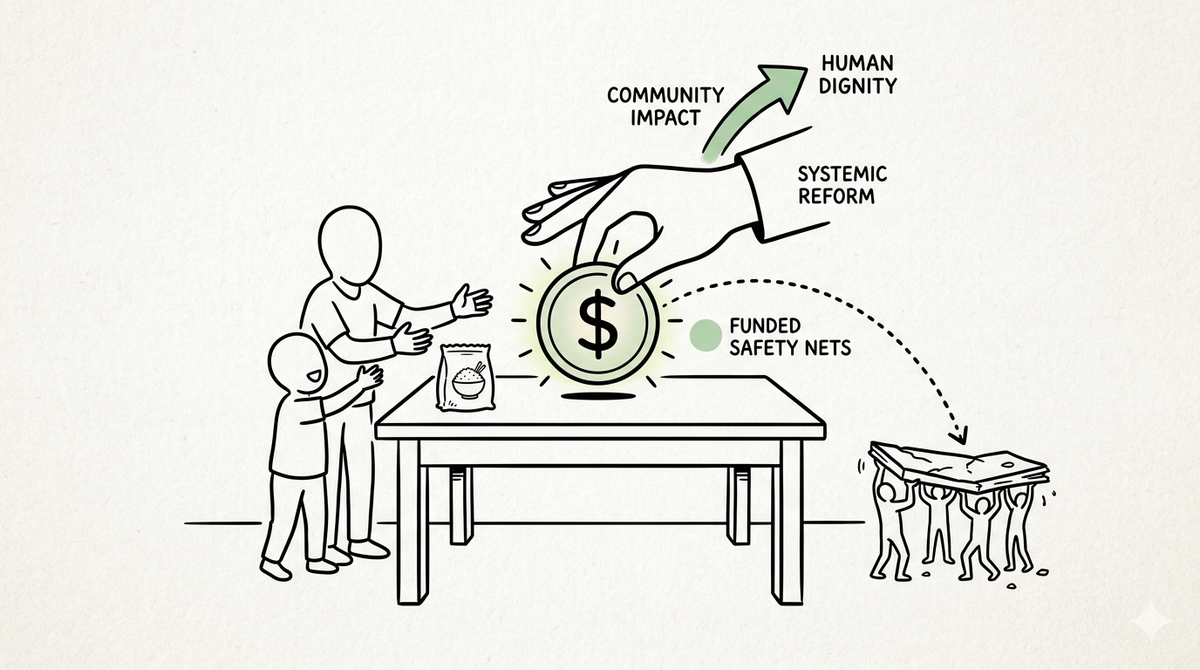
The debate over a national wealth tax is not merely an economic theory or a political talking point, but a deeply human question regarding how society protects its most vulnerable and closes the widening gap between survival and security.
Walk through any neighborhood in Metro Manila just before dawn, and you will see the mechanics of everyday survival in motion. You will see a mother carefully counting loose change to see if she can afford both a small bag of rice and a packet of instant noodles for her children’s breakfast. You will see a father checking his phone, hoping for a notification that a temporary gig or an informal job is available for the day, knowing that a single day without work means a night with empty plates. Elsewhere, an elderly citizen counts out their remaining maintenance medication, wondering if they can skip a dose to make the box stretch until the next informal bit of assistance arrives.
For these families, economics is not measured in gross domestic product (GDP) growth rates, fiscal deficits, or stock market indices. It is measured at the kitchen table. It is measured in the gap between what a basic life costs and what an honest day's labor actually provides.
Recently, public interest has resurfaced around a policy proposal that sounds entirely removed from these quiet, early-morning struggles: the implementation of a national wealth tax. From legislative halls to national television broadcasts, the idea of imposing a direct tax on the country’s ultra-wealthy individuals is being debated with renewed intensity. Economists exchange complex models, policymakers argue over capital flight, and analysts project billions of pesos in potential revenue.
But for the average Filipino, a crucial question remains unanswered behind the loud headlines and massive figures: Why should an ordinary family care about a wealth tax debate?
To understand the core of this issue, one must first demystify what a wealth tax actually is. Unlike the standard income tax—which takes a percentage of the money a person earns from their job or business each year—or the value-added tax (VAT) that everyday consumers pay whenever they buy groceries or fuel, a wealth tax targets accumulated net worth. It is a levy on the total value of assets owned by an individual, including vast real estate holdings, stock portfolios, luxury vehicles, and private capital, usually after crossing a very high financial threshold.
The underlying premise is straightforward: those who have benefited exponentially from the structural design of the economy should contribute a proportionate share back into the collective system that enabled their success.
Proponents argue that the funds generated from a tiny percentage tax on the wealthiest families could directly bankroll expanded social safety nets, modernize public hospitals, construct durable school classrooms, and fund vital agricultural subsidies. In a nation where the disparity between the ultra-rich and the underserved sectors grows wider each year, advocates see it as an indispensable tool for systemic fairness and resource redistribution.
Conversely, critics raise warnings about the unintended consequences of such a policy. They argue that a direct wealth tax could cause affluent individuals to move their capital out of the country, discouraging domestic investments and causing large-scale businesses to scale back expansions. This, they claim, could lead to a contraction in job creation, ultimately harming the very workers the policy intends to protect. They point to historical precedents in other developing economies where wealth taxes proved difficult to enforce, expensive to administer, and prone to legal evasion.
Yet, moving past the academic arguments and structural debates reveals a deeper reality. The wealth tax conversation is not actually about the billionaires at the top; it is about the structural vulnerability of the communities at the bottom.
Consider what happens to an ordinary household when a sudden illness strikes. Without robust public health support, a single medical emergency can erase years of hard-earned stability, forcing a family into deep debt or stripping a young student of their chance to finish school. When public schools lack fundamental learning materials, educational infrastructure, or nutritional support programs, the children of underserved families start life at a severe disadvantage, restricting their future economic mobility.
When structural systems fail to provide adequate public support, the burden of survival does not vanish—it simply shifts onto the shoulders of ordinary citizens. Parents are forced to take on multiple informal jobs, elderly individuals must work long past their retirement years, and older children often sacrifice their own education to help provide for their younger siblings. The lack of institutional social safety nets means that families are constantly operating in survival mode, unable to plan for the long term because they are perpetually managing the emergencies of the present.
This ongoing structural imbalance is precisely why localized, community-based efforts have become so vital for everyday survival across the country. In the absence of comprehensive national safety nets, ordinary citizens have long relied on the spirit of bayanihan—collective coordination and shared responsibility—to patch the holes in the system.
This pressing social reality reflects why community-based efforts around programs like the BUKLURAN Lingap Komunidad matter. When formal institutional resources are scarce or slow to arrive, localized initiatives step in to serve as a vital social safety net for underserved families. Whether through volunteer-driven food pack distributions, community feeding activities, or the sharing of basic health kits, these structured community responses demonstrate how collective care can directly protect vulnerable households from immediate hardship.
Similarly, the structural challenges families face in accessing affordable daily essentials explain the focus of the BUKLURAN HUB Livelihood and Community Enterprise Program. Rather than waiting for broad economic shifts to lower consumer prices, community resource pooling allows ordinary residents to voluntarily combine their limited assets to procure basic commodities like rice and groceries at manageable cost levels. This system demonstrates that while macro-level tax policies are debated in distant halls, the immediate pressures of household inflation must be met with practical, cooperative participation and shared local responsibility.
Ultimately, the debate over a national wealth tax should not be viewed as an isolated argument about corporate balance sheets, fiscal definitions, or legislative technicalities. It is an open question about what kind of society we want to build. It asks whether we will continue to rely entirely on the exhausting, daily resilience of ordinary Filipinos to survive structural gaps, or whether we will actively design structural mechanisms that guarantee basic dignity, security, and opportunity for every citizen, regardless of their background.
The true metric of any economic policy is not found in the total amount of billions it promises to raise or protect, but in how effectively it transforms the quiet realities of everyday life. As long as a mother must choose between her child’s education and the family’s next meal, the conversation around wealth, equity, and public responsibility must continue. The ultimate goal of examining these large economic systems is not to dismantle wealth, but to build a stable foundation where no family is left to weather the storms of life entirely on their own.
Bakit nga ba kahit bilyon-bilyong piso ang pinag-uusapan sa panukalang Wealth Tax, ang tunay na usapin ay tungkol pa rin sa hapag-kainan ng ordinaryong pamilyang Pilipino? Ang debate sa buwis ng mayayaman ay hindi lang teorya ng ekonomiya—ito ay usapin ng kaligtasan, kalusugan, at kinabukasan ng mga komunidad nating naghihikahos.
Power Our Mission, Shape the Future
We empower single parents, PWDs, youths, seniors, and stay-at-home parents through digital livelihood.
Help us build resilient communities.
BUKLURAN remains open to partnerships, sponsorships, and collaborative initiatives that create meaningful community impact.
Whether through funding, in-kind support, volunteerism, or shared services, your organization can help strengthen programs that serve underserved communities.
Do you want to take part in our free livelihood programs, scholarship assistance, and community resource pooling initiatives? Membership is completely free.
Join BUKLURAN!
Register, volunteer, and become a member today.