Integrated Growth: How Nonprofits Build Systems That Drive Real Engagement and Fundraising
Explore how breaking down organizational silos and using thoughtful automation turns disconnected tools into impact.
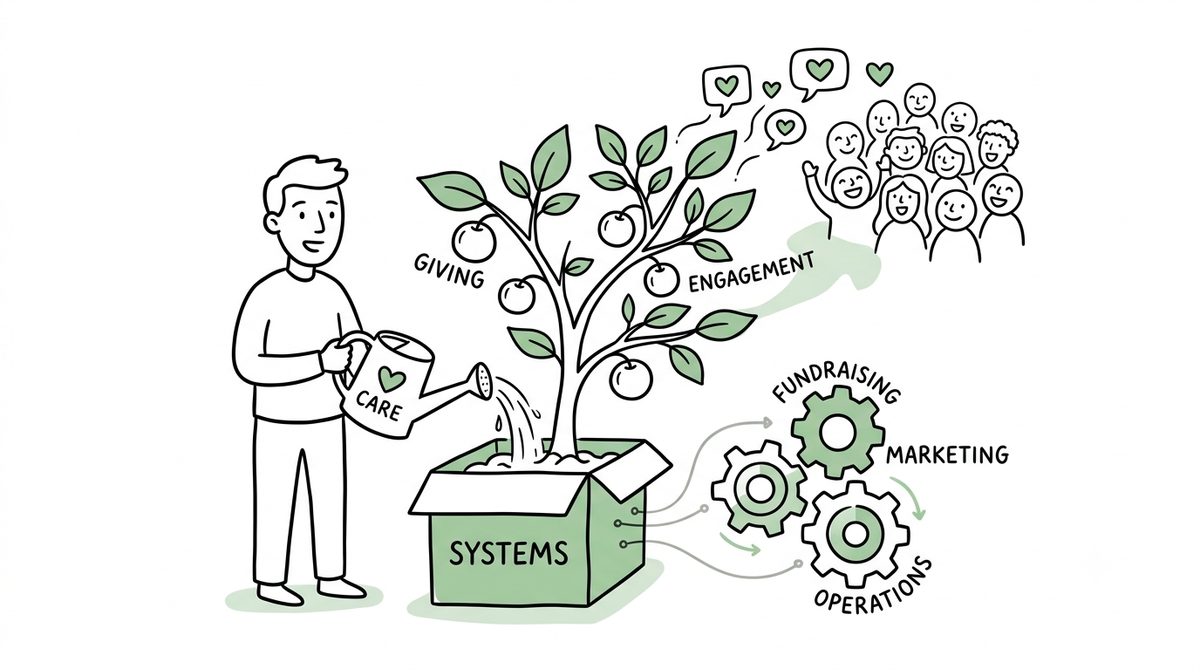
Many mission-driven organizations struggle with fragmented technology, isolated data, and disconnected teams that hinder donor engagement. By aligning fundraising, marketing, and operations, nonprofits can build integrated systems that nurture meaningful supporter relationships. This article explores how thoughtful workflows and smart automation turn daily operations into sustainable community impact.
Modern mission-driven organizations face a continuous balancing act: maintaining clear, human-centered connections with their communities while navigating an increasingly complex web of operational demands. Nonprofits rarely suffer from a lack of passion or vision. Instead, the friction almost always appears behind the scenes. Teams frequently find themselves bogged down by disconnected tools, isolated spreadsheets, and fragmented workflows that separate fundraising from marketing, and marketing from day-to-day operations.
When an organization's internal tools do not talk to each other, the broader mission suffers. Donors receive repetitive or conflicting communications, staff members spend valuable hours manually moving data between platforms, and opportunities to build deep, lasting relationships fade into administrative noise. Building systems that actually drive fundraising and supporter engagement isn't merely a matter of buying the latest software—it requires designing an aligned, human-centered operational framework that connects every point of contact into a single, cohesive experience.
Why Integrated Systems Matter for Community Impact
For many nonprofits, technology growth happens organically and reactively. A team might adopt one platform to launch an emergency campaign, an entirely different tool to manage email newsletters, and a third database to track volunteer hours. Over time, this patch-worked tech stack creates "data siloes"—isolated pockets of information that prevent an organization from seeing a complete picture of its supporters.
       [ Disconnected Tools ]                   [ Integrated System ]

  Fundraising  Marketing  Operations       Fundraising  Marketing  Operations
       │           │          │                 └───┬─────────┴─────────┘
       ▼           ▼          ▼                     ▼
   (Isolated Data & Friction)              (Single Supporter Journey)
This fragmentation brings real-world consequences:
- Supporter Fatigue: A dedicated volunteer might receive a generic, cold donor acquisition email because the fundraising database isn't connected to the volunteer management log.
- Operational Burnout: Small teams waste precious administrative hours manually cross-referencing lists, updating contact information, and fixing formatting errors instead of focusing on community engagement.
- Loss of Organizational Memory: When donor interactions and engagement histories are scattered across personal spreadsheets or isolated software accounts, institutional knowledge vanishes whenever staff transitions occur.
- Stunted Scalability: Without integrated infrastructure, scaling an initiative means linearly increasing administrative burden, making long-term sustainability nearly impossible.
When fundraising, marketing, and operations function in harmony, an organization transitions from reactive messaging to proactive relationship-building. Systems cease to be administrative hurdles and become the reliable engine that drives community impact.
Event Objectives
To address these systemic operational challenges, TechSoup hosted an insightful masterclass featuring expertise from Tapp Network. The session focused on demystifying nonprofit operations and equipping participants with a framework for sustainable growth.
The primary learning objectives included:
- Connecting Internal Functions: Demonstrating how to bridge the gap between fundraising campaigns, digital marketing, and underlying operational workflows.
- Mapping the Supporter Journey: Defining what a holistic, authentic donor path looks like from first interaction to long-term advocacy.
- Leveraging Automation and AI Responsibly: Identifying practical, high-impact areas where automation and artificial intelligence can eliminate routine friction without losing the personal, human touch.
- Designing Scalable Systems: Providing nonprofit leaders with clear strategies to build adaptable processes that support long-term mission delivery.
Key Insights and Takeaways
1. Breaking Down Internal Siloes
The foundational lesson of the session centered on a fundamental truth: fundraising is not an island. When development teams operate in isolation from communications and administrative staff, the organization’s public voice becomes fragmented.
True operational alignment requires shared goals and unified data. Marketing efforts should feed directly into fundraising initiatives, while donor insights should inform how programs communicate their local impact. Unifying these functions ensures that every touchpoint—whether an event invitation, a grant report, or a social media update—feels like part of a single, continuous conversation.
2. Defining a True Supporter Journey
A common misstep among growing organizations is treating supporter interactions as isolated transactions—a donation made, an email opened, or an event attended. The session emphasized replacing transactional thinking with a structured supporter journey.
[ First Touchpoint ] ──► [ Authentic Engagement ] ──► [ Sustained Support ] ──► [ Community Impact ]
Building an effective journey involves mapping out how a community member moves from awareness to active involvement:
- Awareness: Clear, accessible communication that highlights community needs and shared values.
- Engagement: Low-friction opportunities to learn, participate, or volunteer.
- Investment: Transparent, meaningful calls to action that demonstrate exactly how financial support creates change.
- Stewardship: Consistent follow-up that shows impact, expresses genuine gratitude, and invites ongoing dialogue.
3. Practical Automation and AI: Enhancing, Not Replacing, Human Connection
Automation often carries a negative connotation in the public service sector, with leaders worrying it might make their work feel cold or mechanical. However, when applied thoughtfully, automation does the exact opposite: it frees human beings to do human work.
Key Takeaway: The goal of technology in the public-interest sector is not to automate relationships, but to automate the routine processes that keep you from building them.
Participants explored key areas where automation and AI create immediate value:
- Workflow Automation: Automatically tagging new contacts based on interest, sending instant personalized thank-you receipts, and updating records across databases without manual data entry.
- Segmentation: Grouping supporters by their specific interests or past involvement so they receive communications that are genuinely relevant to them.
- Content Assistance: Using AI as a collaborative drafting tool to brainstorm campaign messaging, summarize project updates, or tailor communications for different audiences faster.
Event Snapshot
| Metric / Detail | Event Information |
| Event Title | How Nonprofits Build Systems That Actually Drive Fundraising and Engagement |
| Host Organization | TechSoup (featuring Tapp Network) |
| Date | July 29, 2026 |
| Platform | Virtual (Cloud) |
| Focus Area | Organizational Development & Nonprofit Technology |
This masterclass brought together nonprofit managers, development directors, and public service professionals seeking to modernize their operational infrastructure. Through practical demonstrations and real-world examples, the session highlighted how small-to-midsize organizations can achieve enterprise-level alignment without overwhelming their budgets or staff.
From Learning to Community Impact
Capacity building and operational refinement are never just about internal efficiency—they directly determine how well an organization can serve its community. When public service initiatives and civil society groups operate on strong, well-integrated systems, the real beneficiaries are the people and neighborhoods they support.
When administrative overhead is reduced through smart design:
- Resources Go Further: Fewer hours spent on manual data cleanup means more time and funding directed straight to community programs.
- Trust Grows: Transparent, timely, and personalized communication builds deep trust with partners, local leaders, and supporters.
- Services Become More Reliable: Stable operations ensure that community programs run smoothly, maintain continuity, and respond quickly during times of urgent need.
Continuous learning in digital infrastructure ensures that the nonprofit sector remains resilient, responsive, and capable of driving lasting, positive change.
Looking Ahead
In an era of rapid technological change and evolving community needs, organizations cannot afford to rely on static, outdated systems. The ability to adapt, streamline operations, and adopt thoughtful tools is essential to sustainable public service.
Navigating these shifts requires a commitment to ongoing professional development. By stepping back to evaluate internal systems, challenging old habits, and exploring innovative approaches to donor engagement, mission-driven teams equip themselves to meet future challenges with confidence and clarity.
Join the Conversation
Every meaningful change begins with learning, reflection, and open dialogue. As community organizations navigate new operational landscapes, sharing knowledge and practical insights remains one of our most effective tools for collective growth.
We invite advocates, nonprofit leaders, public servants, and community members to reflect on their own operational practices. How is your organization connecting its systems to better serve your mission? Join the conversation, share your perspectives, and let’s build more resilient, impactful communities together.
How Nonprofits Build Systems That Actually Drive Fundraising and Engagement
July 29, 2026
Virtual
Organizational Development & Nonprofit Technology
This initiative was independently funded by the BUKLURAN Officers through personal contributions.
We gratefully acknowledge the groups and individuals who shared resources, services, venues, supplies, and other forms of community support.
• TechSoup
BUKLURAN remains open to partnerships, sponsorships, and collaborative initiatives that create meaningful community impact.
Whether through funding, in-kind support, volunteerism, or shared services, your organization can help strengthen programs that serve underserved communities.