The Hidden Load on Our Monthly Bills: Why Lightening the Power Burden Takes More Than Turning Off Switches
Meralco rates are up by 15 centavos per kWh this June. Here is what's really driving your power bill higher—and how to protect your budget.
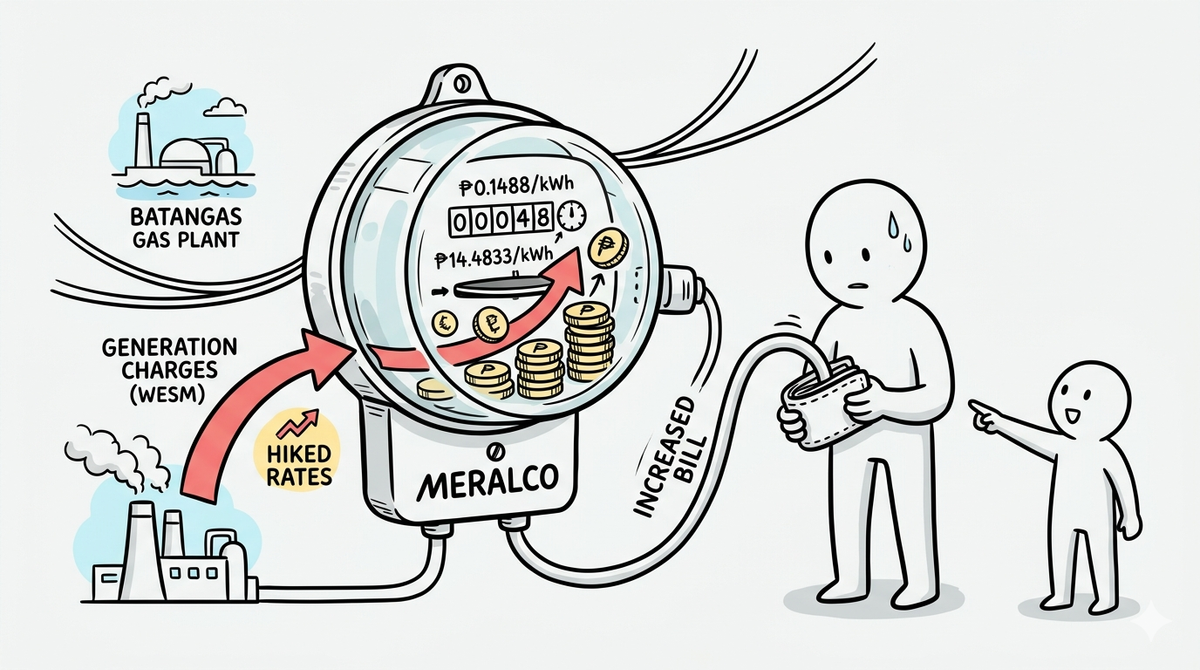
The June 2026 Meralco power rate increase, driven by grid alerts and global energy strains, reminds Filipino families that structural energy fixes are crucial for protecting household budgets.
Walk into any typical Filipino household on a warm afternoon, and you will likely hear the rhythmic, familiar hum of a stand fan oscillating at top speed. In many homes, it is a battle of survival against the heat. Mothers meticulously plan laundry days to maximize a single iron load, while parents gently remind their children to pull the plugs on television sets and phone chargers before heading to bed. In our communities, checking the monthly electric bill is not a minor chore; it is a high-stakes moment of suspense that directly dictates whether a family can afford meat for the coming week or if they will have to adjust the grocery budget down to the bare minimum.
When news breaks that power rates are moving upward again, a heavy, collective sigh ripples through neighborhoods from Tondo to Cavite. It feels like an unpredictable tax on staying cool, one that families are expected to pay without fully understanding why the numbers keep climbing despite their best efforts to save energy.
The June 2026 Adjustments at a Glance
This June 2026, household electric bills across the Manila Electric Co. (Meralco) franchise area are seeing another upward shift. The power distributor announced an overall rate increase of P0.1488 per kilowatt-hour (kWh). This brings the household electricity rate to P14.4833 per kWh, up from P14.3345 per kWh in May.
For a typical household consuming about 200 kWh of electricity in a month, this adjustment means an estimated P30 increase on the total bill. While thirty pesos might sound negligible to corporate planners, in an ordinary Filipino home, it is equivalent to the price of a kilo of affordable rice or a ride to work. For those whose consumption hovers higher due to continuous appliance use during the sweltering dry months, the financial impact multiplies quickly.
Unpacking the Bill: Why Did the Rates Go Up?
To understand why our bills fluctuate, we must look past the local poles and wires outside our windows and look at the broader energy landscape. Meralco does not generate the electricity it distributes; it buys power from large generation companies and the open market, passing these costs directly to consumers without making a profit from them.
The primary culprit behind this month's increase is the generation charge, which jumped by P0.2762 per kWh. This increase was driven by three systemic factors:
- The Luzon Grid Alerts (Tight Supply): Between May 13 and May 15, 2026, the Luzon power grid was placed under a series of stressful Red Alerts. Extreme heat drove power demand to historic highs, surpassing even the severe El Niño records of 2024. Simultaneously, unexpected technical trippings at several major transmission lines took key power plants offline. When supply falls short and demand surges, the Wholesale Electricity Spot Market (WESM) prices skyrocket. Spot market prices reached an average of P7.0281 per kWh during this period.
- Global Fuel Constraints: Our country’s energy mix relies heavily on imported fuels. Power Supply Agreements (PSAs) saw slight cost increases because global market prices for coal and liquefied natural gas (LNG) remained high.
- The Weakening Peso: Because international fuel contracts are settled in US dollars, the ongoing depreciation of the Philippine Peso means we must spend more local currency to buy the exact same amount of energy. Over 54% of PSA costs are exposed to these foreign exchange shifts.
The blow to consumers was slightly softened by a P0.1525 per kWh reduction in transmission charges and an ongoing regulatory refund of P0.4278 per kWh for residential customers, preventing the bill from climbing even higher.
What This Really Means for Everyday Life
The most critical factor affecting this month's bill isn't just the 15-centavo rate hike—it is the lingering effect of how we used electricity during the boiling weeks of May.
When ambient temperatures rise, our home cooling appliances must work twice as hard. An air conditioning unit or a standard refrigerator compressor consumes significantly more electricity just to maintain its internal temperature when the air outside is stifling. Many families who kept their appliances running longer to survive the heat will find that their total consumption (the number of kilowatt-hours used) spiked dramatically in May. When a higher rate is applied to a much larger volume of consumed energy, the resulting total bill can feel like a financial shock.
Moreover, the country uses a socialized power pricing structure approved by the Energy Regulatory Commission (ERC) decades ago. Under this system, households that consume more are charged a progressively higher rate per kilowatt-hour. For instance, while a family keeping their usage below 200 kWh pays the base rate, households using over 300 or 400 kWh move into higher pricing brackets. This structure means that seasonal spikes in comfort choices can inadvertently push low-to-middle-income families into expensive territory.
Shifting from Survival to Long-Term Efficiency
Faced with these realities, ordinary citizens are often left with the sole advice to "tipid" (save). We clean our air conditioner filters, iron our clothes in large single batches, avoid overfilling our refrigerators, and switch to energy-efficient LED bulbs. These habits are vital, and learning how to read the analog or digital meters outside our homes gives us a clearer picture of our real-time usage.
However, individual conservation can only do so much when the underlying energy system remains vulnerable to global market shocks and transmission line failures. True energy security for Filipino communities requires structural shifts—such as upgrading grid infrastructure to prevent transmission failures, accelerating the adoption of local renewable energy sources like solar and wind, and insulating our economy from volatile global fuel prices.
This persistent tension highlights why community-based consumer education and community development initiatives are so vital. When communities understand how energy systems operate, they are better equipped to advocate for equitable utility policies, participate in cooperative energy solutions, and build resilient local economies that can withstand fluctuating living costs. Protecting the household budget is a daily practice of careful management at home, but securing our long-term future requires building stronger, more energy-independent communities.
Moving Forward Together
The next time the monthly utility envelope arrives on the kitchen table, it shouldn't just be a source of anxiety. It can serve as a reminder of our shared vulnerability to larger systems—and the collective necessity to seek sustainable paths forward. As the rainy season gradually begins to cool the archipelago and lower our cooling demands, we have a brief window of relief to rethink our household habits, understand our consumption, and support initiatives that protect our pockets and our planet.
How does your household plan to balance comfort and conservation as we navigate these changing rates?
Bakit nga ba kahit anong tipid natin sa ilaw at appliances, nagugulat pa rin tayo pagdating ng bill sa kuryente? Ngayong Hunyo, may dagdag na halos P0.15/kWh ang singil ng Meralco. Pero alam niyo ba na ang tunay na dahilan ay hindi lang basta pagtaas ng presyo, kundi ang mga nagdaang "Red Alert" at ang tindi ng init nitong nakaraang buwan? Alamin kung paano nito maaapektuhan ang budget ng pamilya.

Power Our Mission, Shape the Future
We empower single parents, PWDs, youths, seniors, and stay-at-home parents through digital livelihood.
Help us build resilient communities.
BUKLURAN remains open to partnerships, sponsorships, and collaborative initiatives that create meaningful community impact.
Whether through funding, in-kind support, volunteerism, or shared services, your organization can help strengthen programs that serve underserved communities.
Do you want to take part in our free livelihood programs, scholarship assistance, and community resource pooling initiatives? Membership is completely free.
Join BUKLURAN!
Register, volunteer, and become a member today.