The Ripple Across the Ocean: How Indonesia’s New Trade Rules Could Reach Your Next Power Bill
When a neighbor across the ocean changes its trade laws, your next power bill might suffer the consequences. Here is why it happens.
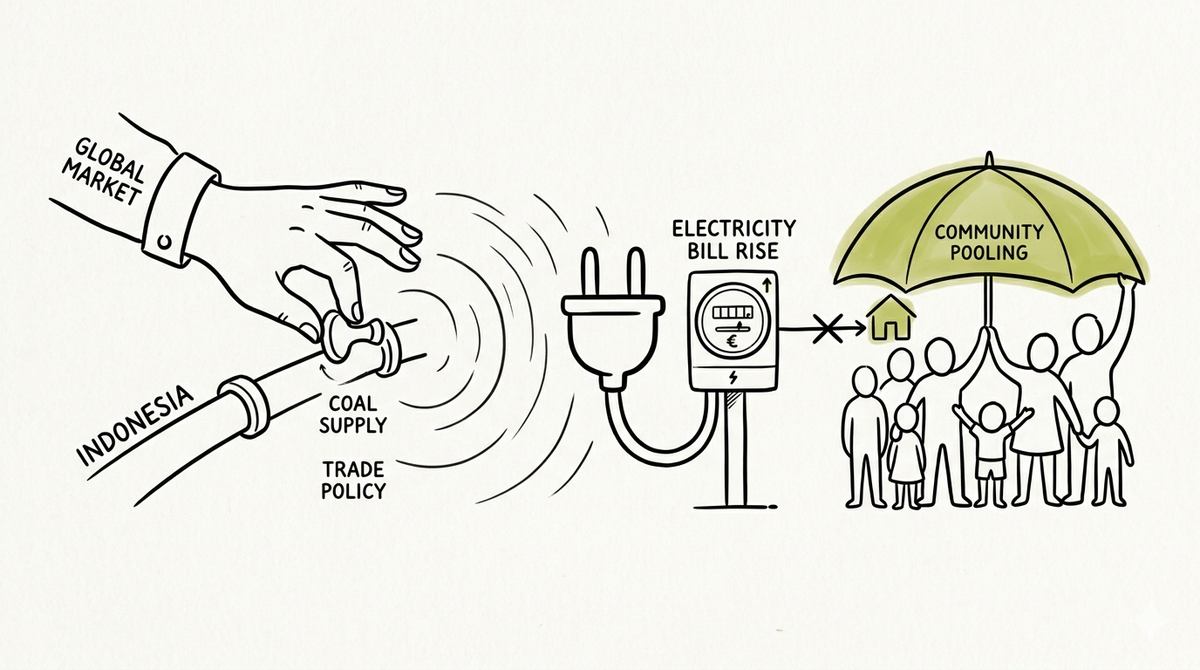
Indonesia's tightening control over its coal exports exposes structural vulnerabilities in the Philippines' power supply, potentially driving up monthly electricity bills for ordinary Filipino households.
Every month, when the electricity bill arrives, most Filipino households go through the same familiar routine. We look at the total amount due, sigh at the unexpected increase, and try to recall if the air conditioner was left running too long or if the children spent too many hours playing video games. We treat the bill as a reflection of our internal household habits. But often, the heaviest burden hidden inside those charges has nothing to do with what happens inside our living rooms. Instead, it is decided thousands of miles away by foreign governments, global shipping routes, and changes in international trade laws.
A stark reminder of this reality arrived recently from Jakarta. Indonesian President Prabowo Subianto announced a major overhaul of how the country manages its primary natural resources. Under the new directive, a newly established state-owned enterprise, Danantara Sumber Daya Indonesia (DSI), is set to centralize and take full control over the nation’s massive exports of coal, palm oil, and iron alloys. Moving from a decentralized system of independent mining companies to a state-controlled monopoly means that every contract, customs clearance, and payment will pass through a single government entity. Combined with planned production cuts aimed at stabilizing global commodity prices, our neighbor is rapidly tightening its grip on its own resources.
To a busy parent in Manila or a small carinderia owner in Quezon City, an administrative shift in Indonesian commodity regulations sounds like a dry topic reserved for the international business pages. But for the ordinary Filipino, understanding this development is critical. The connection between Indonesian state policy and a household kitchen lightbulb is direct, immediate, and financial.
To understand why this matters at home, one must look at what feeds the Philippine power grid. Our country is profoundly dependent on coal to generate basic, day-to-day electricity. More than half of our total power supply relies on coal-fired power plants. However, the Philippines does not produce enough coal domestically to satisfy this massive appetite; we import over 80 percent of our supply from abroad. And when we look across the seas for that fuel, nearly all roads lead to one place. Indonesia is the world’s largest exporter of thermal coal, and it serves as the overwhelming primary source for the fuel that keeps Philippine generators spinning.
When Indonesia decides to restructure its export systems, create new bureaucratic layers, or restrict production quotas to drive up global prices, it introduces immediate friction into the global market. Traders and mining firms have already expressed anxiety over operational delays and unresolved compliance frameworks. Ships wait longer at ports, supply tightens, and the global cost of coal ticks upward.
For the Filipino consumer, this is where the system becomes unfair. Under the current structure of our domestic energy sector, power supply contracts between generation companies and distribution utilities typically feature an "automatic fuel cost pass-through" provision. This mechanism ensures that if the price of imported coal rises due to global market fluctuations, shipping disruptions, or foreign policy shifts, the power companies do not absorb that extra expense. Instead, the additional cost is legally and automatically passed directly down the line. It travels from the global markets, through the utility providers, and lands squarely on the monthly bills of ordinary families and small businesses.
When global coal prices skyrocketed during past energy crises or temporary export freezes, domestic electricity rates across the Philippines experienced immediate spikes. Consumers are left completely exposed to external shocks over which they have absolutely no control. We are paying the price for a structural dependency on foreign fuel.
The human cost of this vulnerability is felt most deeply by those who are already struggling to balance tight household budgets. Consider a stay-at-home parent trying to manage the skyrocketing costs of food and basic household items, or a solo parent counting every peso to cover their children's school shoes and daily allowances. When a monthly power bill jumps by a few hundred pesos because of an export rule change in Jakarta, it forces real, immediate sacrifices at the family table. It means choosing cheaper, less nutritious food items, delaying a medical checkup for a senior family member, or reducing the small savings set aside for a child's education.
Electricity is not a luxury; it is a basic foundation for modern life, safety, and community progress. When external market forces make power unaffordable, it slows down the economic mobility of underserved households, making it even harder for vulnerable sectors to achieve long-term financial stability.
This ongoing international development highlights exactly why community-based efforts around resource optimization and local cooperation matter. While ordinary citizens cannot change foreign trade laws or rewrite international shipping policies, communities can build internal systems to shield themselves from the worst economic shocks. The vulnerability of our national power grid underscores the value of structured community frameworks that focus on collective resilience, reducing overhead costs, and managing shared household pressures cooperatively.
Within the BUKLURAN ecosystem, programs like the BUKLURAN HUB Livelihood and Community Enterprise Program demonstrate how organized groups can mitigate rising external costs. By utilizing a system of Community Resource Pooling, members voluntarily combine resources to purchase essential goods and basic commodities directly at wholesale volumes, thereby bypassing commercial markups. When external pressures like rising electricity rates threaten a family's purchasing power, having a community-driven mechanism to lower the costs of other daily essentials becomes a vital buffer.
Similarly, the structural pressures created by our energy dependence reinforce the importance of programs that target family development holistically, such as the BUKLURAN 3-Generation Community Development Model. When external global economic factors squeeze household income, supporting children's education through the BUKLURAN Pabaon Program while simultaneously providing parents with structured livelihood participation helps a household maintain stability. True insulation from global volatility requires both a national shift toward indigenous energy resources and a localized commitment to building self-supporting, resilient neighborhoods.
Ultimately, the shifts in Indonesia’s export policies should serve as a wake-up call that extends far beyond corporate boardrooms. It reminds us that our current way of life is bound to fragile, global dependency lines. Real energy security and economic peace of mind do not come from hoping that global commodity prices remain low, or that foreign governments keep their trade gates wide open. They come from strengthening our own local capacities, diversifying our resources, and looking out for one another at the grassroots level. Until the country builds a more self-reliant energy system, the best defense a family has is a organized, supportive community willing to share the burden of a changing world.
Talaga bang sa sarili nating mga kamay lang nagmumula ang pagtaas ng singil sa kuryente? Sa unang tingin, akala natin ay sa aircon o appliances lang natin sa bahay ang dahilan. Pero alam niyo ba na ang mga bagong batas sa kalakalan sa ibang bansa ay may direktang epekto sa laman ng pitaka ninyo ngayong buwan?

Power Our Mission, Shape the Future
We empower single parents, PWDs, youths, seniors, and stay-at-home parents through digital livelihood.
Help us build resilient communities.
BUKLURAN remains open to partnerships, sponsorships, and collaborative initiatives that create meaningful community impact.
Whether through funding, in-kind support, volunteerism, or shared services, your organization can help strengthen programs that serve underserved communities.
Do you want to take part in our free livelihood programs, scholarship assistance, and community resource pooling initiatives? Membership is completely free.
Join BUKLURAN!
Register, volunteer, and become a member today.