The Tipping Balance: How a Widening Trade Deficit Shapes the Filipino Home
When global trade balances tip, the weight is felt at the dinner table. Here is how the trade deficit shapes daily Filipino life.
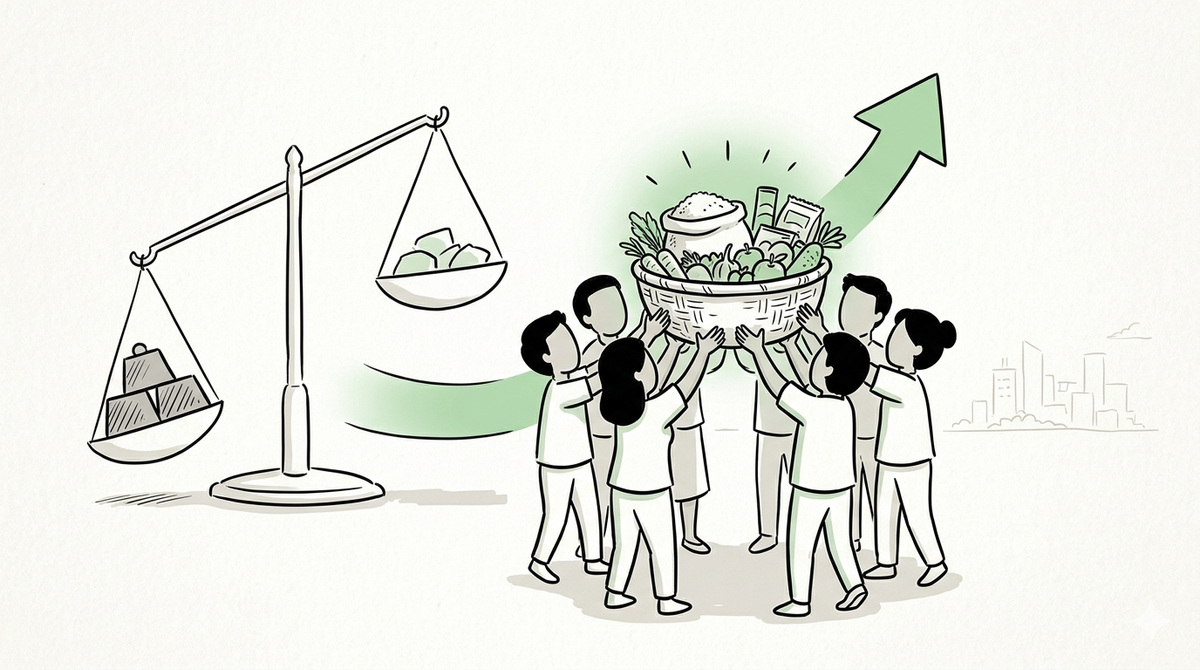
The widening Philippine trade deficit reflects a vulnerability to global shifts that directly affects the purchasing power and daily expenses of ordinary Filipino families.
Walk into any local market or neighborhood grocery store on a weekend morning, and you will hear a familiar, collective sigh. Parents carefully examine the price tags on a kilo of rice, a bottle of cooking oil, or a pack of canned goods, quietly calculating how far their hard-earned money can stretch. Sometimes, an extra twenty or fifty pesos is quietly shaved off another part of the household budget just to make sure the kitchen pantry remains filled. For most ordinary Filipinos, economic discussions are not measured in abstract percentages or high-level policy papers; they are felt deeply in the daily balancing act of survival, choices, and sacrifices.
When news outlets report that the Philippine trade deficit has neared a four-year high, it is easy to dismiss the headline as a distant issue meant only for economists, corporate executives, and policymakers. The term itself sounds entirely detached from the realities of commuters waiting in long lines for a jeepney or stay-at-home parents trying to manage their weekly allowances. Yet, these financial balances are closely tied to the prices of basic commodities, the stability of local jobs, and the quiet pressures weighing on families across the country.
To understand why this matters, it helps to break down what a trade deficit actually means. In simple terms, a country has a trade deficit when it spends more money buying goods and products from other nations (imports) than it earns by selling its own products to the rest of the world (exporters). According to recent economic data, our national trade imbalance has widened significantly, driven by a combination of global conflicts—particularly in the Middle East—and a weakening Philippine Peso against the US Dollar. Because the global marketplace relies heavily on the dollar, a weaker peso means we must spend significantly more money just to bring in the exact same volume of goods we always have.
We live in a world where no country stands completely alone, and the Philippines is particularly sensitive to global economic ripples. Consider fuel, for instance. Our transport systems, delivery trucks, manufacturing plants, and electricity grids rely heavily on imported oil. When tensions rise in oil-producing regions like the Middle East, the global cost of petroleum climbs. For an importing nation like ours, that increase is amplified by the weakening peso. When gas stations adjust their pumps to reflect these higher costs, the impact cascades through the entire local economy. The farmer in the province pays more to run the machinery; the logistics company pays more to transport produce to city centers; and ultimately, the consumer pays more for a piece of fruit or a vegetable at the local market stall.
This situation exposes a deeper, long-term challenge within our domestic infrastructure. Over decades, our local consumption has grown much faster than our capacity to produce essential items internally. We do not just import specialized technology or heavy machinery; we import significant amounts of basic commodities, food ingredients, and raw manufacturing materials. When the cost of importing rises, local manufacturers and retailers face a difficult choice: absorb the losses and risk going out of business, or pass the burden on to consumers. More often than not, the pressure lands on the shoulders of ordinary buyers.
The human impact of these economic movements reveals itself in subtle, everyday shifts. It means a solo parent must choose between buying a fresh set of school notebooks or maintaining the quality of the family's meals. It means a ride-hailing driver or a jeepney operator must work two extra hours every single day just to bring home the same net take-home pay they did months ago, reducing the precious time spent watching their children grow. For our senior citizens and persons with disabilities, who often live on fixed allowances or limited social support, rising costs directly eat into their funds for essential healthcare and maintenance medicines. The data does not replace these human struggles; rather, the trade data explains why these daily challenges have become so incredibly sharp.
When global systemic pressures build up, relying entirely on individual resilience can become exhausting. This is precisely where the philosophy of collective action and community-driven design becomes vital. While an ordinary neighborhood cannot control international fuel prices or manipulate foreign exchange rates, residents can change how they organize, pool resources, and support one another to withstand the pressure.
This widespread challenge reflects exactly why community-based efforts around programs like the BUKLURAN Hub matter. Operating entirely as a non-profit, community-driven framework, the initiative focuses on practical participation rather than passive income or financial speculation. Through a system known as Community Resource Pooling, members voluntarily combine their resources for a specific program cycle, such as a Rice Distribution Cycle or a Grocery Support Cycle. By purchasing essential commodities collectively and directly sourcing goods, communities can bypass multiple commercial layers and access everyday items at more manageable cost levels than standard retail pricing.
This approach does not function as an investment scheme or a savings program, nor does it guarantee financial returns or individual profits. Instead, it serves as a practical, organized social safety net. When global trade deficits drive up the cost of basic commodities, structured resource sharing helps ordinary stay-at-home parents, workers, and underserved families reduce their overall household expenses through shared efficiency and cooperation. It proves that while macroeconomics happens on the global stage, economic resilience is built on the ground, one neighborhood at a time.
Facing a widening trade deficit reminds us that economic numbers are never just numbers; they represent the collective energy, limitations, and well-being of our citizens. True economic stability cannot just be measured by the strength of a currency or the balance sheets of large corporations. It must ultimately be evaluated by how securely a regular Filipino family can sit down at the dinner table without worrying about the cost of tomorrow's meals. As we navigate an uncertain global landscape, perhaps the path forward lies in recognizing that our greatest protection against large-scale economic vulnerabilities is the strength, discipline, and unity we build within our own local communities.
Bakit nga ba kahit masipag tayong magtrabaho araw-araw, parang lalong sumisikip ang halaga ng ating kita? Balita ngayon ang tumataas na trade deficit ng bansa, pero ano nga ba ang kinalaman ng mga pandaigdigang isyu at dambuhalang numero sa presyo ng bigas, ulam, at gastusin ng pamilyang Pilipino? Paano binabago ng ekonomiya ang buhay sa loob ng ating mga tahanan?

Power Our Mission, Shape the Future
We empower single parents, PWDs, youths, seniors, and stay-at-home parents through digital livelihood.
Help us build resilient communities.
BUKLURAN remains open to partnerships, sponsorships, and collaborative initiatives that create meaningful community impact.
Whether through funding, in-kind support, volunteerism, or shared services, your organization can help strengthen programs that serve underserved communities.
Do you want to take part in our free livelihood programs, scholarship assistance, and community resource pooling initiatives? Membership is completely free.
Join BUKLURAN!
Register, volunteer, and become a member today.