Beyond the Green Headlines: What a Local EV Brand Means at the Jeepney Terminal
Beyond the high-level corporate talks about electric vehicles, the real shift happens when green technology is built for the common tao.
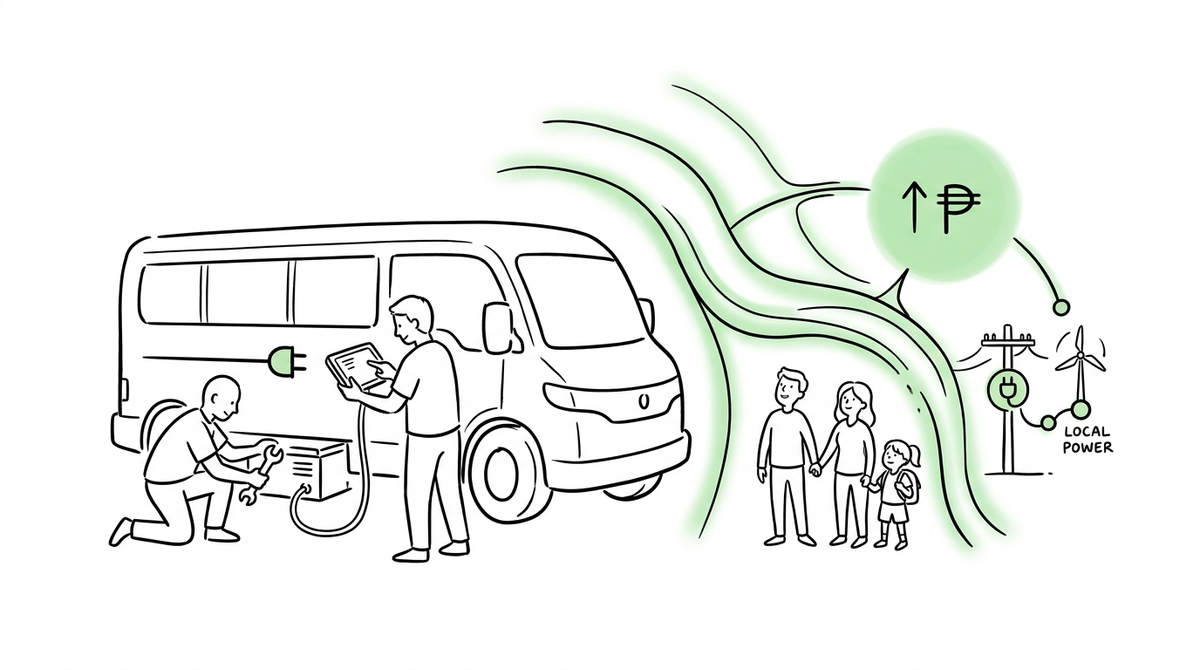
As international automotive players explore setting up a local electric vehicle brand in the Philippines, the true measure of its success lies not in macroeconomic figures, but in how accessibly this transition empowers everyday Filipino commuters and workers.
Walk into any local transport hub or neighborhood street corner at five in the afternoon, and the sounds and smells are instantly familiar. The roar of old diesel engines, the thick blanket of exhaust fumes, and the rhythmic calling of routes by drivers trying to fill their vehicles form the backbeat of the daily Filipino commute. For decades, the local transportation system has run on sheer grit and fossil fuels. Parents budgeting their weekly expenses know exactly how a ten-peso hike in diesel prices ripples directly into the cost of the garlic, rice, and vegetables they bring home to their children.
When news breaks about global technology and modern manufacturing entering the country, it often feels like a conversation happening in high-rise boardrooms, entirely detached from these everyday realities. Recently, the Chinese automotive design and engineering firm Shanghai Launch Automotive Technology Co. Ltd. (Launch Design) expressed strong interest in partnering with local firms to build a domestic electric vehicle (EV) brand. In a high-level meeting with the Department of Trade and Industry, discussions focused heavily on supply chain localization, domestic manufacturing, and the upcoming Electric Vehicle Incentive Strategy (EVIS), which seeks to offer fiscal support for locally produced EVs.
On paper, the details are undeniably impressive. Launch Design is a seasoned global player boasting a portfolio of over 400 vehicle models and partnerships with international automotive titans like BYD, Geely, and Toyota. For an economy trying to position itself in the global green transition, a partnership of this scale signals industrial progress, technical modernization, and the potential creation of thousands of manufacturing jobs.
Yet, for the ordinary Filipino commuter standing in line under the sweltering heat or the jeepney driver counting loose coins at the end of a fourteen-hour shift, an intelligent question arises: Why should I care? Will a local electric vehicle brand remain a luxury ecosystem for the affluent, or will it fundamentally reshape the economic safety of the working class?
Moving past the enthusiastic corporate headlines reveals that the real value of an EV transition does not lie in the sophistication of the technology itself, but in its accessibility. Historically, the greatest barrier to modernizing public and private transport in the Philippines has been the staggering cost of adoption. When advanced technology is imported entirely as finished goods, the cost is passed straight down to the operator, which inevitably translates into higher fares for the public or unmanageable debts for small transport workers.
By discussing supply chain localization—meaning the parts, assembly, and maintenance happen within the country—the equation begins to shift. Localized manufacturing has the potential to drive down production costs, making clean transportation a viable alternative rather than an unattainable ideal. Furthermore, it insulates the local transport sector from the volatile swings of the global oil market. Every time geopolitical tensions cause oil prices to spike, everyday families feel the squeeze. Shifting the foundation of local movement toward a localized, electric-driven ecosystem creates a structural buffer, protecting the household budgets of ordinary citizens from forces half a world away.
However, building a factory or establishing a brand is only the first step. For industrial modernization to truly benefit the community, it must be accompanied by a massive evolution in local human capability. Advanced automotive engineering and EV assembly require an entirely different set of skills than traditional internal combustion engines. A country cannot transition its vehicles if it does not simultaneously transition its workforce.
This is where the human element of industrial progress becomes critical. The transition to electric vehicles introduces complex digital interfaces, advanced electrical systems, and electronic diagnostic processes. If the ordinary mechanic on the street corner or the young worker looking for employment is left without a pathway to learn these systems, the economic rewards of a new industry will remain concentrated in the hands of a select few. True development requires democratization of knowledge, transforming complex technical shifts into accessible learning tracks that everyday individuals can utilize to uplift their livelihoods.
This intersection of shifting realities and the necessity for accessible, practical knowledge reflects why community-based efforts around programs like the BUKLURAN Bagong Simula Program matter. Industrial developments are fundamentally digital and technical shifts. Ensuring that youth, solo parents, and underserved households are not alienated by modern systems requires proactive, grassroots initiatives in digital literacy and technical readiness. When communities focus on making digital tools and technical safety understandable to the average person, they build the groundwork necessary for citizens to navigate an evolving economic landscape.
Similarly, the emerging demand for localized technical support highlights the value of structured training tracks found in initiatives like the BUKLURAN Kasanayan Program. Long before a brand-new vehicle hits the road, the community needs individuals who understand basic troubleshooting, electronics setup, and hardware maintenance. By providing hands-on, output-based training in electronics repair and technical problem-solving, grassroots frameworks prove that high-level industrial trends can be translated into practical, neighborhood-level capabilities. When a community possesses its own base of technically capable individuals, it ceases to be a passive bystander to corporate progress and becomes an active participant in its own economic resilience.
Ultimately, the true success of an EV brand in the Philippines cannot be measured by the number of vehicles rolling off an assembly line, nor can it be verified by gross domestic product charts. The real metric of progress is found on the ground: in the security of a driver who no longer fears the weekly fluctuation of fuel pumps, in the relief of a mother whose child breathes cleaner air on the way to school, and in the dignity of a local worker who has gained the skills necessary to build the future of Philippine transport. As the country stands on the edge of this green transition, the challenge is to ensure that as the vehicles move forward, no Filipino family is left behind in the exhaust of the past.
Talaga bang para sa lahat ang pagdating ng mga electric vehicles sa bansa natin? May mga malalaking kumpanya na nagpaplanong magtayo ng local EV brand sa Pilipinas. Magandang pakinggan, pero ano nga ba ang magiging totoong epekto nito sa bulsa ng mga ordinaryong commuter at kabuhayan ng mga tsuper? Kakayanin ba nitong ibaba ang pamasahe at gastusin sa pamilya?

Power Our Mission, Shape the Future
We empower single parents, PWDs, youths, seniors, and stay-at-home parents through digital livelihood.
Help us build resilient communities.
BUKLURAN remains open to partnerships, sponsorships, and collaborative initiatives that create meaningful community impact.
Whether through funding, in-kind support, volunteerism, or shared services, your organization can help strengthen programs that serve underserved communities.
Do you want to take part in our free livelihood programs, scholarship assistance, and community resource pooling initiatives? Membership is completely free.
Join BUKLURAN!
Register, volunteer, and become a member today.