Beyond the White Ribbons: What Fighting Corruption Looks Like When the Rally Ends
A new faith-based movement is heading to EDSA to protest corruption. But what does fighting corruption actually look like for the rest of us?
While massive anti-corruption rallies create headlines, the true measure of systemic change lies in how ordinary citizens demand transparency in their everyday local transactions.
Every morning, millions of Filipinos step out of their homes to face a familiar ritual of survival. A vendor sets up her stall, calculation always hovering over the daily cost of permits—and the unwritten, unspoken fees sometimes required just to keep her spot. A father wakes up early to line up at a local government office, hoping that having the complete set of required documents will be enough this time, without needing a "backer" or a middleman to speed up the process. A public school teacher looks at her crowded classroom, wondering how a budget allocation that looks so generous on paper somehow thins out by the time it reaches the actual desks and textbooks of her students.
For most of us, corruption is not a theoretical problem debated in halls of power or analyzed in thick economic reports. It is a weight. It is a slow, draining tax on our daily patience, our limited income, and our faith that the rules apply equally to everyone.
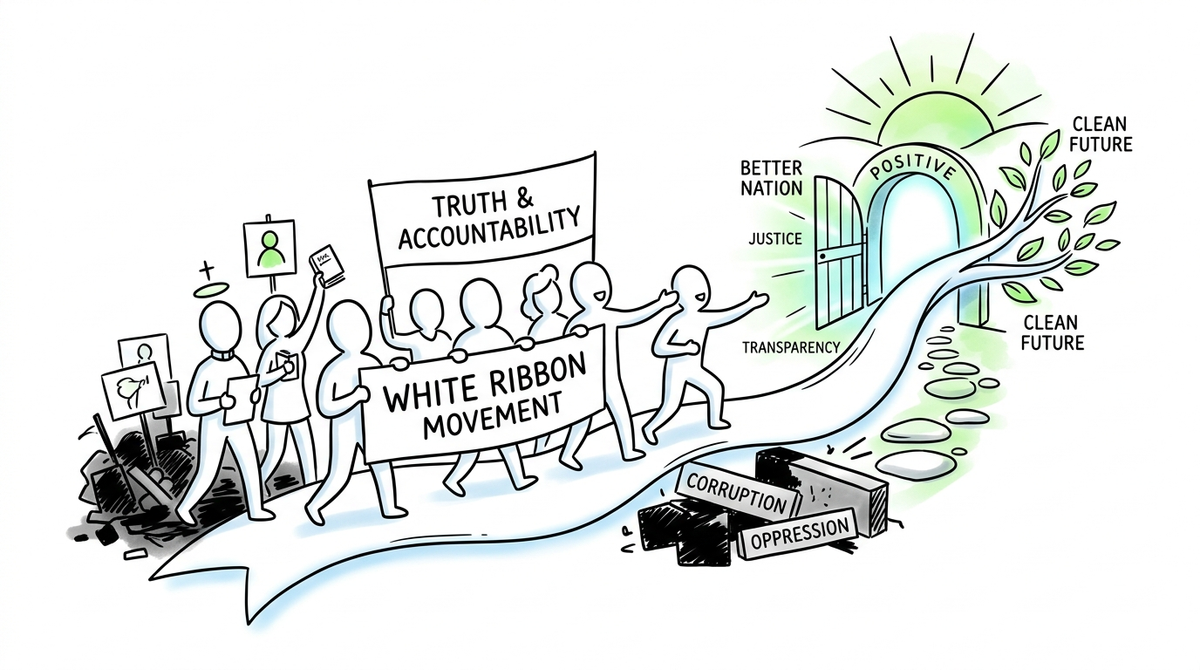
When news broke that a broad coalition of religious and civil society groups is organizing the "White Ribbon Movement"—a massive anti-corruption rally scheduled for June 28 along EDSA—it struck a deeply familiar chord. The protest is a direct response to the staggering "Trillion Peso March" scandal, a controversy that has once again exposed how public funds can vanish into the pockets of the powerful while vital public services remain underfunded. The organizers are calling for sweeping systemic fixes: real accountability, deep electoral reforms, and the long-delayed passage of an anti-political dynasty law.
It is easy to understand the spark behind this movement. There is a specific kind of exhausting frustration that builds up when headlines reveal billions of pesos missing, while ordinary families are told to tighten their belts because inflation is high and resources are scarce. Gathering along EDSA with white ribbons is a visible, powerful way to say that the status quo is no longer acceptable.
But for the commuter stuck in traffic, the farmer watching crop prices drop, or the youth looking for a decent job, a crucial question always hovers behind the spectacular images of a street protest: What happens after the headlines fade? How does a sea of white ribbons on a Sunday afternoon change the reality of a barangay health center running out of basic medicine on a Tuesday morning?
To understand how high-level corruption trickles down to everyday life, we have to look at the invisible math of public funds. In economics, there is a concept known as the opportunity cost—what we lose by choosing one path over another. When a single infrastructure project is overpriced due to kickbacks, or when public contracts are awarded to unqualified cronies rather than the best bidder, the loss is rarely just financial. The true cost is paid in the things that were never built, the services that were never delivered, and the lives that were never made easier.
Consider a public hospital. When procurement processes are compromised, the direct result is a shortage of diagnostic machines, delayed maintenance on life-saving equipment, or a lack of items as simple as clean gauze and specialized medication. A low-income patient does not just experience this as "governance failure"; they experience it as a heartbreaking choice between buying medicine or putting food on the dinner table.
Similarly, when local road projects are substandard because a portion of the budget was diverted, a community loses more than just smooth asphalt. Farmers face higher transport costs and more spoiled produce because the road to the market is broken. Tricycle drivers spend more on vehicle repairs, cutting directly into the daily earnings they bring home to their children. In the most severe cases during typhoon seasons, poorly constructed retaining walls or compromised drainage systems become active hazards, turning systemic corruption into a direct threat to public safety.
This is why systemic change cannot rely on massive rallies alone. A protest is an alarm clock—it wakes people up, it signals an emergency, and it forces those in power to look out the window. But an alarm clock does not clean the house or prepare the meal. The actual work of building an accountable society happens in the quiet, unglamorous spaces of daily monitoring and community-level awareness.
True transparency is built from the bottom up. It looks like citizens attending their local barangay assemblies, not just to listen, but to ask how the local development fund is being utilized. It looks like civil society organizations sitting in on local school boards and health boards to ensure that public bidding processes are genuinely competitive and open to scrutiny. It looks like ordinary consumers refusing to pay small bribes to bypass bureaucratic lines, choosing instead to demand efficient, digitized public services that reduce human discretion.
When a community begins to understand that public money belongs to them—that it is funded by the value-added tax on every kilo of rice and every mobile load card they buy—the relationship with governance changes. The mindset shifts from viewing public service as a favor granted by a politician to demanding it as a right earned by the public.
This deep intersection between public integrity and community survival reflects why community-based efforts around local resource management and civic literacy matter. When ordinary neighbors gather regularly to plan, budget, and oversee their own small-scale community projects, they are doing more than just building local infrastructure. They are practicing governance. They are learning how to read line items, how to question discrepancies, and how to demand quality from contractors. This micro-level experience creates an educated citizenry that becomes highly resistant to manipulation and exploitation at the macro level. A community that knows how to protect its local funds is a community that will eventually demand that the nation do the same.
The White Ribbon Movement on June 28 will undoubtedly capture the nation’s attention, and rightly so. Demanding truth, justice, and righteousness in public office is a noble and necessary endeavor. The sight of thousands standing shoulder-to-shoulder is a vital reminder that the spirit of civic responsibility remains alive in the country.
Yet, the ultimate success of any anti-corruption movement is not measured by how many people turn up on the highway, but by how many people carry that exact same demand for accountability back into their schools, their workplaces, their barangay halls, and their homes. The real antidote to corruption is not an occasional burst of anger, but a steady, unyielding culture of participation. Long after the banners are folded and the white ribbons are put away, the quiet, daily insistence that things must be done correctly, transparently, and fairly remains our most powerful tool for lasting change.
Lahat tayo galit kapag may nababalitaang bilyun-bilyong pisong nawawala sa kaban ng bayan. Kaya naman marami ang naghahanda para sa gaganaping "White Ribbon Movement" rally ngayong June 28. Pero sapat nga ba ang pagtayo sa EDSA para matigil ang korapsyon? Paano nga ba binabago ng nakatagong "padulas" at anomalya ang presyo ng bigas, ang pila sa ospital, at ang kinabukasan ng iyong pamilya?
Power Our Mission, Shape the Future
We empower single parents, PWDs, youths, seniors, and stay-at-home parents through digital livelihood.
Help us build resilient communities.
BUKLURAN remains open to partnerships, sponsorships, and collaborative initiatives that create meaningful community impact.
Whether through funding, in-kind support, volunteerism, or shared services, your organization can help strengthen programs that serve underserved communities.
Do you want to take part in our free livelihood programs, scholarship assistance, and community resource pooling initiatives? Membership is completely free.
Join BUKLURAN!
Register, volunteer, and become a member today.