How Community Resource Pooling Helps Filipino Families Lower Daily Expenses
This article examines the persistent challenge of rising commodity prices facing Filipino families nationwide and explains how community-based resource pooling mechanisms—such as the BUKLURAN HUB ecosystem—help lower household expenses through bulk sourcing, shared logistics, and cooperative participation.
The Financial Power of Community Resource Pooling
| Essential Commodity | Standard Retail Cost | Pooled Sourcing Price | Estimated Monthly Savings |
|---|---|---|---|
| Well-Milled Rice (25kg Sack) | ₱1,300.00 | ₱1,050.00 | ₱250.00 |
| Cooking Oil (1 Liter) | ₱85.00 | ₱68.00 | ₱34.00 (2 Liters) |
| Canned Goods (Pack of 10) | ₱240.00 | ₱190.00 | ₱50.00 |
| Laundry Detergent (1kg Pack) | ₱160.00 | ₱125.00 | ₱35.00 |
| Transport & Logistics Fee | ~₱150.00 (Individual trips) | ~₱30.00 (Shared logistics) | ₱120.00 |
Managing a household budget in the Philippines has become an increasingly demanding exercise. For millions of families, daily earnings are constantly stretched by the rising costs of staple goods like rice, cooking oil, and basic groceries. When retail margins, transport overheads, and multi-tier distribution networks add to the final shelf price, low-income households and daily-wage earners bear the heaviest burden.
While macroeconomic factors driving price adjustments remain outside the average consumer's control, local communities are finding practical ways to protect their purchasing power. One effective approach gaining traction is organized community resource pooling.
What Is Community Resource Pooling?
Community resource pooling is a cooperative, non-commercial system where neighborhood residents combine their financial and operational resources to purchase essential goods collectively.
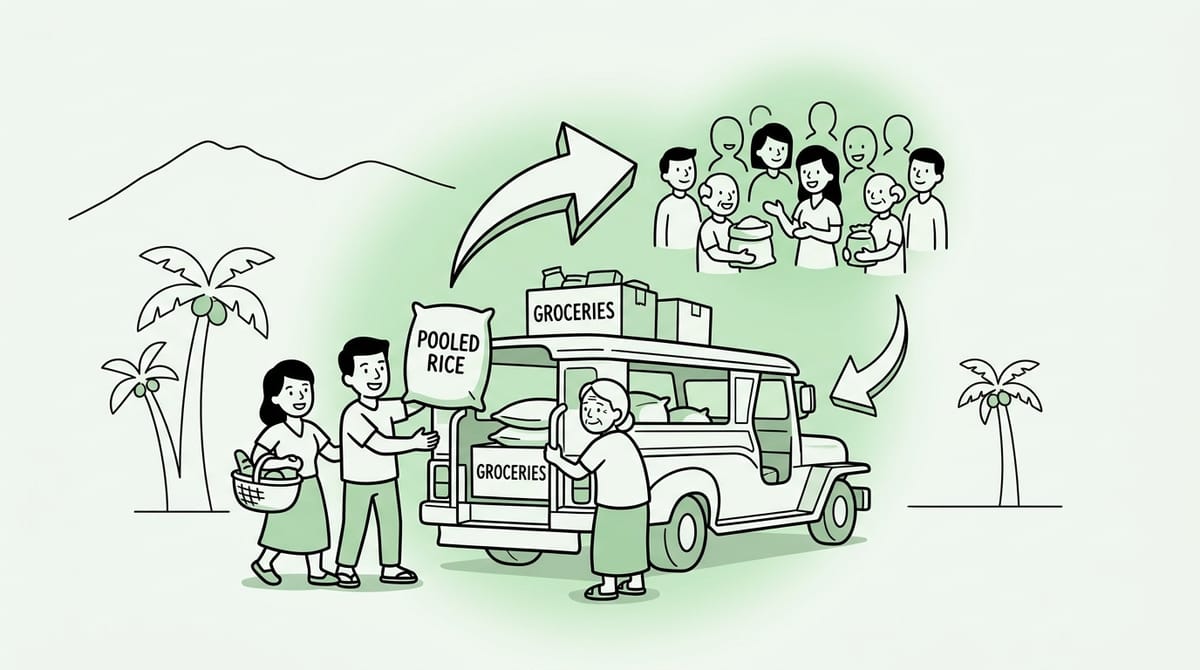
Instead of individual families buying small quantities at standard retail prices—which include compounding markup fees from middlemen—the group aggregates its demand. This collective scale allows the group to access wholesale rates or bulk pricing directly from suppliers or primary distributors.
Supply Chain Comparison
* Multiple markups and repeated transport costs are added at each individual stage.
* Direct bulk sourcing cuts out intermediate distribution costs and retail markups.
How Sourcing Cycles Reduce Household Costs
Resource pooling operates through defined operational cycles rather than continuous commercial sales. A typical cycle involves clear phases:
- Demand Aggregation: Members voluntarily opt into a scheduled cycle (such as a rice or grocery distribution) and pool their allocated contributions.
- Bulk Sourcing: Program coordinators negotiate bulk procurement directly with sources, eliminating intermediate retail markups.
- Shared Logistics: Freight, handling, and logistics costs are shared across the entire group, drastically lowering the per-unit shipping cost.
- Direct Allocation: Sourced items are brought to a central neighborhood pickup point (or microhub) and allocated to participating families based on their voluntary contribution.
By streamlining the supply chain, families frequently access essential goods below the Suggested Retail Price (SRP).
What the Headlines Leave Out About Wholesale Buying
While bulk buying is a standard recommendation for saving money, standard commercial advice assumes a household has sufficient spare cash to buy in large quantities upfront. For low-income families or informal workers, lump-sum spending is impossible.
Organized community pooling solves this barrier by allowing multiple families to combine small, individual contributions into a single bulk order. Additionally, properly managed community systems operate on a strict cash-based framework:
- Zero Debt Sourcing: Cycles require upfront resource pooling, preventing families from incurring high-interest informal loans or credit traps.
- Non-Profit Sourcing: Contributions are allocated strictly toward procurement, transport, and system maintenance rather than commercial profit margins.
- Volunteer Opportunities: Members without spare funds can often participate by providing volunteer labor, such as packing, logistics, or distribution coordination, receiving in-kind support or expense reimbursements.
Practical Takeaways for Neighborhood Sourcing
Filipinos interested in starting or joining a community resource pooling initiative should keep several key practices in mind:
- Focus on Non-Perishable Staples: Begin with high-volume, long-shelf-life necessities such as rice, canned goods, cooking oil, and laundry detergents to minimize spoilage risks.
- Maintain Strict Transparency: Every cycle must have documented contributions, supplier receipts, and clear distribution logs accessible to all participants.
- Avoid Credit Operations: Keep the ecosystem strictly cash-based or pre-funded to protect the community from unpaid debts and financial strain.
- Distinguish Sourcing from Investment: Resource pooling is a distribution tool to reduce consumption expenses, not a financial scheme designed to yield monetary interest or passive income.
Community Livelihood in Action
In Quezon City, community organizations like BUKLURAN NG KALINGA NG MAMAMAYANG DISTRITO SINGKO INC. utilize this structured approach through initiatives like the BUKLURAN HUB Livelihood Ecosystem. By facilitating group funding cycles and bulk sourcing of goods, the HUB allows stay-at-home parents, single parents, senior citizens, and local workers to stretch their household budgets safely and cooperatively.
By turning individual purchasing power into collective community action, Filipino families gain a reliable tool to build resilience against economic pressures.

Power Our Mission, Shape the Future
We empower single parents, PWDs, youths, seniors, and stay-at-home parents through digital livelihood.
Help us build resilient communities.
BUKLURAN remains open to partnerships, sponsorships, and collaborative initiatives that create meaningful community impact.
Whether through funding, in-kind support, volunteerism, or shared services, your organization can help strengthen programs that serve underserved communities.
Do you want to take part in our free livelihood programs, scholarship assistance, and community resource pooling initiatives? Membership is completely free.
Join BUKLURAN!
Register, volunteer, and become a member today.