More Than a Glass of Milk: What It Takes to Feed a Child’s Future
A 100-day initiative in Laguna shows that fighting child malnutrition requires looking at both classroom hunger and local farm livelihoods.
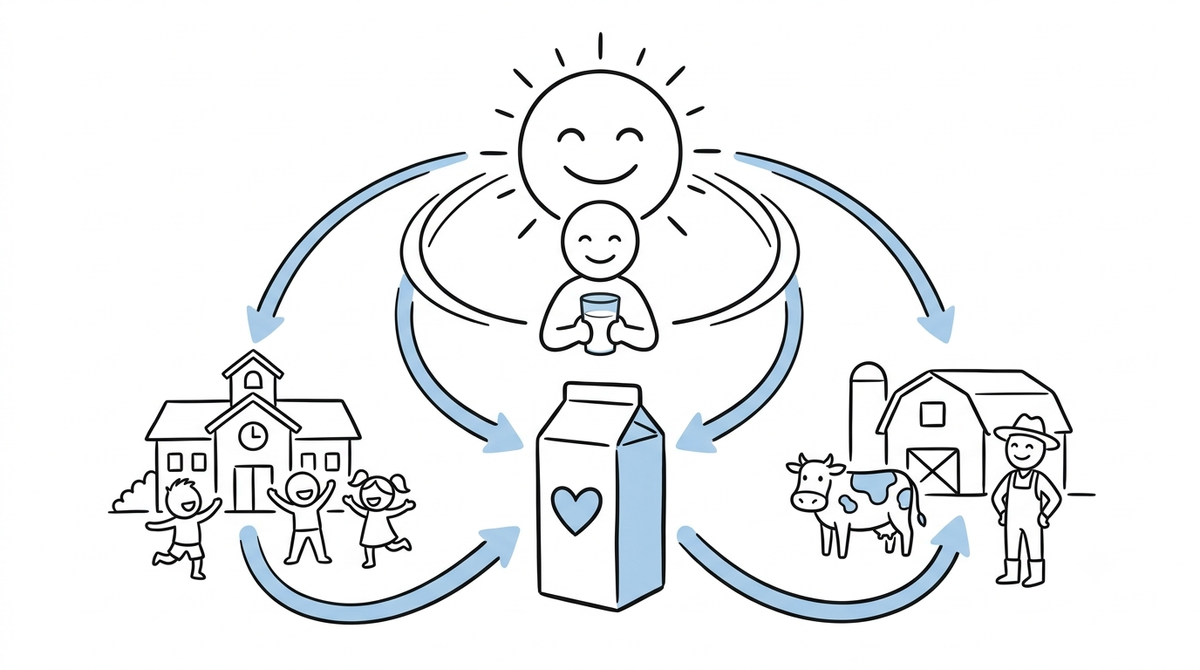
The milk feeding program in Laguna highlights how tackling child malnutrition and supporting local farmers can build a stronger community from the ground up.
Every morning across the Philippines, a familiar ritual plays out in millions of households. A mother wakes up before dawn, counts the remaining pesos left in her purse, and tries to figure out how to stretch a meager budget to feed her children before sending them off to school. In many homes, breakfast is minimal—perhaps a small plate of leftover rice split among siblings, or a piece of bread washed down with water.
When a child walks through the school gates with an empty or poorly nourished stomach, the classroom ceases to be a place of opportunity. It becomes a place of endurance. It is incredibly difficult to focus on a math equation or a reading exercise when your body is running on empty. Teachers see it every day: the glazed expressions, the heavy heads resting on desks, and the sudden drop in attendance when a child is too weak or sick to attend class.
This is the quiet, everyday reality of child malnutrition in our communities. It is not just a medical statistic found in annual health reports; it is a daily hurdle that shapes what our children can achieve, how they grow, and who they will become.
The Lifeline in the Classroom
Recently, a new effort was launched to address this exact struggle in the city of Sta. Rosa, Laguna. A 100-day milk feeding initiative has commenced at Malitlit Elementary School, aiming to provide daily milk servings to 500 public school students from kindergarten to Grade 6.
The program brings together a unique coalition: the National Dairy Authority (NDA), the Department of Education (DepEd), the local government of Sta. Rosa, and a private sector partner, ABI Pascual Foods Inc. For the next few months, these 500 young learners will receive a reliable source of nutrition directly in their classrooms.
On the surface, it sounds like a straightforward story of institutional charity—a corporate donor and government agencies teaming up to give away food. But if we look closer, this initiative reveals a much deeper narrative about how our society functions, where our food comes from, and what it truly takes to protect the next generation of Filipinos.
Connecting the Dots: From Farm to Desk
To understand why a program like this matters, we have to look past the school gates and travel to the nearby pastures and cooperative farms of local dairy producers.
The milk being served to the children at Malitlit Elementary School is not coming from cargo ships or overseas manufacturing plants. It is being sourced directly from local Filipino dairy farmers. This design choice addresses two massive structural issues at the exact same time: childhood undernutrition and agricultural insecurity.
For decades, the Philippines has lived under a strange and troubling paradox. We are a deeply agricultural nation, yet we depend overwhelmingly on foreign imports to meet our basic food needs. When it comes to dairy, the numbers are stark: the vast majority of the milk, cheese, and butter consumed by Filipinos is imported from countries thousands of miles away.
This heavy reliance on foreign markets leaves us vulnerable. When global supply chains disrupt or international prices spike, the price of milk on local grocery shelves goes up, making it even harder for low-income families to afford. Meanwhile, our own local dairy farmers often struggle to survive. They possess the land, the skills, and the willingness to produce fresh, high-quality milk, but they frequently lack a steady, reliable market willing to buy their goods at a fair price.
By intentionally linking the school feeding program to local dairy production, the initiative creates a vital economic bridge. The farmers receive a guaranteed market for their produce for at least 100 days. This predictable income allows them to buy feed for their livestock, invest in better equipment, and support their own households. In turn, the children receive fresh, nutrient-dense milk that hasn't spent weeks in transit across the ocean.
What This Really Means for Everyday Families
For the parents of the 500 students at Malitlit Elementary School, this program represents a profound sense of relief. When a family is living on tight daily wages, the cost of providing balanced, nutritious meals every single day is a constant source of stress.
Nutrition is expensive. Fresh fruits, vegetables, and quality proteins are often priced far out of reach for a family relying on informal or minimum-wage labor. Often, the cheapest calories available are heavily processed snacks or instant noodles—foods that fill a stomach temporarily but leave a developing body starved of vital micro-nutrients.
When the school provides a daily glass of milk, it lifts a fraction of that financial and emotional burden off the shoulders of parents. It means a mother can rest a little easier knowing that, regardless of how tough things are at home that week, her child will get a boost of calcium, protein, and essential vitamins at school.
Furthermore, the impact of proper nutrition during these formative years cannot be overstated. Health experts have long pointed out that malnutrition during childhood leads to long-term cognitive and physical setbacks, a condition often referred to as stunting. Stunting isn't just about height; it affects brain development, immune function, and future earning potential. By intervening in the classroom, we are not just helping a child get through their afternoon lessons; we are actively protecting their future capacity to learn, work, and thrive.
The Long-Term Challenge Beyond the 100 Days
While the launch of this program is a step in the right direction, it also forces us to ask a critical, uncomfortable question: What happens on day 101?
A 100-day initiative is an excellent proof of concept. It shows that public agencies, private companies, and local farmers can successfully coordinate to improve children's lives. But child growth and community development do not stop when a 100-day calendar runs out. Malnutrition is a chronic, systemic problem, and it demands chronic, systemic solutions.
If we want to see real, generational shifts in the health of our communities, these types of localized partnerships cannot remain temporary experiments or isolated corporate social responsibility projects. They need to become the blueprint for how we handle public welfare and food security nationwide.
True sustainability means expanding our local dairy infrastructure so that our farmers can supply not just one school, but entire municipalities. It means ensuring that local governments have the institutional budget and will to keep these programs running year-round, without depending solely on the temporary goodwill of private corporations.
This issue reflects why community-based efforts around agricultural resilience and health equity matter so deeply. It reminds us that big social problems—like poverty and hunger—are not insurmountable walls. They are networks of smaller, interconnected challenges that can be untangled when we value the well-being of our people over the convenience of importing everything from abroad.
A Mirror for the Community
Ultimately, the milk feeding program in Laguna serves as a mirror for how we view our responsibilities to one another. It forces us to realize that the health of a child in a public school classroom is directly connected to the economic survival of a farmer tending to his livestock a few kilometers away. We are all part of the same ecosystem.
When we invest in the health of our children, we are investing in the very foundation of our society. And when we support our local producers, we are ensuring that our communities retain the power and capacity to feed themselves.
As the children of Malitlit Elementary School line up for their daily milk in the coming weeks, the real measure of success will not just be found in the empty glasses left behind. It will be found in the lessons we learn as a community about what it truly takes to nourish a child, sustain a livelihood, and build a future where no Filipino family has to worry about the basic cost of health.
Lahat tayo masaya kapag may mga bagong programa para sa kalusugan ng mga bata, tulad ng 100-day milk feeding initiative sa Laguna. Pero naisip ba natin kung ano ang mangyayari pagkatapos ng 100 araw? Bakit nga ba kailangan pa nating umasa sa ganitong mga panandaliang proyekto, at paano ito nakakabit sa kabuhayan ng ating mga lokal na magsasaka?
Power Our Mission, Shape the Future
We empower single parents, PWDs, youths, seniors, and stay-at-home parents through digital livelihood.
Help us build resilient communities.
BUKLURAN remains open to partnerships, sponsorships, and collaborative initiatives that create meaningful community impact.
Whether through funding, in-kind support, volunteerism, or shared services, your organization can help strengthen programs that serve underserved communities.
Do you want to take part in our free livelihood programs, scholarship assistance, and community resource pooling initiatives? Membership is completely free.
Join BUKLURAN!
Register, volunteer, and become a member today.