More Than Concrete: The Real Value of the Hours We Lose Every Day
What do multi-billion rail hubs and training programs actually mean for a parent waking up at 4:00 AM? A look into the human side of infrastructure.
The recent approval of four major public investment projects highlights a vital shift toward addressing the everyday realities of Filipino commuters, jobseekers, and families.
Every single morning, long before the sun rises over Metro Manila, thousands of alarms ring out in darkened bedrooms across the region. For the average Filipino worker, waking up at four o’clock in the morning is not a choice born out of a desire for early-morning productivity; it is a defensive strategy. It is the tactical calculation required to navigate a daily journey that has become an exhausting test of endurance. You walk out the door, queue under the humid morning air, hop onto a tricycle, squeeze into a crowded jeepney, and wait in an endless line just to get onto a train platform. By the time you reach your workplace, you have already spent two hours fighting the city. In the evening, the entire ritual repeats itself.
When we talk about the problems of a developing nation, we often frame them through grand economic indicators: gross domestic product, inflation rates, and foreign direct investments. But for the ordinary person on the street, the economy is measured in a much simpler currency: time and energy. It is measured in the hours stolen from sleep, the missed dinners with children, and the constant, underlying anxiety of whether a sudden rainstorm or a train breakdown will throw an entire week’s budget into absolute chaos.
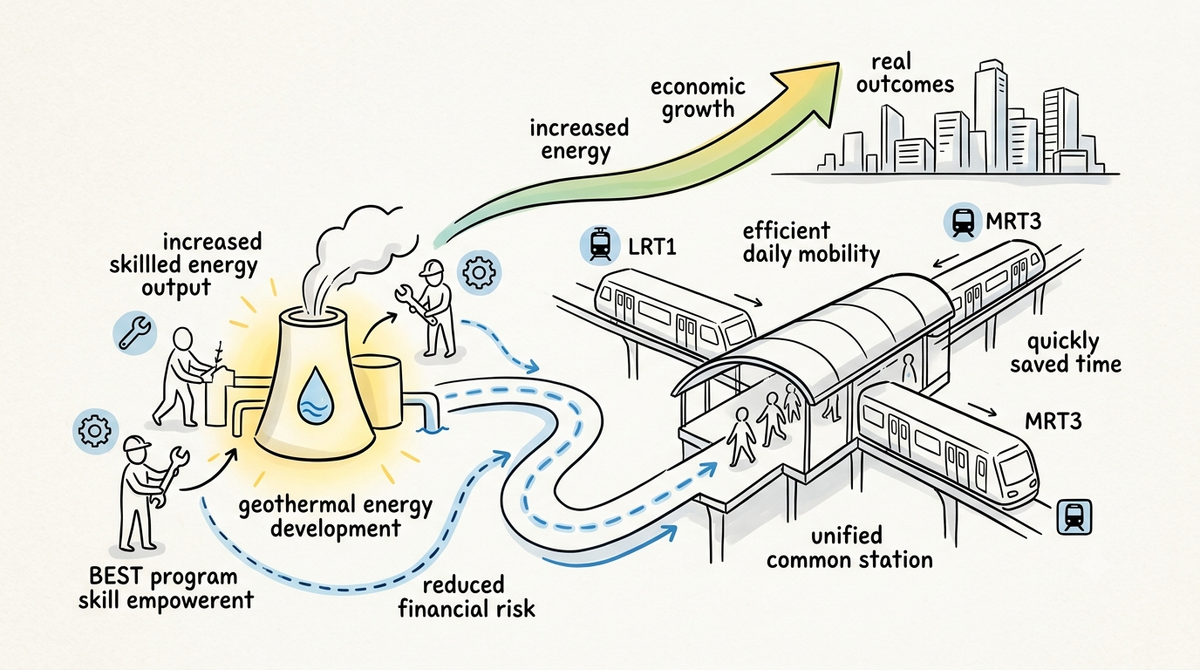
This is the ground-level context through which we must look at macro-level developments. Recently, the Investment Coordination Committee-Cabinet Committee (ICC-CC) approved four major public investment projects designed to address these very core pillars of daily life: transportation, technical employment, clean energy, and disaster resilience. The list includes the Light Rail Transit Line 1 (LRT-1) South Extension Common Station, the Technical Education and Skills Development Authority’s (TESDA) Boosting Employability in Strategic TVET Sectors (BEST) program, the Philippine Geothermal Resource Derisking Facility (PGRDF), and the Philippine Seismic Risk Reduction and Resilience Project (PSRRRP). All four projects are now being elevated to the Economy and Development (ED) Council for final approval.
To understand why this matters, we must look past the heavy technical titles and the multi-billion peso budgets. Consider the LRT-1 Common Station, which clears the way for a Unified Grand Central Station along North Avenue in Quezon City. On paper, it is a massive transport hub linking LRT-1, MRT-3, the incoming MRT-7, and the Metro Manila Subway under a single roof, projected to serve approximately 1.28 million passengers every single day.
But what does a unified station actually mean for a commuter? Right now, transferring between different train lines in the metropolis is an obstacle course. It requires exiting a station, walking along exposed, narrow sidewalks, dodging traffic, and paying multiple separate fares just to continue a single journey. It is a system that penalizes the worker for not owning a car. By integrating these four distinct rail lines into a single interchange, the project aims to slash transfer times and lower total commuting costs. When an infrastructure project functions seamlessly, it does something far more profound than moving bodies from point A to point B: it gives people back their time. Shorter commutes mean an extra hour of sleep, a chance to help a child with their homework, or the energy to pursue a side livelihood.
Similarly, the challenge of building a secure future is not just about having a transport network; it is about finding work that pays a living wage. Millions of young Filipinos and stay-at-home parents looking to re-enter the workforce face a frustrating paradox: while thousands of job openings exist in expanding industries, applicants often lack the specific, highly technical skills required to fill them.
This mismatch is what the newly cleared BEST program aims to dismantle. By expanding access to industry-aligned technical and vocational education and training (TVET) in high-demand fields like manufacturing, construction, information and communication technology (ICT), and agri-fishery, the program looks to bridge the gap between unemployment and opportunity. For a young adult who cannot afford a traditional four-year college degree, high-quality vocational training is a direct path toward financial independence, offering practical skills that lead to higher incomes and long-term career advancement.
True economic security, however, also requires a stable foundation beneath our feet. This is where the final two approved projects connect to the broader picture of community welfare. The Philippine Geothermal Resource Derisking Facility focuses on reducing financial risks for early-stage geothermal exploration to unlock private investment in renewable energy. For the ordinary household, this isn't an abstract environmental goal—it is a long-term strategy to protect families from soaring electricity bills and unpredictable rotating power outages by securing a cleaner, more reliable, and more affordable domestic energy supply.
Meanwhile, the Philippine Seismic Risk Reduction and Resilience Project directly targets our most vulnerable public spaces by retrofitting school buildings across Metro Manila against earthquakes and boosting disaster response capabilities. For every parent who waves goodbye to their child at the school gate each morning, knowing that the building has been structurally reinforced against a major disaster provides a form of security that no financial metric can fully capture.
This holistic approach to development—where transport, skills training, energy, and safety are advanced together—closely mirrors the challenges faced at the grassroots level. This pressing need for accessible, practical empowerment is precisely why community-based efforts, such as the BUKLURAN Bagong Simula Learning Program, focus so heavily on localized training sessions. While massive state-led initiatives like the BEST program build the nation's broader industrial talent pipeline, grassroots initiatives show that regular community learning sessions, digital literacy workshops, and financial awareness orientations are absolutely essential in preparing underserved individuals to take advantage of these emerging economic opportunities. True development requires a continuum: large-scale structural investments from the national government must connect seamlessly with accessible, community-level preparation so that no family is left behind.
Ultimately, public investments should never be judged solely by the scale of the structures they build, but by the burdens they lift from the shoulders of ordinary citizens. A grand central station is only as good as the minutes it saves a tired worker at the end of a long shift. A vocational program is only as successful as the stable income it brings to a struggling household. As these four major projects move closer to final implementation, the true measure of their success will be found not in corporate reports or political headlines, but in the quiet, everyday improvements in the lives of millions of Filipinos—more time with family, safer schools for our children, and a clearer path toward a dignified livelihood.
Bakit nga ba parang laging kulang ang oras natin sa pamilya? Para sa mga commuters at naghahanap ng trabaho, ang trapiko at kawalan ng tamang skills ay hindi lang abala—ito ay nakaw na oras at oportunidad. May mga bagong proyektong inaprubahan para sa transportasyon at livelihood training, ngunit ano nga ba ang totoong magiging epekto nito sa pang-araw-araw na buhay mo?
Power Our Mission, Shape the Future
We empower single parents, PWDs, youths, seniors, and stay-at-home parents through digital livelihood.
Help us build resilient communities.
BUKLURAN remains open to partnerships, sponsorships, and collaborative initiatives that create meaningful community impact.
Whether through funding, in-kind support, volunteerism, or shared services, your organization can help strengthen programs that serve underserved communities.
Do you want to take part in our free livelihood programs, scholarship assistance, and community resource pooling initiatives? Membership is completely free.
Join BUKLURAN!
Register, volunteer, and become a member today.