Small Baon, Big Future: Easing the Everyday Burden of Education
Every school day brings invisible hurdles for families. See how simple things like snacks and pencils can protect a child's education.
This article explores how basic, practical support helps underserved families keep their young children motivated and prepared for school days.
Introduction
If you walk through any neighborhood in the early morning, you will see a familiar routine. Doors open, slippers click against the concrete, and parents scramble to get their young children ready for school. There is a universal rhythm to it: fixing uniforms, hunting for a missing slipper, and the final, crucial step—handing over the daily baon.
For most families, this routine is filled with a sense of hope. We send our children to school because we believe that every notebook filled with sketches and letters is a stepping stone to a more stable life. We look at our young ones, trailing their oversized backpacks, and we tell ourselves that the hard work will pay off.
But if we look a little closer at this morning scene, we also notice the quiet calculations happening in the background. A parent stands by the doorway, looking into a coin purse, trying to figure out how to stretch a tight budget to cover the day's needs. It is an experience that countless ordinary Filipinos recognize all too well. It is the silent anxiety of making sure a child does not feel left out or hungry during the school day, balanced against the reality of rising everyday costs.
Why This Matters
When we talk about the challenges of education, our minds often jump to the big things: tuition fees, large institutional budgets, or the lack of classrooms. While those macro-problems are real, they are not always the immediate reasons a child might struggle to stay focused or why a parent might feel overwhelmed on a Tuesday morning.
In daily life, education is impacted by much smaller, more immediate barriers. It is about whether a child has a clean sheet of paper when the teacher says, “Bring out a cross-line notebook.” It is about having a small snack during recess so that a rumbling stomach does not distract from a math lesson.
For vulnerable households—such as single-parent families, stay-at-home parents trying to manage on a single income, households headed by senior citizens, or families caring for persons with disabilities (PWDs)—these small daily requirements add up rapidly. When resources are limited, a sudden request for a new box of crayons or the daily expense of putting together a snack pack can become a source of real pressure.
When these everyday necessities are missing, it subtly affects a child’s motivation. A student who goes to school without the necessary supplies or without a pocket full of snacks might feel hesitant, anxious, or less inclined to participate actively in class activities. Over time, these small barriers can accumulate, turning the joyful experience of early learning into a source of stress for both the parent and the child. Protecting a child’s education means finding ways to dismantle these tiny, everyday hurdles before they grow into insurmountable walls.
Connecting the Issue to Action
No single person can solve every institutional challenge in the educational system. However, as communities, we have always possessed a unique way of dealing with heavy loads: we divide the weight. This is the foundation of bayanihan—the understanding that when a neighbor is carrying a heavy bundle, we can offer a hand to make the walk a little easier.
When we shift our perspective from trying to fix everything at once to simply looking at what is right in front of us, practical pathways open up. We begin to ask: What if we could make sure that the children in our immediate neighborhood are simply prepared and motivated to walk into their classrooms every day? What if we could lighten the burden on the most vulnerable households so that they do not have to choose between a basic utility bill and a child's school kit?
This is exactly where organized, structured community action fits into the picture. Real development does not happen by imposing grandiose, unsustainable projects from the outside. Instead, it happens when local residents, volunteers, and mindful partners pool their focus and resources together to create simple, reliable support systems for the families living alongside them.
Program Spotlight
Recognizing these exact everyday pressures, the BUKLURAN Pabaon Program was established. As the Children’s Education Support Program of BUKLURAN NG KALINGA NG MAMAMAYANG DISTRITO SINGKO INC., its mandate is simple and deeply practical: to provide basic school support to children of members, focusing particularly on those in Kindergarten and Elementary school.
The program works by directly addressing the small, daily barriers that can disrupt early learning. Rather than offering sweeping promises, it focuses on ensuring that children are prepared, nourished, and motivated to learn when they arrive at school.
Here is how the initiative works on the ground:
- Core Objectives: The program exists to sustain educational motivation and reduce the out-of-pocket costs that burden underserved families. By covering the small essentials, it helps ensure that economic vulnerability does not stand in the way of basic primary education.
- Target Beneficiaries and Prioritization: The program serves the children of validated BUKLURAN members. Because resources are carefully managed, clear priority guidelines are in place to ensure support reaches those who need it most. Priority is given to single-parent households, families with persons with disabilities (PWDs), households headed by senior citizens, and low-income families within the community.
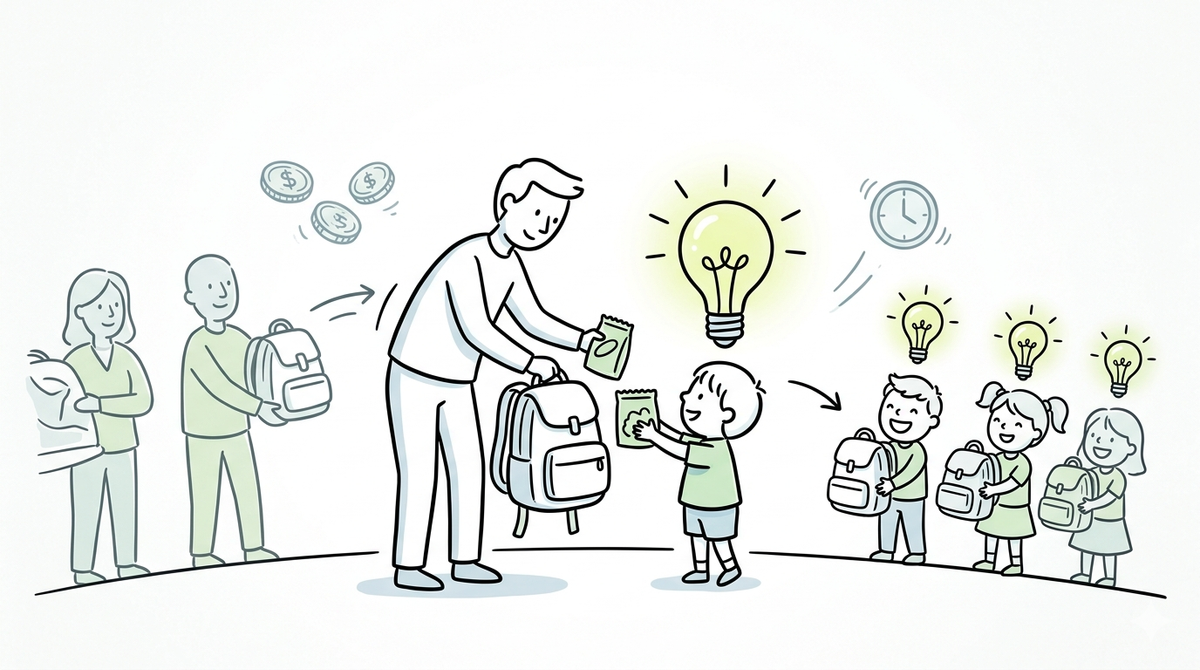
- Practical Support Packages: To maintain sustainability, the program targets a small but meaningful support value ranging from ₱1,500 to ₱2,500 per child per program cycle. This manifests through tangible support packages, such as:
- School Supplies & Learning Materials: Essential items like notebooks, pencils, and school kits so that students have the physical tools required for classwork.
- School Pabaon Support: Snack packs containing biscuits or healthy snacks intended for school days, ensuring children have energy during recess.
- Phased Implementation: The program is rolled out in structured batches (such as Batch 1 and Batch 2). It begins with small, tightly managed support mechanisms and expands gradually as community resources, volunteer capacity, and partnerships grow. This ensures every distribution event—often organized as community “Pabaon Day” events—is completely transparent, documented, and properly accounted for.
Community Perspective
What makes this system resilient is that it does not treat families as passive recipients of charity. Within the wider framework of the organization, education is viewed as one part of a shared ecosystem. While the Pabaon program protects the children, other initiatives support parents through livelihood participation, and the broader community through skills training. Everything is interconnected.
Because of this, community participation is the heartbeat of the program. The entire implementation relies heavily on a structured volunteer system where ordinary community members step forward. Neighbors volunteer to assist in packing the snack pouches, preparing the educational materials, coordinating the logbook lines during distribution drives, and documenting the program's outcomes to ensure complete transparency.
By participating actively, community members reinforce a vital message to their own youth: Your education matters to all of us, and we are working together to keep you in school. It shows that while an individual family might be navigating a difficult season, they do not have to stand completely alone against the daily costs of raising a student.
Conclusion
The morning rush will happen again tomorrow. Parents will count their coins, pack bags, and send their children off with a quiet prayer for a brighter future. The challenges of poverty and limited economic opportunities cannot be solved overnight, but the hurdles that prevent a young child from happily entering a classroom can be managed, one notebook and one snack pack at a time.
By focusing on small, sustainable, and transparent community actions, we protect the fragile spark of curiosity in our youngest learners. It reminds us that real progress does not always require massive, disruptive shifts. Sometimes, it looks like a community gathering on a weekend to make sure that come Monday morning, every child walks to school with a full backpack, a nourished body, and the quiet confidence that their community has their back.
Alas-sais na naman ng umaga. Kasabay ng pag-gising ng mga bata ang pagkuwenta natin sa pitaka: sapat ba ang baon? Kasya ba ang notebook? Sa hirap ng buhay ngayon, ang maliit na gastusin sa eskwela ay mabigat na pasanin para sa maraming pamilya. Pero alam niyo bang pwedeng pagaanin ang pasaning ito kung magtutulungan ang komunidad? Basahin sa ating bagong blog kung paano binabago ng tamang pag-gabay at simpleng suporta ang kinabukasan ng ating mga mag-aaral. Ano ang kwentong baon ng iyong anak? Let's talk!
Power Our Mission, Shape the Future
We empower single parents, PWDs, youths, seniors, and stay-at-home parents through digital livelihood.
Help us build resilient communities.
BUKLURAN remains open to partnerships, sponsorships, and collaborative initiatives that create meaningful community impact.
Whether through funding, in-kind support, volunteerism, or shared services, your organization can help strengthen programs that serve underserved communities.
Do you want to take part in our free livelihood programs, scholarship assistance, and community resource pooling initiatives? Membership is completely free.
Join BUKLURAN!
Register, volunteer, and become a member today.