The Cost of the Dream: When Family Expectations and Personal Future Clash
When a child’s dream clashes with a family’s survival, how do Filipino families navigate the heavy price of educational choices?
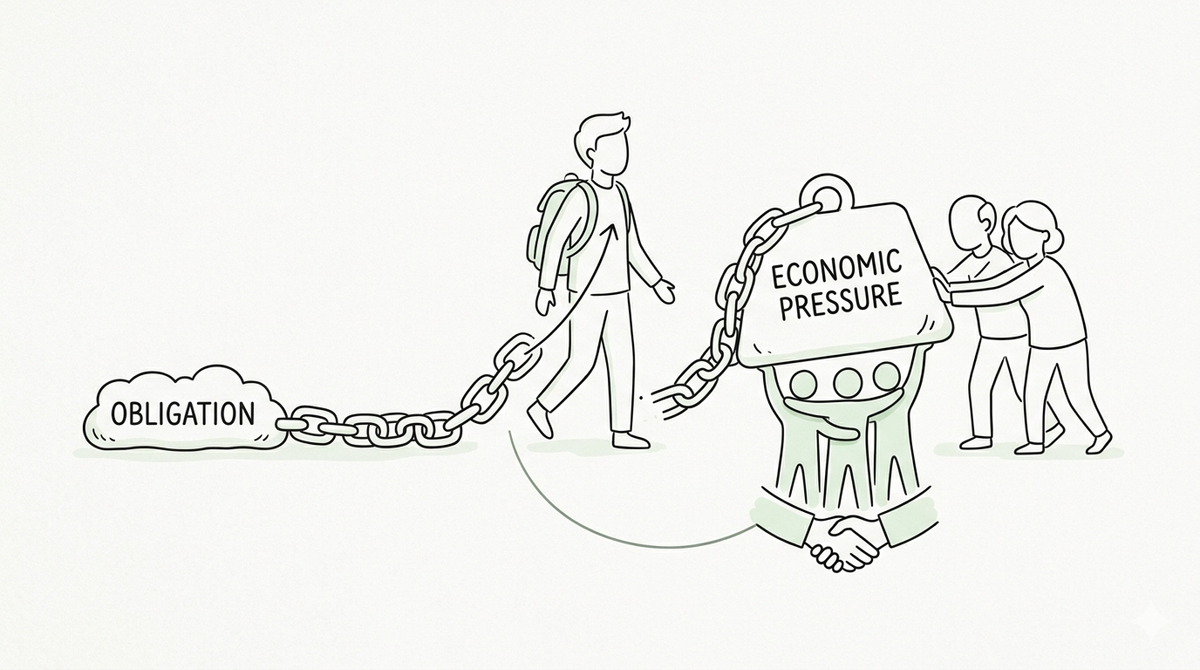
The article explores the silent, structural pressure Filipino youth face when balancing personal career aspirations with family financial obligations, using a generational clash to analyze broader economic realities.
Every evening across the Philippines, thousands of families gather around dinner tables where an unspoken ledger is laid out. It is a ledger written not in ink, but in years of labor, sacrificed comforts, and deferred dreams. For many Filipino parents, a child’s education is the ultimate investment—the lone definitive ticket out of generational financial vulnerability. But what happens when the child, standing on the precipice of adulthood, realizes that the path chosen for them is a coat that does not fit?
Consider the quiet tension that arises when a young student—perhaps nineteen years old, sitting over a mountain of heavy medical textbooks—looks at her mother and confesses she wants to take a different path. To the student, it is an issue of authenticity, mental well-being, and personal direction. To the mother, who has carefully distributed the family’s lean financial resources to afford those very textbooks, it feels like a sudden disruption to a fragile survival strategy. This is not just a domestic misunderstanding; it is a profound structural dilemma faced by countless households across our communities. It exposes a painful friction where emotional realities, generational expectations, and economic pressures collide.
To understand this conflict, one must look closely at the unique anatomy of the Filipino family economy. Unlike highly individualistic societies where children are expected to fully decouple financially from their parents upon reaching legal adulthood, the Filipino household typically functions as a collective economic unit. In this ecosystem, resources are pooled, and individual milestones are intrinsically linked to collective survival. When a family invests in a high-cost professional track like medicine, nursing, or engineering, it is rarely viewed merely as an individual career choice. Instead, it is frequently treated as a long-term community project. The older child is often silently designated as the future economic anchor who will eventually lift the younger siblings, shoulder medical bills for aging parents, and provide stability to the home.
When a young adult seeks to alter this trajectory, the immediate implication is an economic shock wave within the household. It forces an agonizing reallocation of lean resources. Money already spent on specialized tuition or institutional fees feels lost in a landscape where there is no margin for error. Furthermore, it creates deep anxiety about the siblings left in the queue. If the eldest student derails the expected timeline by switching paths or stepping back, what happens to the high schooler whose future enrollment depended on the eldest starting to earn? The conflict is rarely about a lack of love; it is about the acute scarcity of alternative options.
This structural pressure reveals why faster economic growth indices or sweeping macroeconomic announcements don't automatically translate to peace of mind at home. When the safety nets of a society are thin, the family is forced to become the health insurance, the pension fund, and the unemployment office all at once. In such an environment, an individual's career path becomes heavily weighted by structural necessity. The young student is caught in a paralyzing paradox: pursuing her personal aspiration feels like an act of profound ingratitude, while continuing down the mandated path ensures a lifetime of quiet resentment and potential professional burnout.
The human impact of this dynamic ripples across generations. For the youth, the mental toll of carrying a family's collective future can be crushing. When a student goes to school not out of a passion for discovery but out of a desperate sense of obligation, their relationship with learning becomes transactional and anxious. They face an intense fear of failure because a failing mark is not just a personal setback—it is a financial blow to the people they love most. Conversely, for the parents—especially solo parents or stay-at-home mothers navigating volatile livelihoods—the resistance from a child can feel terrifying. It looks like a rejection of their sacrifices, leaving them to wonder who will protect the family when they are no longer able to work.
Resolving these deep-seated generational clashes requires moving away from defensive posturing and toward a framework of shared responsibility and open communication. It demands that families find a way to talk about numbers and emotions in the same breath, without resorting to blame. Young adults must find the courage to express their gratitude for the sacrifices made, while calmly laying out realistic, alternative steps that respect the family’s economic realities. Parents, on the other hand, are challenged to see their children not as financial risk-mitigation instruments, but as individuals who require sustainable paths to thrive. Compromise might mean finding shorter, alternative learning tracks, adjusting timelines, or seeking secondary support mechanisms that alleviate the immediate pressure on the household.
This delicate balance between supporting the next generation's growth and managing everyday household strain reflects why community-based ecosystems are so vital. When structural vulnerabilities press hard against families, isolated households struggle to bear the weight alone. This overarching challenge is precisely why holistic community-based frameworks matter. When initiatives are designed to address the interconnected needs of multiple generations simultaneously—such as easing the day-to-day educational barriers for young learners while creating cooperative economic participation for parents—the intense pressure on any single individual begins to diffuse.
For instance, simple community efforts like providing basic learning materials or snack packs through initiatives like the BUKLURAN Pabaon Program help chips away at the daily cost of keeping younger children in school. Simultaneously, helping parents lower household expenses through cooperative purchasing systems at a local pickup point, such as the BUKLURAN HUB, allows families to retain a fraction of their hard-earned income. When the community steps in to share the burden of basic survival, a family gains a small breathing room. That small margin can be the difference between forcing a child into an agonizing career choice out of sheer panic, or having the stability to sit down, listen, and plan a sustainable future together.
Ultimately, the goal of navigating these family conflicts is not to determine who wins or loses the argument. The goal is to preserve the fabric of the family while honoring the potential of the youth. We must move toward a society where a young person's education is an avenue for discovery and community contribution, rather than a heavy chain of economic survival. Until wider structural safety nets are realized, the path forward lies in the quiet, empathetic spaces we build within our homes and the cooperative structures we foster within our neighborhoods. By learning to distribute both our resources and our expectations with compassion, we ensure that the dreams of our youth do not have to be purchased at the price of our families' harmony.
Bakit nga ba madalas magkasalubong ang pangarap ng anak at ang kakayahan ng pamilya? Kapag ba pinili mo ang sarili mong landas, ibig sabihin ba nito ay hindi ka na nagpapasalamat sa sakripisyo ng iyong mga magulang?
Power Our Mission, Shape the Future
We empower single parents, PWDs, youths, seniors, and stay-at-home parents through digital livelihood.
Help us build resilient communities.
BUKLURAN remains open to partnerships, sponsorships, and collaborative initiatives that create meaningful community impact.
Whether through funding, in-kind support, volunteerism, or shared services, your organization can help strengthen programs that serve underserved communities.
Do you want to take part in our free livelihood programs, scholarship assistance, and community resource pooling initiatives? Membership is completely free.
Join BUKLURAN!
Register, volunteer, and become a member today.