The Hidden Map Behind the Billions: Why Big Corporate Moves Matter at Home
When a corporate giant moves billions, the real story isn't on the stock exchange—it’s in the changing landscape of our local communities.
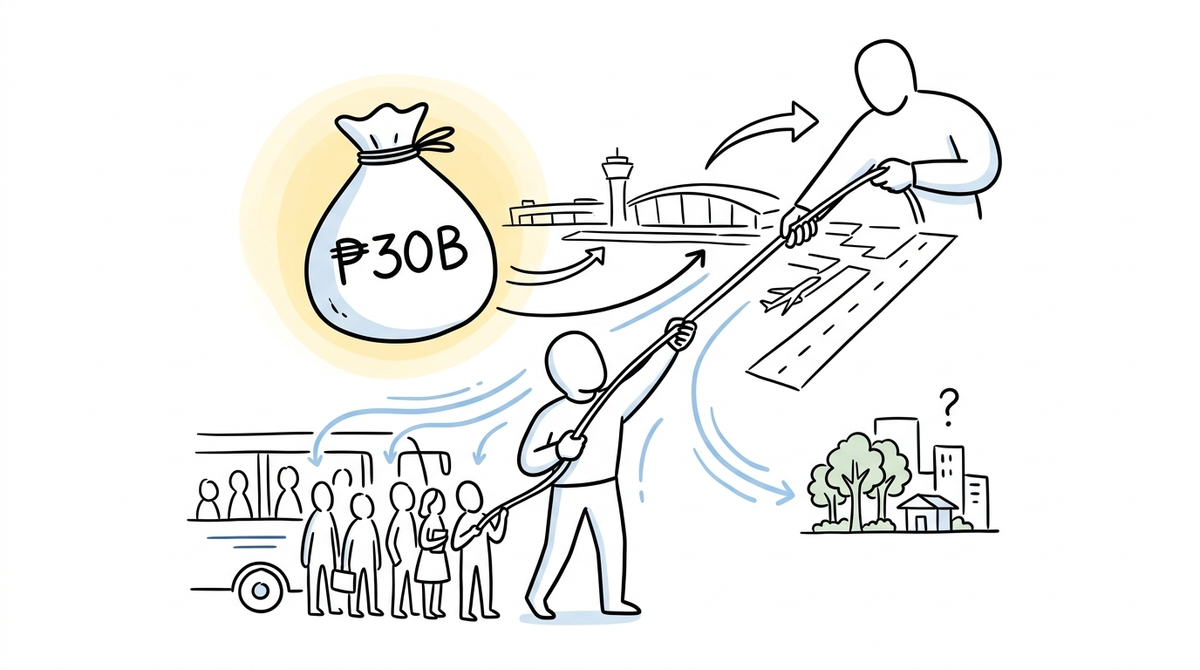
While big financial moves look abstract on paper, their true impact lies in how they shape local employment, community displacements, and the everyday commute of ordinary Filipinos.
Every single day, millions of Filipinos wake up before dawn to face a familiar ritual. It is the calculation of time against traffic—estimating whether leaving the house at five in the morning instead of five-thirty will save them an hour of gridlock on the way to work or school. We measure our days not in kilometers, but in patience. Parents whisper quiet goodbyes to sleeping children, and workers squeeze into overflowing public transport, all bound by a collective desire for a country that simply moves faster and breathes easier.
Against this backdrop of daily endurance, news headlines often report on a completely different world—one populated by massive figures, financial instruments, and corporate boardrooms. Recently, San Miguel Corporation (SMC) filed a registration statement for a ₱30-billion preferred share offering. On paper, the language is dense and sterile: it is about refinancing debt, settling maturing bonds, and funding massive capital expenditures. To the average commuter waiting for a delayed jeepney under the scorching sun, a ₱30-billion corporate transaction sounds like abstract math happening on a cloud far above their reality.
Yet, these two worlds are deeply connected. The money raised in these financial markets is the exact fuel used to alter the physical geography of our neighborhoods. A large portion of these billions is earmarked for massive infrastructure developments, specifically the ongoing construction of the New Manila International Airport in Bulacan. When a company moves an amount of money that could fund small cities, it isn't just balancing a ledger. It is drawing a new map for the country—one that will directly dictate where future jobs will be, whose lands will be transformed, and whether the next generation will still spend their youth stuck in traffic.
Translating the Corporate Ledger
To understand why an ordinary citizen should care about preferred shares and debt refinancing, we have to look past the financial jargon. When a major conglomerate issues preferred shares, they are essentially inviting investors to lend them an immense amount of money in exchange for fixed dividend payments. It is a tool for raising massive capital without giving up voting control of the company.
For the economic system, this is a sign of deep corporate momentum. It shows that large financial institutions still have the confidence to back mega-projects. But for the public, the real focus must shift from how the money is raised to where the money goes.
When financial resources are funneled into large-scale infrastructure, it sets off a domino effect through the local economy. In the short term, it creates an immediate demand for labor, raw materials, and local services. In the long term, it aims to relieve the choking congestion of Metro Manila's existing gateways. The busy professional, the small-scale merchant, and the overseas Filipino worker (OFW) looking forward to a smoother homecoming all have a stake in whether these projects succeed or stumble. The efficiency of our national infrastructure directly dictates the cost of bringing food to metropolitan markets and the amount of time a father gets to spend with his family at the end of the week.
The Realities on the Ground
However, infrastructure is never just a matter of pouring concrete and laying down runways. Mega-projects do not happen in a vacuum; they happen in living, breathing ecosystems. The construction of a massive airport complex in Bulacan represents a profound shift for the communities that have called those coastal and agricultural areas home for generations.
For a local fisherman or a farming family in the province, a new airport isn't just a promise of modern travel. It represents a fundamental disruption to their livelihood. When coastal areas are reclaimed or modified, traditional fishing grounds can change, and families are often required to relocate and adapt to an entirely new way of living. The promise of economic progress must always be weighed against the immediate, human cost of displacement.
This tension reveals the dual nature of massive development:
- The Promise: The creation of thousands of construction and service jobs, booming local businesses, increased land values, and a modernized transport hub that connects the Philippines more efficiently to the world.
- The Peril: The loss of traditional livelihoods, environmental pressures on fragile coastal ecosystems, and the risk that ordinary locals might be left behind if they do not possess the highly technical skills required by a modern aviation economy.
True development cannot be measured solely by the height of a terminal or the length of a runway. It must be evaluated by how well the most vulnerable members of the community are supported during the transition. If a project creates billions in value but leaves the surrounding neighborhoods struggling to find clean water or steady income, the growth is uneven.
Infrastructure as a Shared Social Responsibility
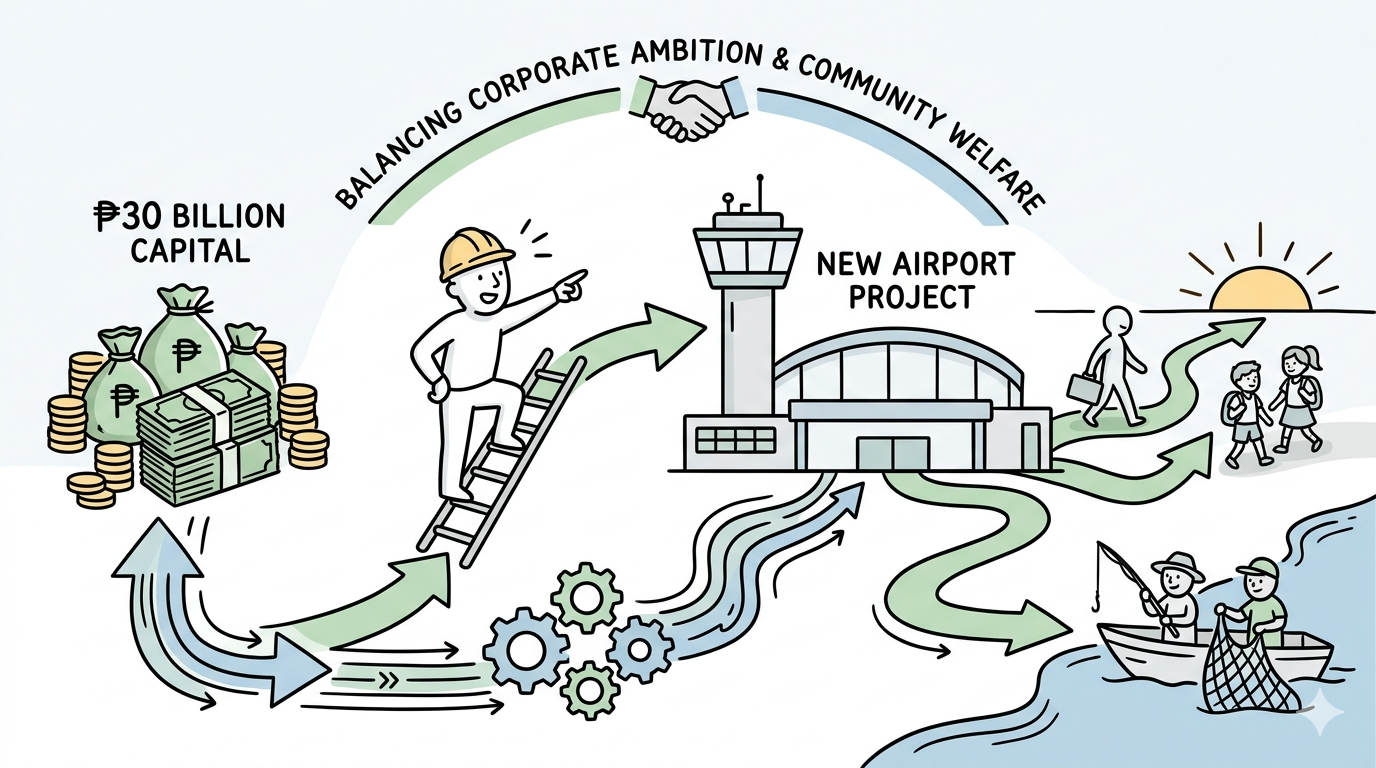
This balance between corporate ambition and community welfare highlights a vital reality: large-scale developments are not just business ventures; they are matters of public interest. When private entities take on the role of building major public utilities like airports and highways, they are essentially shaping the public ecosystem.
This intersection reflects why community-based efforts and localized social welfare monitoring matter so deeply. In any developing landscape, there is a constant need for independent, grassroots observation to ensure that as big industries move in, basic human rights, environmental protections, and fair compensation are strictly maintained. Community development programs play a critical role in helping displaced families learn new skills, transitioning them from traditional livelihoods like fishing to new economic opportunities in construction, tourism, or logistics. Without these social safety nets, the gap between the corporate boardroom and the rural household only grows wider.
Progress is necessary. The Philippines desperately needs modern infrastructure to break the transport bottlenecks that stunt our economic growth and drain our citizens' energy. But this progress must be inclusive. The workers building the infrastructure, the families living on its borders, and the citizens whose daily commutes are affected by these changing landscapes deserve to be active participants in this growth, not just spectators.
Looking Toward the Horizon
When we read about the next multi-billion peso deal on the business pages, we should train ourselves to look for the human faces behind the numbers. The true value of that ₱30 billion will not be determined by the stock market performance or the interest rates negotiated with the banks.
The ultimate test of these billions lies in the answers to very simple, human questions: Will a mother in Bulacan find a stable, decent-paying job at the new airport complex that allows her to provide for her children? Will the small business owner in Manila see their shipping costs go down because transport networks have become more efficient? Will the coastal families who had to give up their lands be given genuine opportunities to thrive in a changing world?
Economic growth is a powerful engine, but it must have a conscience. As our skyline changes and new gateways rise, the ultimate goal must always remain clear: to build a nation where progress does not come at the expense of the people, but rather serves as the very ladder that lifts everyone up together.
Talaga bang para sa lahat ang pagdating ng mga electric vehicles sa bansa natin? May mga malalaking kumpanya na nagpaplanong magtayo ng local EV brand sa Pilipinas. Magandang pakinggan, pero ano nga ba ang magiging totoong epekto nito sa bulsa ng mga ordinaryong commuter at kabuhayan ng mga tsuper? Kakayanin ba nitong ibaba ang pamasahe at gastusin sa pamilya?

Power Our Mission, Shape the Future
We empower single parents, PWDs, youths, seniors, and stay-at-home parents through digital livelihood.
Help us build resilient communities.
BUKLURAN remains open to partnerships, sponsorships, and collaborative initiatives that create meaningful community impact.
Whether through funding, in-kind support, volunteerism, or shared services, your organization can help strengthen programs that serve underserved communities.
Do you want to take part in our free livelihood programs, scholarship assistance, and community resource pooling initiatives? Membership is completely free.
Join BUKLURAN!
Register, volunteer, and become a member today.