The Hidden Price Tag on Our Daily Digital Escape
Beyond corporate tech announcements lies a deeper story about how everyday Filipino families balance digital entertainment and household survival.
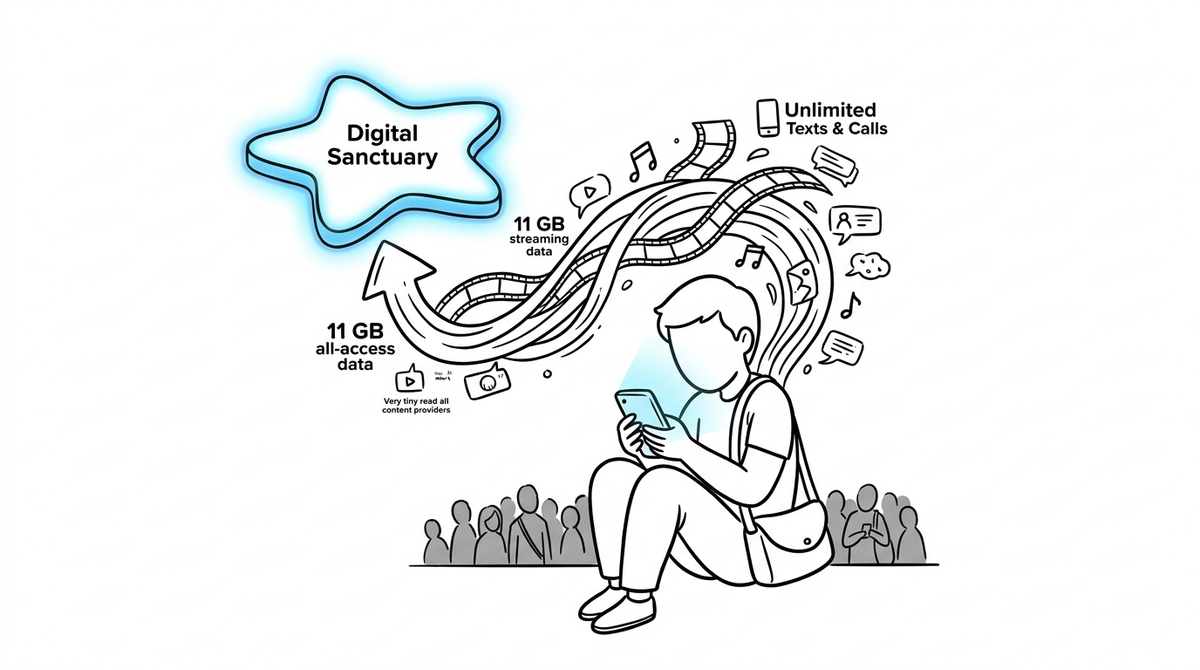
The launch of affordable, streaming-centric mobile data packages highlights how digital entertainment has become an essential household need for ordinary Filipinos, shifting both family budgets and telecom competition.
Imagine a typical evening inside a packed city bus creeping along the gridlocked stretches of EDSA, or a slow-moving jeepney navigating the humid streets of a provincial capital. The environment is loud, exhausting, and cramped. Yet, if you look closely at the passengers, a striking pattern emerges. Almost every head is bowed, illuminated by the pale blue glow of a smartphone screen. A retail worker watches a short-form drama clip; a construction builder catches up on local news; a university student streams an episode of a series to forget the stress of an upcoming exam. This is the modern ritual of the Filipino commute—a collective, silent effort to escape the grueling realities of daily traffic and exhausting work hours through digital media.
For the ordinary Filipino household, the smartphone has transformed from a mere communication tool into a vital emotional sanctuary. But this sanctuary is not free. Every minute of video watched, every song streamed, and every message sent represents a direct financial calculation. In a landscape where inflation has steadily pushed up the cost of rice, utilities, and basic transportation, mobile data has quietly integrated itself into the monthly family ledger. It is no longer an optional luxury; it is a fixed utility that families must negotiate against their primary survival needs. This silent renegotiation of the household budget changes how we view entertainment, connectivity, and consumer choice.
This deep-seated reality forms the backdrop for the latest development in the country’s telecommunications sector. DITO Telecommunity recently announced the nationwide rollout of its new prepaid lineup called "StreamZone," highlighted by its entry-level package, StreamZone199. For ₱199, a prepaid subscriber receives a bundle valid for 30 days that splits its data allocation into two parts: 11 gigabytes (GB) of all-access data and another 11 GB dedicated purely to streaming activities. It also includes unlimited mobile calls and text messages to all networks, data rollover features, and free 30-day access vouchers to streaming platforms such as Prime Video Mobile, iWant, and BLAST TV, while supporting other popular networks like Netflix, VivaMax, and iQIYI.
To the casual observer, this is just another corporate product launch, a standard entry in the ongoing marketing wars between the Philippines' major telecom providers. For years, the industry was dominated by a long-standing duopoly, leading to widespread consumer complaints regarding high costs and inconsistent service. The entry of a third player was legally and socially framed as a way to disrupt the market, drive down consumer expenses, and force innovation through direct competition. Offers like this new prepaid bundle represent the tangible manifestation of that corporate rivalry, shifting away from generic data packages toward highly targeted, lifestyle-oriented bundles aimed at capturing the everyday consumer.
When we look beyond the corporate press releases and the promotional launch events, this new development reveals a deeper narrative about how the digital economy is reshaping the economic choices of ordinary Filipinos. A ₱199 monthly package that integrates entertainment access tells us that telecom companies have realized a crucial truth: Filipinos do not just want connectivity to check work emails or send messages; they consume data primarily as a cultural and psychological liferaft.
This shift highlights a broader transition from traditional broadcast media to a mobile-first digital environment. Historically, the Filipino working class relied on free-to-air television for evening entertainment and news. However, the changing media landscape, coupled with the convenience of on-demand content, has migrated that collective experience onto small five-inch screens. This mobile-first shift democratizes access to global entertainment, but it also privatizes the cost. Entertainment is no longer funded by network advertisers on a shared living room television; it is paid for directly out of the pocket of the individual prepaid subscriber.
The introduction of data rollover features in these packages also points to an evolution in consumer rights within the digital space. For years, prepaid users felt penalized by rigid expiration dates that swallowed up unused data that they had already paid for with their hard-earned money. When a promo allows leftover gigabytes to carry over into the next month, it shifts the power dynamics slightly back to the consumer. It acknowledges that digital consumption is fluid; a worker might have an intense week where they barely have time to look at their phone, followed by a weekend where they need to catch up on everything. This flexibility prevents the quiet financial bleeding that low-income users frequently experience when navigating prepaid services.
However, the introduction of aggressive pricing structures raises critical questions about structural barriers and actual consumer value. While an affordable price tag is a welcome development for cash-strapped consumers, the utility of any data package remains entirely dependent on the physical infrastructure supporting it. A budget-friendly promo loses its value if a user living in a dense urban settlement or a remote rural barangay experiences constant buffering, weak signal reception, or dead zones. True value in the telecom sector cannot be measured solely by the low cost of a registration code; it must be backed by consistent, high-quality infrastructure that ensures equity of access across different socio-economic topographies.
To understand why these minor adjustments in telecom pricing matter, one must look at the kitchen tables where household budgets are painstakingly calculated. Consider the perspective of a single parent working a minimum-wage job in the service sector. Every single peso must be accounted for. When digital entertainment and communication become essential for a child’s school research or a parent’s sanity after a twelve-hour shift, an unexpected surge in data costs can disrupt an entire week’s financial planning. A predictable, low-cost monthly bundle provides a rare measure of financial predictability. It allows a household to secure a month's worth of basic digital lifestyle needs for less than the cost of two kilograms of premium rice, preserving remaining funds for nutrition, medicine, and education.
For the country’s massive gig economy workers—such as delivery riders, ride-hailing drivers, and freelance couriers—data is literally the lifeblood of their livelihood. These workers spend long, exhausting hours on the road or waiting in commercial zones for their next notification. For them, a phone is not a distraction; it is an office, a map, and a companion. Affordable data packages that bundle entertainment alongside unlimited communication tools directly alleviate their daily operational expenses. It allows them to stay connected with their families and unwind during forced downtimes without worrying that their data allocation will run out before their shift ends.
We must also consider the multi-generational household, a staple of Filipino community life. In many homes, a single smartphone is shared among several family members. Grandparents use it to video-call relatives working abroad as Overseas Filipino Workers (OFWs), parents use it to monitor local market prices or find side gigs, and children use it for entertainment and homework. When data bundles become more affordable and comprehensive, it reduces the friction within these households. It alleviates the subtle tension of a child being told to stop watching a video because it drains the family's shared load, or a grandparent waiting days to speak to their child overseas because the family cannot afford to top up. In essence, lower data barriers help preserve the emotional threads that keep fractured, long-distance Filipino families intact.
The younger generation of Filipinos, particularly students from low-income backgrounds, also experience the direct impact of these market shifts. For these individuals, the line between academic utility and personal leisure is heavily blurred. The same smartphone used to access online learning modules during the day becomes the tool for social interaction and cultural consumption at night. When data is tightly rationed due to high costs, young people are forced to make uncomfortable choices between studying effectively and participating in the digital social circles that define their peer relationships. Affordable, comprehensive data allocations help mitigate this hidden form of digital isolation, allowing youth to engage with the modern digital world on more equitable terms.
When we step back and examine these dynamics from a community-wide perspective, it becomes clear that digital connectivity is no longer just a technical issue—it is a cornerstone of modern community development and social welfare. The way ordinary citizens navigate data costs reflects a larger, ongoing struggle for digital literacy and inclusion across the archipelago. Grassroots communities are increasingly relying on digital networks to organize local initiatives, share public safety alerts during typhoon seasons, and sustain informal neighborhood economies.
When telecommunications companies are pushed by market competition to lower barriers to entry and offer more comprehensive packages, the positive externalities extend beyond individual entertainment. It strengthens the community's collective digital resilience. A neighborhood where residents can afford to stay consistently online is a neighborhood that can communicate faster in emergencies, access public health information more reliably, and participate more actively in local governance conversations. The commercial push for entertainment-heavy bundles inadvertently underscores a fundamental public reality: consistent, affordable access to the digital highway is an absolute prerequisite for equitable community advancement in the modern age.
The evolution of the Philippine telecom landscape, characterized by the introduction of budget-friendly, entertainment-linked data packages, serves as a mirror to our current social realities. It reminds us that behind every statistic of data consumption, and beneath every corporate milestone celebrated in corporate boardrooms, are real people seeking small moments of joy, relief, and connection in an otherwise demanding world. Cheaper data and bundled entertainment are undeniable victories for the consumer’s wallet, offering temporary relief to millions of hardworking Filipinos.
Yet, as we log on, stream our favorite shows, and benefit from the competitive friction between massive telecom corporations, a larger question remains for us to ponder as a society. If the private sector can innovate and lower costs to make digital entertainment universally accessible and affordable, how far are we as a nation from applying that same urgency, affordability, and infrastructure quality to the things that matter most—such as public education, universal healthcare, and basic civic services? True progress is achieved when the seamless accessibility we enjoy on our mobile screens finally reflects the standard of living we experience in our physical communities.
Bakit nga ba kahit anong kayod natin, tila kulang pa rin ang sweldo para sa mga simpleng pampalipas-oras? Sa panahon ngayon, ang load sa cellphone ay hindi na lang luho kundi naging kasing-halaga na ng bigas at pamasahe. Pero habang nagpapakitang-gilas ang mga telco sa pagbibigay ng mas murang promo, ano nga ba ang totoong kapalit nito sa ating pang-araw-araw na pamumuhay at pamilya?

Power Our Mission, Shape the Future
We empower single parents, PWDs, youths, seniors, and stay-at-home parents through digital livelihood.
Help us build resilient communities.
BUKLURAN remains open to partnerships, sponsorships, and collaborative initiatives that create meaningful community impact.
Whether through funding, in-kind support, volunteerism, or shared services, your organization can help strengthen programs that serve underserved communities.
Do you want to take part in our free livelihood programs, scholarship assistance, and community resource pooling initiatives? Membership is completely free.
Join BUKLURAN!
Register, volunteer, and become a member today.