The Light in Our Trash: The Human Cost and Promise of Turning Garbage into Power
Turning garbage into electricity sounds like a perfect solution for our mounting trash. But what happens when these plants open near you?
While expanding waste-to-energy targets aims to address the twin crises of trash disposal and high electricity rates, its true success depends on whether local communities are protected from environmental risks and included in the benefits.
Every morning, the sound of plastic rustling and broom bristles scraping against concrete signals the start of the daily routine for millions of Filipino households. Sweeping the yard, tying up trash bags, and leaving them by the curb is an act of closure—once the garbage truck rolls away, the waste becomes someone else’s problem. For decades, that "somewhere else" meant rapidly filling landfills, open dumpsites, or, worst of all, the esteros and rivers that flood our streets during typhoons.
At the same time, another daily anxiety plays out when the monthly electric bill arrives. Families sit around kitchen tables, scrutinizing the kilowatt-hour charges, wondering why a country surrounded by natural resources still suffers from some of the highest power rates in Asia.
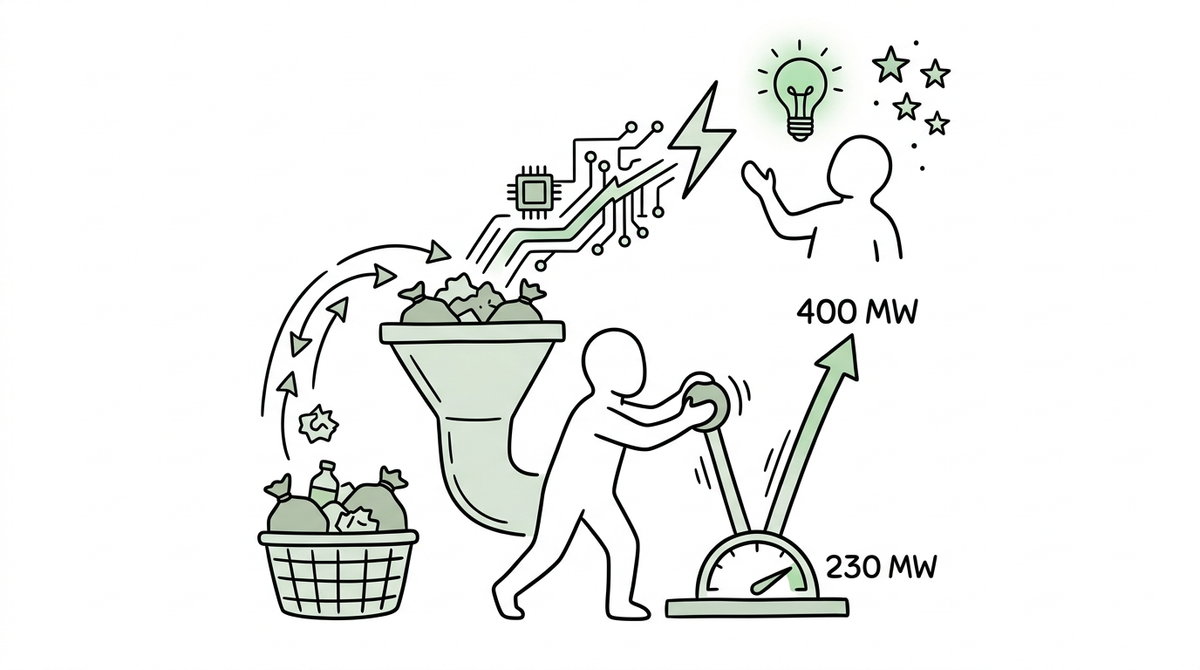
Recently, the Department of Energy (DOE) announced a major policy shift that attempts to hit both of these problems at once. The government nearly doubled its target for "waste-to-energy" (WTE) projects under its Green Energy Auction Program, raising the goal from 230 megawatts to 400 megawatts. In simple terms, the state is inviting large companies to build specialized facilities that take local municipal garbage, burn or process it, and convert the resulting heat into electricity for the grid.
On paper, it sounds like a flawless victory. We get rid of the mountain of plastic bags clogging our waterways, and we generate electricity to keep our lights on. But move beyond the corporate press releases and the technical jargon of Department Circulars, and a critical question emerges: What does turning trash into power actually mean for the ordinary Filipino living near these proposed plants?
To understand the reality of waste-to-energy, one must understand how a typical neighborhood functions. In many urban and peri-urban communities, garbage is not just waste; it is an informal economy. Thousands of informal waste pickers, junk shop owners, and neighborhood segregators make a living by sorting through what others throw away. They rescue cardboard, copper wires, and plastic bottles, feeding them back into the recycling loop.
When a massive waste-to-energy plant enters the picture, it requires a steady, massive stream of high-calorie waste—mostly plastics and dry materials—to keep its furnaces running efficiently. If the high-value recyclables are diverted entirely to fuel these multi-million dollar plants, the vulnerable sector of community-based waste pickers stands to lose their meager livelihoods overnight.
Furthermore, there is the lingering question of environmental safety. Modern waste-to-energy technologies are highly advanced, utilizing complex filtration systems to trap toxic ash and harmful gases like dioxins. However, the anxiety among local mothers and health workers is rarely about what the technology can do, but rather how tightly it will be regulated. In a country where environmental monitoring can sometimes be inconsistent due to lack of local government resources, residents worry about the long-term quality of the air their children breathe. If a facility is built near a residential area, will local health centers be equipped to monitor respiratory trends? Will the promised reduction in garbage translate to cleaner neighborhoods, or simply shift the pollution from the ground into the sky?
Yet, the promise of this development cannot be dismissed entirely. If executed with strict transparency and community safeguards, waste-to-energy could offer a lifeline to municipalities running out of land for dump sites. Traditional landfills emit massive amounts of methane, a greenhouse gas that traps heat in our atmosphere and worsens the intense typhoons ravaging our archipelago. Diverting trash to tightly monitored energy plants could significantly reduce these emissions while offering a stable, "baseload" source of renewable energy—unlike solar or wind power, garbage is something the Philippines produces consistently, rain or shine.
For consumers, the DOE’s decision to extend deadlines and attract more bidding companies is intended to drive competition. When more companies compete to supply this energy, it can drive down the cost per kilowatt-hour, potentially offering relief to households struggling with inflation. But this relief is only real if the savings are passed down to the consumer, rather than absorbed by distribution utilities and project developers.
This complex intersection of environment, health, and economy reflects why community-based efforts around grassroots ecological governance matter. When local neighborhoods are organized, informed, and actively involved in monitoring their own environment, large-scale infrastructure projects are forced to adapt to human needs. Sustainable development cannot be handed down through top-down directives alone; it requires local mechanisms where residents can voice concerns, demand air quality data, and ensure that their neighborhoods do not bear the environmental costs of powering the rest of the city.
Ultimately, the shift toward a 400-megawatt waste-to-energy target is a reminder that technology is only as good as its impact on the ground. As these facilities begin to take shape across the provinces, ordinary citizens must look beyond the novelty of turning garbage into light. We must ask whether these systems respect the health of our children, protect the livelihoods of the poorest workers, and genuinely lower the bills of the households funding them. True progress isn't just about generating more power; it’s about making sure no community is left in the dark to produce it.
Lahat tayo masaya kapag nababawasan ang basura sa ating komunidad, lalo na kung gagamitin pa ito para magkapasiklab ng kuryente. Pero naisip ba natin kung ano ang mangyayari sa hangin na nilalanghap ng ating mga anak kapag itinayo na ang mga dambuhalang waste-to-energy plant malapit sa ating mga bahay? May magandang balita nga ba sa pitaka natin, o may kaakibat itong banta sa kalusugan ng pamilya?

Power Our Mission, Shape the Future
We empower single parents, PWDs, youths, seniors, and stay-at-home parents through digital livelihood.
Help us build resilient communities.
BUKLURAN remains open to partnerships, sponsorships, and collaborative initiatives that create meaningful community impact.
Whether through funding, in-kind support, volunteerism, or shared services, your organization can help strengthen programs that serve underserved communities.
Do you want to take part in our free livelihood programs, scholarship assistance, and community resource pooling initiatives? Membership is completely free.
Join BUKLURAN!
Register, volunteer, and become a member today.