The Premium Lens: What Today’s Smartphone Race Asks of the Filipino Household
Flagship camera specs are hitting the local market, but for everyday families, the real digital conversation isn't about luxury lenses.
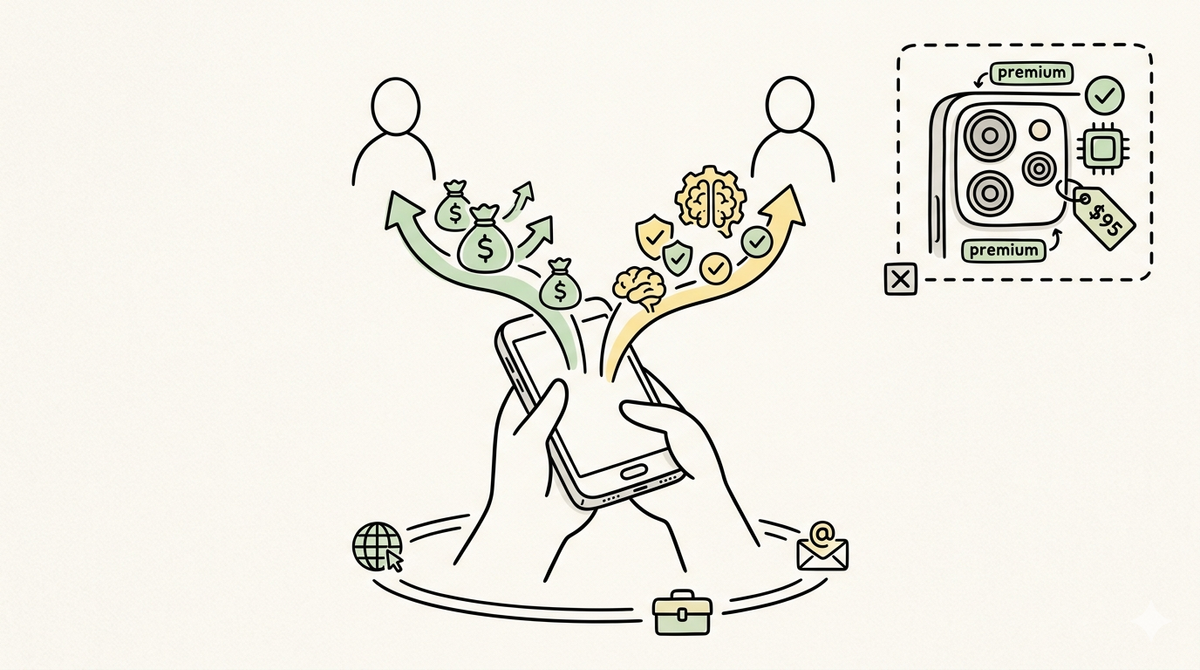
While advanced mobile camera technology reshapes the local smartphone landscape, ordinary Filipino families face a deeper negotiation between digital necessity, premium features, and practical literacy.
Walk down any busy street in a local neighborhood, and you will see a familiar rhythm. A mother sits by her small storefront, managing her daily inventory on a cracked mobile screen. A few doors away, a student hunches over a shared dining table, watching an online instructional guide on an old, lagging handset. Nearby, a delivery rider rests under the shade of a tree, frantically tapping a device that overheats under the midday sun. In today’s Philippines, the smartphone is no longer an item of leisure or a statement of status. It is a vital tool for survival, an absolute prerequisite for earning a living, keeping up with school, and keeping a household connected to the modern world.
Yet, a look at the commercial landscape presents a completely different narrative. Headlines are dominated by major tech arrivals, such as the local launch of the Xiaomi 17T and 17T Pro series on May 29, 2026. This introduction marks a noticeable shift in the local smartphone arena, bringing high-end Leica telephoto lenses and professional-grade features down to a more accessible flagship price tier. For tech enthusiasts and mobile photographers, a development like this is an exciting milestone. It brings corporate innovation and premium glass into a competitive bracket, forcing other manufacturers to rethink what they offer to the local market.
But for the average family budget, an engineering breakthrough like a high-performance telephoto lens sparks a completely separate set of practical questions. When high-end features become the benchmark for commercial technology, it exposes a persistent tension in everyday life: the growing distance between what advanced technology can capture and what an ordinary household actually needs from a digital tool.
To understand why this matter is worth examining, one must look at how digital necessity has changed for the Filipino household. A decade ago, choosing a phone was simple. It was an exercise in finding something that could send text messages, make clear voice calls, and survive an accidental drop. Today, the demands are far more complex. The modern mobile phone is expected to act as an office, a classroom, a bank account, and a storefront all at the same time. When a household allocates resources to acquire a mobile phone, they are investing in an economic lifeline.
When major brands launch devices that lean heavily on advanced photography capabilities—like specialized portrait modes, live moment captures, and premium lenses—it introduces a specific dilemma to the consumer market. It frames digital progress through the narrow lens of luxury imaging. For an executive or a content creator, an advanced camera is an asset that yields direct financial returns. For an ordinary worker, a solo parent managing a home business, or a student balancing modules, a flagship camera is often an expensive surplus. What they find themselves searching for instead are the unglamorous, foundational features of a smartphone: consistent battery performance, reliable signal reception, durable internal components, and enough memory to run essential applications without constant freezing.
When consumer trends push the market to prioritize high-end creative features, the practical needs of everyday users can easily be overshadowed. The premium features that inflate device costs do not necessarily solve the concrete difficulties that families face online. An expensive lens cannot stabilize an unstable internet connection. It cannot protect an elderly relative from clicking a malicious link that drains an e-wallet, nor can it teach a young person how to spot a fraudulent job advertisement on social media.
This reality highlights the true barrier to meaningful digital inclusion in the country. The challenge facing ordinary citizens is rarely a shortage of advanced hardware options in the marketplace. Rather, it is the systemic gap in foundational digital literacy and resource accessibility. When households view a mobile device as a massive financial hurdle, the pressure to choose between low-cost, disposable electronics and high-priced, feature-heavy flagships can lead to poor long-term financial compromises. A family might overextend their finances to secure a recognizable brand name for the sake of durability, only to realize they have paid a steep premium for camera capabilities they will rarely utilize.
This delicate balance between technological capabilities and everyday community needs highlights why structured, grassroots learning is so vital. It emphasizes that a community’s digital readiness is built on practical understanding rather than the ownership of high-end consumer goods. In local neighborhoods, true empowerment does not come from mastering the creative adjustments of a high-performance telephoto lens. It comes from knowing how to utilize basic digital tools safely, efficiently, and responsibly to improve everyday economic outcomes.
This ongoing negotiation between technology and practical use reflects exactly why community-based efforts around the BUKLURAN Bagong Simula Program matter. Rather than focusing on premium retail trends, initiatives within this framework emphasize knowledge, awareness, and digital readiness for youth and adults. Through sub-tracks like Financial & Digital Literacy, community members learn the essential safety practices that directly impact their household resources—such as navigating e-wallets, securing online transactions, recognizing digital scams, and understanding modern digital banking tools.
Furthermore, when the conversation shifts to practical application, the focus moves toward how everyday technology can support independent livelihoods. This is seen in how the BUKLURAN Kasanayan Learning Program approaches skills development through output-based learning. Instead of treating a device as a passive medium for consumption or basic messaging, the applied digital skills track teaches participants how to set up online selling accounts, navigate basic freelancing platforms, and use everyday digital tools to manage a home-based business. When a stay-at-home parent or a solo parent learns how to turn an ordinary, entry-level smartphone into an active economic tool, the device ceases to be a consumer expense and becomes a genuine asset. True digital progress is measured not by the complexity of the sensor inside the phone, but by the confidence and capability of the person holding it.
As commercial brands continue to push the boundaries of what mobile hardware can achieve, the public conversation must remain anchored to the ground. Innovation is undeniably valuable, and a competitive tech market eventually drives down the cost of older, yet perfectly functional, technology. This gradual shift makes entry-level connectivity more accessible over time. But as these premium flagships claim space in local store windows and online feeds, they should serve as a constructive reminder for the rest of society.
We must continue to look past the attractive sheen of high-end specifications and ask what our communities truly require to thrive in an increasingly automated world. The ultimate strength of a digital society is not determined by the sharpness of the photos its citizens can take. It is measured by whether an ordinary family can use their technology to secure a stable livelihood, protect their hard-earned savings from online threats, and provide their children with a clear pathway toward a secure future. Hardware will always change, and new models will inevitably replace the old. The real challenge is ensuring that our collective understanding keeps pace with the tools in our hands.
Lahat tayo masaya kapag may mga bagong labas na high-tech na smartphone sa merkado, pero naisip ba natin kung ito nga ba ang totoong kailangan ng isang ordinaryong pamilyang Pilipino? Sa mundong panay mamahaling features at camera lenses ang bida, paano naman ang mga simpleng pangangailangan tulad ng ligtas na pag-gamit ng e-wallet at pagpapatakbo ng online business nang hindi nabubudol?

Power Our Mission, Shape the Future
We empower single parents, PWDs, youths, seniors, and stay-at-home parents through digital livelihood.
Help us build resilient communities.
BUKLURAN remains open to partnerships, sponsorships, and collaborative initiatives that create meaningful community impact.
Whether through funding, in-kind support, volunteerism, or shared services, your organization can help strengthen programs that serve underserved communities.
Do you want to take part in our free livelihood programs, scholarship assistance, and community resource pooling initiatives? Membership is completely free.
Join BUKLURAN!
Register, volunteer, and become a member today.