The Price of Distance: Why a Conflict Thousands of Miles Away Hits the Filipino Kitchen Table
When global fuel and food prices rise, the heaviest burden falls on the families already fighting hard just to stay above water.
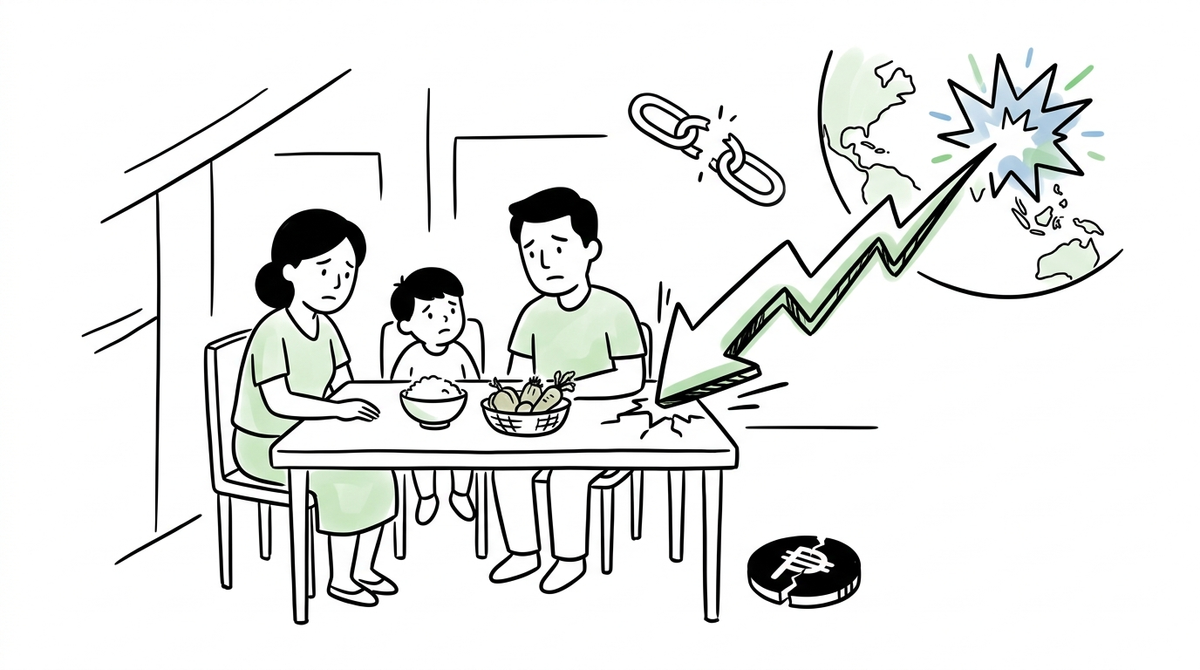
A prolonged geopolitical conflict in the Middle East directly threatens the daily survival of vulnerable Filipinos by driving up inflation, weakening the peso, and pushing thousands into poverty.
Every morning, long before the sun rises over Manila, a jeepney driver counts his crumpled bills, gauging if today’s earnings will cover both the diesel tank and a kilo of rice. Nearby, a mother checks her phone, waiting for a notification from her husband working abroad, computing how far this month's remittance will stretch against the rising cost of vegetables.
To these families, geopolitical standoffs and international policy briefs feel like abstractions. The Middle East is a place on a map, a workplace for millions of overseas Filipinos, or a headline flashed on evening television. It feels entirely disconnected from the immediate reality of rushing to work, packing school lunches, or budgeting for the monthly electricity bill. Yet, our world is knitted together by invisible threads of trade, fuel, and labor. When a thread snaps oceans away, the tension is felt most acutely at the Filipino kitchen table.
The Breakdown of the Headline
A recent policy brief by the United Nations Development Programme (UNDP) brought this reality into sharp focus. The report details how escalating warfare in the Middle East threatens to stall, or even reverse, years of hard-won human development progress in the Philippines.
When we talk about "human development," we are not just talking about abstract economic indicators or gross domestic product. Human development measures the actual quality of a person's life: how healthy they are, how long they can expect to live, their access to education, and whether their income allows for a decent standard of living. It is a metric of human dignity.
According to the UNDP analysis, the economic fallout of a prolonged Middle East crisis could instantly push over 35,000 Filipinos below the lower middle-income poverty line—defined as living on less than $4.20 a day. If global markets struggle to adjust, thousands more could follow, nudging the national poverty rate up from 16.9% to 17%. While a 0.1% increase sounds minuscule on an economic spreadsheet, in the real world, it translates to over 20 million Filipinos submerged in poverty, facing the daily stress of deprivation.
What This Really Means for Everyday Life
How does a missile strike or a closed shipping lane thousands of miles away transform into a crisis for a household in Luzon, the Visayas, or Mindanao? The transmission belt relies on three main pressure points: inflation, currency depreciation, and a slowdown in economic growth.
First is the immediate volatility of oil. The Philippines remains heavily reliant on imported fuel. When tension spikes in the Middle East, global oil prices surge. This creates a domino effect across the local economy. It does not just mean it costs more to fill up a vehicle. Higher fuel costs mean it costs more to transport carrots from Benguet to markets in Manila. It costs more to run fishing boats in Palawan. It costs more to operate the factories that produce basic consumer goods. Inflation acts like an invisible tax, quietly shrinking the purchasing power of every single peso.
Second, global instability tends to drive investors toward "safe-haven" currencies like the US dollar, causing the Philippine peso to weaken. While a weaker peso is traditionally seen as a boost for families receiving foreign remittances, today that benefit is largely neutralized. The extra pesos received are instantly swallowed up by the inflated costs of domestic goods.
Finally, as global markets contract, general economic growth slows down. Businesses become hesitant to expand, hiring freezes are implemented, and the informal economy—where millions of Filipinos rely on daily earnings without a safety net—shrinks.
The Faces Behind the Statistics
The burden of global conflict is never distributed evenly. Large corporations and affluent individuals have buffers—savings accounts, investments, and assets that shield them from sudden economic shocks. The people who bear the brunt of geopolitical friction are those who live hand-to-mouth.
Consider the informal sector. Jeepney and tricycle drivers cannot easily raise fares to match spiking fuel prices without facing a drop in passengers or entering conflict with regulatory boards. Every additional peso spent on diesel is a peso taken away from their children's school allowances.
Consider our farmers. Modern agriculture depends on petroleum-based fertilizers and fuel-driven irrigation pumps. When input costs skyrocket while the purchasing power of their consumers drops, farmers are forced to absorb the losses, further threatening food security in rural communities.
Consider the domestic service workers, the young call-center agents, and women in low-paid care sectors. When households are forced to tighten their belts due to inflation, non-essential services are the first to be cut. These workers find their hours reduced or their jobs eliminated entirely, with very few institutional safety nets to catch them.
Furthermore, a setback of this nature ripples across generations. When a family’s income is squeezed, difficult choices must be made. Parents are forced to pull children out of school to help earn an income, or shift them from private institutions to overcrowded public schools. Healthcare is deferred; a trip to the doctor for a persistent cough is postponed because the money is needed for dinner tonight. This erosion of education and health outcomes is precisely how a short-term economic shock transforms into long-term, generational poverty.
A Deeper Perspective on Resilience
This looming economic vulnerability underscores a fundamental truth about our society: community-level stability is incredibly fragile when it relies solely on macroeconomic trends. True resilience cannot just be measured by national growth targets; it must be felt in the stability of local neighborhoods and small livelihoods.
When global macro-pressures threaten to destabilize vulnerable households, the importance of localized, community-led initiatives becomes undeniably clear. Whether through local food-security networks, community-supported agriculture, or grass-roots livelihood associations, creating localized buffers is essential to ensuring that ordinary families do not bear the full shock of global volatility alone. Enhancing the capacity of neighborhoods to support one another structurally is what prevents a macro-economic dip from becoming a humanitarian disaster on the ground.
Moving Beyond Survival
The current global climate reminds us that the Philippines does not exist in a vacuum. We are deeply connected to international shifts, and our vulnerabilities are exposed whenever global systems fracture.
However, understanding these connections should not move us to helplessness; it should move us toward a deeper awareness of what needs protection. It challenges policymakers, community leaders, and citizens alike to look beyond the top-line economic numbers and ask hard questions about who survives when the global economy stumbles.
How do we build local safety nets that insulate the daily wage earner from global market shocks? How do we ensure that a crisis abroad does not compromise the education of a Filipino child or the health of a working mother? True progress is not measured by how high our economy can soar during global booms, but by how well we protect our most vulnerable citizens when the rest of the world catches fire.
Lahat tayo masaya kapag sinasabing umuunlad ang ekonomiya, pero naisip ba natin kung gaano kabilis itong mabura dahil sa mga gulo sa ibang bansa? Ayon sa isang bagong ulat, ang tensyon sa Middle East ay maaaring magbaba sa libo-libong pamilyang Pilipino patungo sa kahirapan dahil sa taas ng bilihin at petrolyo. Paano nga ba naaapektuhan ng digmaan sa kabilang dako ng mundo ang laman ng iyong bulsa at hapag-kainan ngayon?

Power Our Mission, Shape the Future
We empower single parents, PWDs, youths, seniors, and stay-at-home parents through digital livelihood.
Help us build resilient communities.
BUKLURAN remains open to partnerships, sponsorships, and collaborative initiatives that create meaningful community impact.
Whether through funding, in-kind support, volunteerism, or shared services, your organization can help strengthen programs that serve underserved communities.
Do you want to take part in our free livelihood programs, scholarship assistance, and community resource pooling initiatives? Membership is completely free.
Join BUKLURAN!
Register, volunteer, and become a member today.