The Price of Legitimate Hustle: What the BIR’s New Badge Means for the Home-Based Seller
For years, online sellers faced a tough choice: comply with tax rules or protect their private home addresses. A new digital badge changes that.
The BIR's new digital registration badge strikes a crucial balance between tax compliance and personal privacy for Filipino online entrepreneurs.
If you step into the living room of a typical residential neighborhood in the Philippines today, you are likely to find a corner dedicated to the modern Filipino hustle. It might be a stack of brown cardboard boxes waiting to be taped, a ring light standing next to a smartphone, or rows of homemade baked goods, clothing items, or skincare products ready for dispatch.
For hundreds of thousands of Filipinos, the digital marketplace is no longer just a side gig; it is the primary engine keeping their households afloat.
Yet, for the past few years, a quiet anxiety has hung over these home-based entrepreneurs. When the call came for digital merchants to formalize their operations and register with the Bureau of Internal Revenue (BIR), most well-meaning citizens wanted to comply. They wanted to pay their taxes and operate above board.
But doing so came with a hidden, troubling cost.
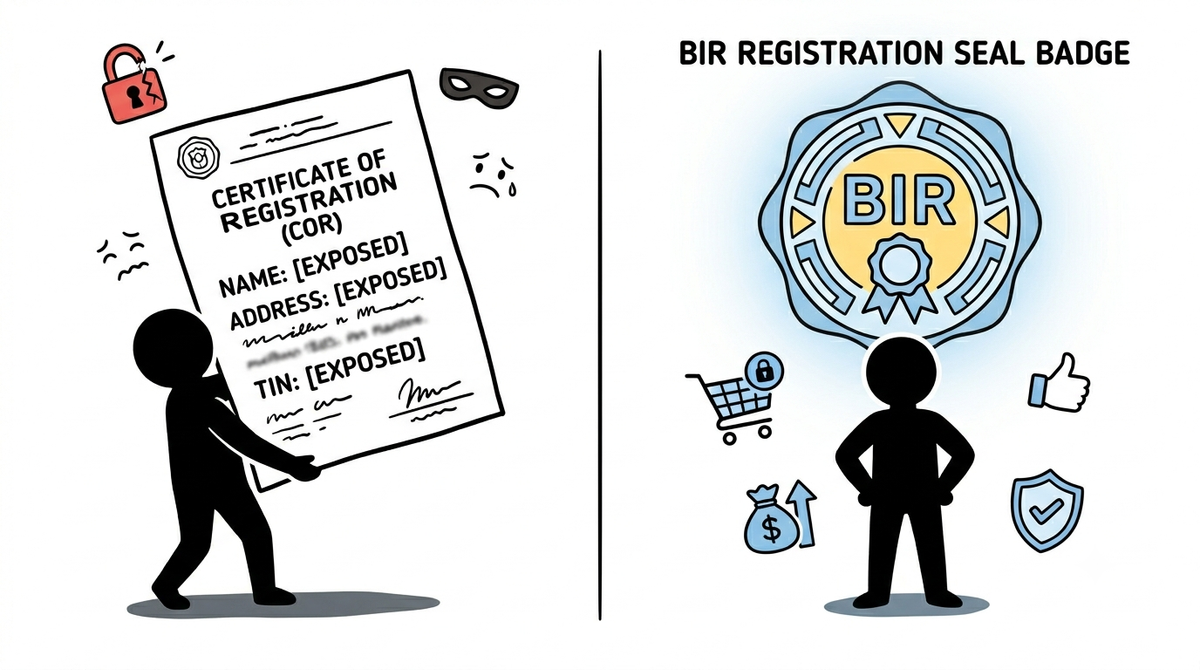
To prove their legitimacy on major e-commerce platforms or social media pages, sellers were required to publicly display their Certificate of Registration (COR) or its electronic equivalent (eCOR). For a large corporation with a commercial office address, this was standard procedure. But for a mother selling crocheted items from her dining room table or a working student managing a small clothing shop from their bedroom, uploading that document meant blasting their exact home address, full name, and Taxpayer Identification Number (TIN) across the open internet.
It was an invitation to an entirely different kind of risk. Now, a new policy shift aims to close that vulnerability, raising an important question: Can we create a digital economy that is both accountable and safe for the ordinary people who power it?
The Issue Explainer: From Paper Trails to Digital Badges
The Bureau of Internal Revenue recently announced the introduction of the BIR Registration Seal Badge, an initiative specifically designed for online sellers and e-commerce platforms.
Previously, the regulatory framework treated a virtual storefront exactly like a physical boutique in a shopping mall. Under older rules, businesses had to prominently display their physical COR on their walls. In the digital space, this manifested as a high-resolution image of a tax document pinned to a profile page or uploaded to a platform's seller dashboard, visible to anyone with an internet connection.
The new system replaces this clumsy, exposure-prone method with a streamlined digital badge—essentially a verified "blue check" for tax compliance. Instead of revealing an entire page of sensitive personal data, legitimate online sellers will now be issued a secure digital seal.
This badge serves as immediate, verified proof that the business is recognized by the government and is operating legally. However, it keeps the underlying sensitive information—like residential addresses and individual tax numbers—shielded from casual browsers, malicious actors, and automated data-scraping bots.
What This Really Means: Balancing Accountability with Privacy
To understand why this development matters, one has to look at the unique nature of the Philippine digital economy. Unlike western markets dominated by massive retail conglomerates, the heartbeat of Filipino e-commerce relies heavily on micro-, small-, and medium-sized enterprises (MSMEs). Many of these are casual, home-grown operations born out of economic necessity.
When a regulatory system requires these micro-entrepreneurs to expose their personal details, it creates a direct conflict between two public goods: fiscal compliance and data privacy.
1. Shifting the Burden of Risk
When an ordinary citizen's home address and TIN are freely accessible online, the risks are far from hypothetical. In an era rampant with identity theft, phishing scams, and digital harassment, a public COR is a goldmine for fraudsters. Scammers can easily use a legitimate seller’s TIN and address to create dummy accounts, clone stores, or open fraudulent financial lines, leaving the innocent business owner to clear their name with authorities. By replacing the full document with a verified seal, the government effectively shifts the burden of verification away from public exposure and into a secure database.
2. Lowering the Barrier to Formalization
Many small-scale sellers have hesitated to register their businesses not because they refuse to pay taxes, but because they fear the loss of privacy. For a solo female entrepreneur running a business from her home, broadcasting her physical location to every anonymous buyer on the internet is a genuine safety concern. By removing this barrier, the new badge system makes the path to formalization much more accessible, encouraging more informal operators to join the formal banking and regulatory ecosystems without compromising their personal security.
3. Redefining Consumer Trust
For the everyday consumer, navigating the online marketplace can feel like walking through a minefield of potential scams. We have all heard stories—or experienced them firsthand—of ordering an item online only to receive a brick in a box, or worse, having a seller vanish entirely after receiving a down payment. The presence of a standardized, unforgeable digital seal gives consumers a reliable metric to gauge who is a legitimate merchant and who is operating in the shadows, all without requiring the consumer to play detective with a seller’s personal paperwork.
The Human Impact: Beyond the Dashboard
Data and policy updates are often written in the dry language of circulars and memos, but their effects are felt at the kitchen table.
Consider the reality of delivery riders, customers, and entrepreneurs interacting daily. When an online store is compromised or an identity is stolen, the fallout ripples through an entire household. A frozen digital wallet or a flagged tax account means a family’s grocery money for the month is tied up in bureaucratic red tape.
+-----------------------------------------------------------------------------+
|                         THE TRIPARTITE BENEFIT                              |
+------------------------------------+----------------------------------------+
| For the Seller                     | Protects home addresses and individual  |
|                                    | tax numbers from identity thieves.     |
+------------------------------------+----------------------------------------+
| For the Consumer                   | Provides instant visual confirmation  |
|                                    | of a legitimate, traceable business.   |
+------------------------------------+----------------------------------------+
| For the Community                  | Encourages local economic growth by    |
|                                    | making home businesses safer to run.   |
+------------------------------------+----------------------------------------+
Furthermore, this development acknowledges a truth that small communities have known for a long time: livelihood and safety are deeply intertwined. In many neighborhoods, a home-based online business is what allows a parent to care for an elderly relative or look after young children while still bringing in an income. Forcing them to choose between economic survival and domestic privacy was an unfair compromise. The introduction of a protective verification layer respects the dignity of the small-scale merchant, recognizing them not just as tax-yielding entities, but as citizens who deserve protection.
Closing Thoughts: A Step Toward Smarter Governance
The evolution of the BIR’s registration requirements from a exposed paper document to a secure digital badge marks a quiet but significant shift in how public institutions approach the digital age. It demonstrates an understanding that modern governance cannot simply copy-paste old rules onto new realities; it must adapt to protect the vulnerable.
True progress in our digital economy shouldn't require ordinary citizens to sacrifice their peace of mind just to make an honest living. As these digital seals begin to roll out across online storefronts, they represent more than just tax compliance. They stand as a reminder that in our push toward a fully digital future, the safety, privacy, and livelihoods of everyday people must always remain the ultimate priority.
The next time you see that small digital badge on your favorite online storefront, remember that it represents a hard-working Filipino who can now open their virtual doors to the public while keeping their front door safely locked.
Bakit nga ba kailangang i-sakripisyo ang iyong privacy para lang sa legal na negosyo?
Para sa maraming online sellers na naghahanap-buhay sa loob ng kanilang mga bahay, ang pag-display ng Certificate of Registration (COR) ay nangangahulugan din ng pagbulatlat ng kanilang home address at TIN sa publiko. Ngunit may bagong hakbang ang gobyerno para baguhin ito. Ligtas nga ba ang iyong maliit na negosyo sa bagong patakarang ito?

Power Our Mission, Shape the Future
We empower single parents, PWDs, youths, seniors, and stay-at-home parents through digital livelihood.
Help us build resilient communities.
BUKLURAN remains open to partnerships, sponsorships, and collaborative initiatives that create meaningful community impact.
Whether through funding, in-kind support, volunteerism, or shared services, your organization can help strengthen programs that serve underserved communities.
Do you want to take part in our free livelihood programs, scholarship assistance, and community resource pooling initiatives? Membership is completely free.
Join BUKLURAN!
Register, volunteer, and become a member today.