The Price of Purple: Why Global Fame Shouldn’t Erase the Roots of Bohol’s Famed Ubi Kinampay
Ube is booming globally, but are the farmers growing it actually winning? A new legal application aims to protect Bohol's purple gold.
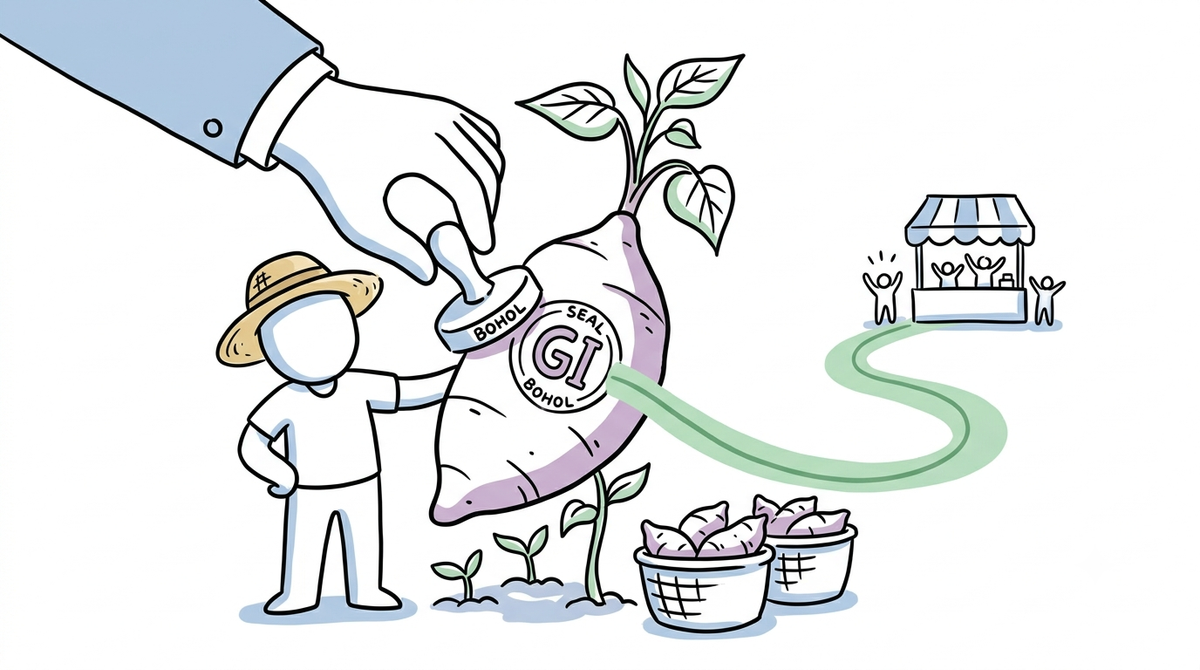
The application for Geographical Indication protection for Bohol’s iconic Ubi Kinampay highlights the vital balance between global market success and safeguarding the livelihood, heritage, and identity of local agricultural communities.
Walk into almost any trendy cafe in New York, Los Angeles, or London today, and you are bound to see it: a striking, vibrant shade of violet coloring ice cream, lattes, pastries, and donuts. Ube—the humble purple yam that has graced Filipino town fiestas, Christmas tables, and family gatherings for generations—has officially gone global. International food critics call it a "purple gold rush," and export figures show that overseas demand is higher than ever, bringing millions of dollars into the food industry.
Yet, if you travel far from the neon signs of global dessert shops and walk along the rocky, sun-baked fields of Bohol, the reality looks quite different. Here, an elderly farmer wipes sweat from his brow, tending to a crop that takes up to eight long months to mature under the soil. For him, this purple tuber is not a viral social media trend or a luxury flavor profile. It is a lifeline. It is Ubi Kinampay, a specific, highly fragrant, and deeply sacred variety of yam that has sustained his family and his ancestors through droughts, wars, and economic hardships.
As the rest of the world scrambles for a taste of this purple phenomenon, a quiet but critical legal step was taken back home. The provincial government of Bohol, in coordination with the Intellectual Property Office of the Philippines (IPOPHL), officially filed an application for Geographical Indication (GI) protection for Bohol Ubi Kinampay. While it sounds like bureaucratic jargon, this move touches the very heart of how we value our land, our heritage, and the ordinary workers who feed us.
Understanding the Legal Shield: What is a Geographical Indication?
To understand why this matters, we must first look at what a Geographical Indication actually does. Think of Champagne. By international law, a sparkling wine cannot be labeled as "Champagne" unless it was actually produced in the Champagne region of France using traditional methods. The specific soil, climate, and centuries-old expertise of that region are what give the product its unique identity and value.
A GI registration works the same way. It is a form of intellectual property right that legally ties a product’s quality, reputation, and characteristics directly to its place of origin.
Currently, the Philippines has only a handful of registered GIs, including Guimaras Mangoes and Bohol's own artisanal sea salt, Asin Tibuok. By adding Bohol Ubi Kinampay to this elite list, the government aims to create a legal perimeter fence around the name. Once approved, no corporation, foreign producer, or external supplier can slap the label "Bohol Ubi Kinampay" onto their products unless the yam was genuinely grown in Boholano soil by local farmers adhering to strict heritage standards.
What This Really Means Beyond the Headlines
On paper, this is a massive victory for economic strategy. It protects the market identity of Philippine ube against cheap imitations and corporate exploitation. But for the ordinary Filipino, the implications run much deeper than international trade agreements.
The global boom has created a paradox. While the demand for ube-flavored treats has skyrocketed, actual ube production in the Philippines has faced severe hurdles over the years, squeezed by changing weather patterns, high production costs, and fragmented supply chains. When a crop becomes a global commodity, there is a recurring danger that large industrial agricultural firms will swoop in, mass-produce homogenized varieties elsewhere, and leave the original, traditional farmers behind.
By securing GI protection, the narrative shifts back to the community. It gives smallholder farmers leverage. When a product is legally recognized as a unique heritage item, its market value rises. This prevents large commercial buyers from driving prices down to unfair levels, ensuring that the financial rewards of the global "purple gold rush" actually trickle down to the families digging in the dirt, rather than just the commercial distributors and international bakers.
The Human Impact: Keeping Heritage Grounded
For Boholanos, ubi is not just food; it is woven into their cultural DNA. It is the only agricultural crop explicitly mentioned in the official Bohol province hymn. Local folklore tells of ancient famines where all other crops withered under a relentless sun, yet the ubi survived buried deep in the earth, saving entire villages from starvation. Because of this, traditional farmers treat the root crop with a level of reverence that borders on the sacred—some elders still apologize to the tuber if it is accidentally dropped on the floor.
When we protect Ubi Kinampay, we are protecting the livelihoods of the members of groups like the Bohol Ubi Growers Association. These are small-scale farmers who manage small plots of land, relying on traditional knowledge passed down through generations.
Consider the impact on a typical farming family. Without legal protections, a farmer is at the mercy of unpredictable middle-men who buy the yams at rock-bottom prices to grind into generic powders. But with a GI certification, that farmer’s crop transforms from a basic raw commodity into a premium heritage ingredient. For a parent trying to send a child to college or a family trying to fortify their home against the next typhoon, that premium price tag translates directly into financial security, dignity, and a reason to keep farming instead of abandoning the fields for urban labor.
The Broader Context of Community Resilience
This effort to safeguard Bohol’s purple gold reflects a much larger truth: true economic development must be rooted in community preservation. Growth means very little if it requires ordinary citizens to give up their identity, their environment, or their traditional livelihoods just to survive in a commercial marketplace.
This ongoing struggle to balance global economic competitiveness with local welfare reflects why community-based efforts around agricultural preservation and localized sustainable development matter so deeply. Across the country, rural communities are discovering that their best defense against economic displacement is not erasing their past, but rather securing the legal and structural tools to protect it. When a community owns its story, its traditions, and its unique geographic advantages, it creates an economic shield that no external market crash can easily destroy.
Looking Ahead: A Seed for the Future
The application for Bohol Ubi Kinampay's GI status is currently undergoing rigorous evaluation by intellectual property authorities. It requires meticulous documentation of soil quality, climate patterns, and traditional cultivation methods.
But regardless of how fast the legal machinery turns, the conversation it prompts is vital for every Filipino. The next time we enjoy a scoop of vibrant purple ice cream or buy a traditional ube halaya from a local market, we should look past the striking color. We must remember that behind the global craze is a real plot of land, a rich history of survival, and a hardworking farmer holding a spade. Protecting our local assets isn't just about winning an international trade game—it is about ensuring that as the fruits of our culture travel across the world, our people are never left behind in the dust.
Lahat tayo masaya kapag sikat ang ube sa buong mundo. Pero alam ba nating habang patuloy ang "purple gold rush" sa ibang bansa, marami sa ating mga lokal na magsasaka sa Bohol ang nahaharap sa hamon ng pandaraya sa merkado at mababang kita? Isang mahalagang hakbang ang ginagawa ngayon para protektahan ang sikat na Bohol Ubi Kinampay. Bakit nga ba malaki ang epekto nito sa buhay ng karaniwang pamilyang Pilipino?

Power Our Mission, Shape the Future
We empower single parents, PWDs, youths, seniors, and stay-at-home parents through digital livelihood.
Help us build resilient communities.
BUKLURAN remains open to partnerships, sponsorships, and collaborative initiatives that create meaningful community impact.
Whether through funding, in-kind support, volunteerism, or shared services, your organization can help strengthen programs that serve underserved communities.
Do you want to take part in our free livelihood programs, scholarship assistance, and community resource pooling initiatives? Membership is completely free.
Join BUKLURAN!
Register, volunteer, and become a member today.