The Price of Saying Goodbye: Why a Benefit Hike Speaks to More Than Just Funerals
GSIS raised its funeral benefit to P50,000. Beyond the policy change, here is what this means for families navigating grief and rising costs.
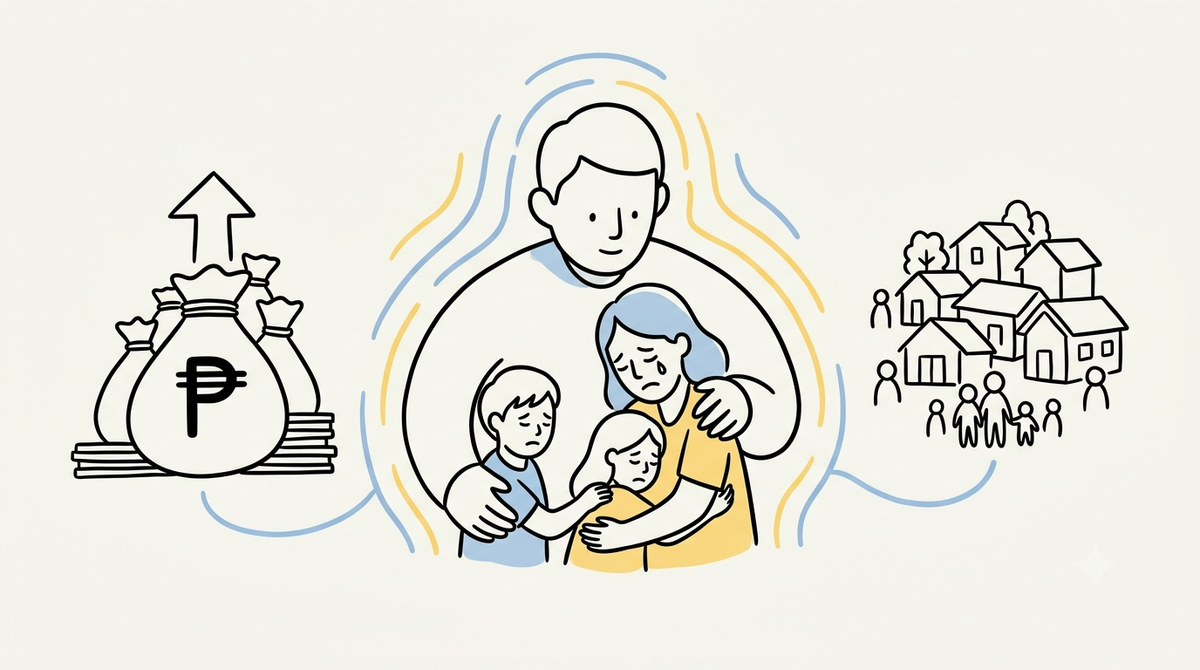
The increase in the GSIS funeral benefit to P50,000 provides critical, immediate financial relief to grieving families, highlighting the profound intersection of dignity, economic vulnerability, and the rising cost of saying goodbye.
When a loved one passes away in a typical Filipino household, grief rarely arrives alone. It is almost always accompanied by a quiet, stressful math.
Before the first visitors arrive at the wake, family members are already whispering in corners, calculators in hand. They count the cost of the casket, the chapel rental, the burial plot, the food for those paying their respects, and the transport for relatives coming from the provinces. In our culture, saying goodbye is a deeply communal, sacred duty. But in modern times, it has also become an incredibly expensive one.
For decades, the families of public school teachers, clerks, barangay health workers, and retired government employees have had to stretch every peso when death knocks on the door. The suddenness of loss frequently sends families into a tailspin of urgent borrowing, pledging whatever small assets they have to informal lenders just to give a mother, father, or spouse a respectable departure.
That is why the recent announcement from the Government Service Insurance System (GSIS) to increase its one-time funeral benefit from ₱30,000 to ₱50,000 is more than just a adjustment in government accounting. It is a policy change that directly hits the emotional and financial nerve center of hundreds of thousands of ordinary Filipino homes.
The Policy Shift: What Changed?
On July 13, 2026, the GSIS officially implemented a ₱20,000 increase in its funeral benefits, raising the total payout to ₱50,000 for all eligible claims where the death occurred on or after that date.
To fund this expanded support, the state pension fund has earmarked approximately ₱1.25 billion annually. According to agency estimates, this higher payout will benefit between 21,000 and 25,000 grieving families across the country every single year.
The updated benefit is structured to reach a broad spectrum of the public sector. To understand who qualifies, it helps to look at the specific groups covered under the new rules:
- Active Members: Currently employed government workers who are actively contributing.
- Separated Members: Those who have left government service but are entitled to future retirement or separation benefits.
- Old-Age Pensioners: Retirees receiving monthly pensions.
- Specific Retirees: Individuals who retired under Republic Act (RA) 1616 (even if they were of pensionable age under RA 8291), and those who retired under RA 1616 before RA 8291 took effect, provided they rendered at least 20 years of government service.
This one-time payment of ₱50,000 is released to a single qualified claimant, following a strict order of priority: first to the legitimate spouse; next, to the legitimate child who actually paid for the funeral expenses; or, in the absence of both, to any person who can present incontrovertible proof—like official receipts—that they personally shouldered the costs.
What This Really Means Beyond the Headlines
At first glance, a ₱20,000 increase seems straightforward. But to understand its true value, one must look at the real-world inflation of dying in the Philippines.
In urban areas, even a modest, no-frills funeral package—including a basic wooden casket, three days of viewing, embalming, and municipal permit fees—easily starts at ₱40,000 to ₱60,000. This does not yet include the cost of a cemetery plot, cremation fees, or the food and drinks expected during the traditional padasal (novena prayers) and lamay (wake). In reality, the previous ₱30,000 benefit barely covered half of these foundational costs, leaving families to scramble for the remainder at the worst possible time.
By lifting the assistance to ₱50,000, the benefit moves closer to covering the actual baseline cost of a dignified, simple funeral.
The timing of the disbursement is also critical. When a family member dies, household liquid cash is often frozen or exhausted by end-of-life medical care. Hospital bills can drain savings accounts in a matter of days. In these moments, the biggest hurdle is not just having the money, but having it now.
Because the GSIS funeral benefit is designed to be one of the agency’s most immediate forms of assistance, it serves as an essential cash bridge. It prevents families from having to make desperate financial compromises, such as turning to high-interest loan sharks (5-6 lenders) or delaying the release of their loved one's remains because they cannot pay the mortuary.
The Human Impact: Dignity in Times of Vulnerability
Economics is never just about numbers; it is about human dignity. In the Philippines, the way we send off our dead is viewed as a final reflection of how much we loved and respected them.
For a retired public school teacher who dedicated 40 years of their life to educating the nation's youth, or a municipal utility worker who kept local streets clean, their funeral is the community's chance to say thank you. When a family has to beg, borrow, or cut corners on a funeral, it leaves a lingering sense of shame and unresolved grief.
Consider a household where the primary breadwinner has just passed away. The surviving spouse is not only dealing with emotional devastation but is also looking at an immediate future with reduced income. A ₱50,000 benefit does not solve their long-term economic worries, but it acts as a protective shield. It ensures that the first step of their transition into life without their partner is not marked by immediate, suffocating debt.
It allows a grieving widow to sit by her husband's casket and receive comforting neighbors, rather than spending those precious final hours on the phone trying to secure emergency loans.
A Broader Reflection on Social Safety Nets
While this policy update is a massive step forward for public sector workers, it also shines a light on a larger, ongoing national conversation about social welfare and inequality.
The GSIS covers government employees, but millions of informal sector workers, tricycle drivers, farmers, and fisherfolk do not have access to these specific state pension funds. They rely on other networks, such as the Social Security System (SSS) or local government assistance (pantawid or tulong-pinansyal programs), which often offer lower or highly variable funeral subsidies.
The ease with which we can access these safety nets in our darkest moments determines whether a family stays afloat or slips into poverty. When institutions streamline their processes—such as reducing documentary hurdles and utilizing electronic wallets for faster payouts—they recognize that administrative delays during times of grief are not just bureaucratic inconveniences; they are deeply painful burdens.
The GSIS hike serves as a model of responsive governance. It recognizes that inflation does not just affect the food on our tables or the fuel in our tanks; it also affects the final, quiet spaces of our lives.
Looking Forward
How we treat our most vulnerable—both in life and in death—is the ultimate measure of our society's safety nets. The expansion of the funeral benefit to ₱50,000 is a reminder that state institutions can, and should, adapt to the changing economic realities of the people they serve.
As we move forward, perhaps the most meaningful question we can ask ourselves as a community is this: How can we continue to build a society where no Filipino family has to choose between honoring their loved ones with dignity and protecting their own financial survival?
Bakit nga ba napakahirap magpaalam sa mahal sa buhay sa Pilipinas?
Hindi lang emosyonal na sakit ang dala ng pagpanaw, kundi mabigat na gastusin din. Sa pagtaas ng GSIS funeral benefit sa ₱50,000, may malaking ginhawa ba itong dala sa mga pamilya ng mga kawani ng gobyerno? Alamin ang tunay na halaga ng tulong na ito sa gitna ng nagtataasang bilihin at paano nito pinoprotektahan ang dignidad ng ating mga pamilya.

Power Our Mission, Shape the Future
We empower single parents, PWDs, youths, seniors, and stay-at-home parents through digital livelihood.
Help us build resilient communities.
BUKLURAN remains open to partnerships, sponsorships, and collaborative initiatives that create meaningful community impact.
Whether through funding, in-kind support, volunteerism, or shared services, your organization can help strengthen programs that serve underserved communities.
Do you want to take part in our free livelihood programs, scholarship assistance, and community resource pooling initiatives? Membership is completely free.
Join BUKLURAN!
Register, volunteer, and become a member today.