The Weight Behind the Blackboard: What 22,000 New Jobs Tell Us About the Reality of Teaching
Over 22,000 new school staff are promised to ease teacher workloads. But will hiring more personnel truly fix the systemic classroom strain?
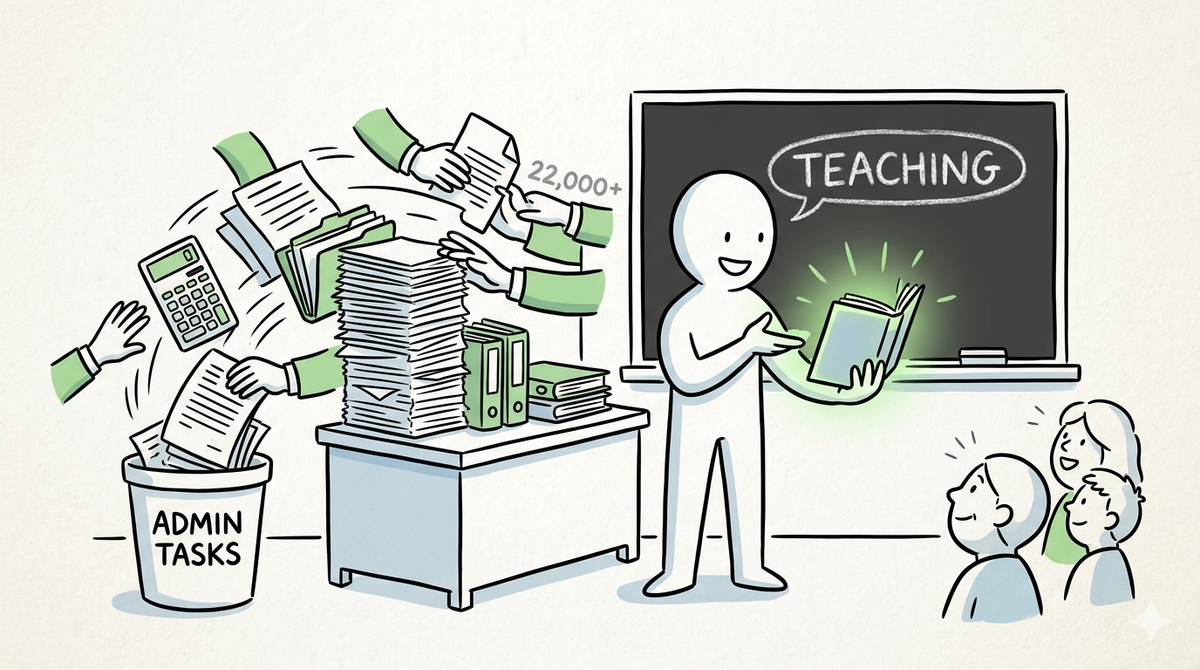
While the Department of Education's plan to hire 22,000 non-teaching staff is a step toward reducing administrative burdens, achieving real relief requires looking beyond numbers and restructuring how communities support teachers and students.
Long before the morning bell rings, a quiet ritual takes place in thousands of public schools across the Philippines. A teacher sits at her desk, surrounded not by lesson plans or colorful visual aids, but by stacks of liquidation reports, student tracking profiles, nutritional assessment forms, and asset inventory sheets. She is an educator by training and passion, but by necessity, she has also become a clerk, an accountant, a data encoder, and a frontline social worker.
This daily reality highlights a long-standing structural crisis in Philippine education: the invisible, non-teaching workload that pulls educators away from their primary calling. Recently, the Department of Education (DepEd) announced a major initiative intended to address this chronic burden. The agency plans to create over 22,000 non-teaching positions nationwide to absorb administrative tasks, particularly as schools navigate the complex logistical transition back to a three-term academic calendar.
On paper, this announcement feels like a significant victory for the educational sector. It directly responds to years of persistent calling from labor groups, such as the Alliance of Concerned Teachers (ACT), who have raised the alarm over how exhausting administrative burdens degrade the quality of instruction. Yet, an honest look at the state of our public schools suggests that numbers alone cannot solve systemic exhaustion. To understand whether 22,000 new personnel will truly transform the daily lives of Filipino teachers, we must look beyond the macro-level policy announcements and analyze what happens inside the neighborhood classroom.
The True Cost of Administrative Overload
For years, the phrase "workload reduction" has been a frequent talking point in educational reforms. However, the modern public school classroom operates under an expanded set of expectations. A teacher is no longer just responsible for managing a class of forty to sixty students for several hours a day. They are required to document every interaction, manage community feeding initiatives, spearhead local disaster mapping, coordinate continuous assessment frameworks, and maintain extensive paper trails for institutional compliance.
When an individual is forced to split their energy between instructional design and bureaucratic maintenance, a silent compromise occurs. The hours spent filling out administrative matrices are hours stolen from reviewing student essays, crafting engaging learning activities, or providing one-on-one remediation to children falling behind in basic reading and mathematics. The administrative load does not just tire out the adult standing at the front of the room; it directly affects the child sitting at the desk.
The introduction of 22,000 administrative assistants, clerks, and support staff is an essential acknowledgement of this structural imbalance. By design, these positions are meant to act as a shield, absorbing the logistical and clerical demands of the school bureaucracy so teachers can return to their core expertise. But the effectiveness of this policy relies heavily on how these roles are distributed and integrated into the existing ecosystem.
The Calendar Shift and the New Wave of Strain
The urgency of this hiring initiative is closely tied to the shifting rhythms of the academic calendar. The planned transition back to a traditional school schedule introduces unique friction points for educational institutions. Adjusting school terms requires re-mapping lesson distributions, shifting grading periods, and managing complex enrollment intervals—all while handling regular operations.
Without targeted structural support, a major administrative shift inevitably triggers a wave of extra work. If school administrators and teachers are left to absorb the administrative shock of a calendar transition while managing crowded classrooms, the quality of instruction faces an immediate threat.
Furthermore, hiring personnel is only the first step in a much longer operational chain. In a country with thousands of public schools scattered across diverse geographical terrains, distributing 22,000 roles means that many small or rural institutions may only receive a single helper—or perhaps must share personnel with neighboring areas. If the underlying bureaucratic processes are not simplified, the influx of new staff might simply create a new layer of coordination instead of removing the core burden.
Moving Beyond Institutional Walls
The conversation around teacher workloads ultimately reminds us that a school does not exist in a vacuum. It is deeply connected to the economic, emotional, and social health of the neighborhood surrounding it. When students walk through the school gates hungry, lacking basic supplies, or dealing with financial stress at home, those societal challenges show up directly on their report cards and in their classroom behavior. Teachers frequently find themselves stepping into these gaps—acting as informal counselors or resource providers—because there are few other safety nets available.
True relief for our educational system cannot happen solely through internal hiring within the Department of Education. It requires an environment where families and community structures are stable enough to share the responsibility of supporting a child’s development. When a community can ease the socioeconomic pressures that weigh on a household, it naturally reduces the non-academic challenges that spill into the classroom.
This broader perspective helps explain why localized, grassroots interventions are so vital to the educational landscape. Within various communities, non-profit initiatives work to address the everyday barriers that prevent children from learning effectively. For instance, localized education support programs—such as the BUKLURAN Pabaon Program—focus on providing fundamental school kits, learning materials, and basic snack packs directly to kindergarten and elementary students from vulnerable households.
By ensuring that young learners arrive at school prepared and nourished, these community-led efforts quietly lift a portion of the pastoral burden from the shoulders of public school teachers. When grassroot systems take care of basic student readiness, teachers are given the space to focus purely on instruction, rather than worrying about whether a child has a pencil or an empty stomach. These small, targeted interventions show that supporting education is a shared responsibility that extends well beyond the school walls.
Redefining Shared Responsibility
The Department of Education's plan to bring thousands of non-teaching personnel into the system is a necessary step toward valuing the professional focus of our educators. It is an administrative solution to an administrative problem. But as these new employees find their desks and take over the paperwork, our larger society must confront a deeper question about what we expect from our public schools.
A teacher’s true value is found in the moments of connection that happen on the blackboard—the breakthrough when a struggling student understands a fraction, the spark of curiosity during a science experiment, or the guidance that keeps a teenager from giving up on their studies. These moments require patience, mental clarity, and focus.
Hiring non-teaching staff can clear away the paperwork, but long-term educational recovery requires a commitment to a simpler truth: education thrives when teachers are allowed to teach, when schools are supported by structured systems, and when communities actively wrap their arms around the families they serve. The 22,000 new jobs are a welcome foundation, but the real work lies in building a culture that protects the sacred space of the classroom.
Lahat tayo masaya kapag may balita tungkol sa pagbawas ng overload ng mga guro. May plano ang DepEd na magbukas ng mahigit 22,000 non-teaching positions para sa ating mga paaralan. Pero sapat nga ba ang dagdag-tao para masolusyunan ang pagod at bigat ng sistema sa loob ng silid-aralan? Ano nga ba ang totoong pasanin sa likod ng blackboard?
Power Our Mission, Shape the Future
We empower single parents, PWDs, youths, seniors, and stay-at-home parents through digital livelihood.
Help us build resilient communities.
BUKLURAN remains open to partnerships, sponsorships, and collaborative initiatives that create meaningful community impact.
Whether through funding, in-kind support, volunteerism, or shared services, your organization can help strengthen programs that serve underserved communities.
Do you want to take part in our free livelihood programs, scholarship assistance, and community resource pooling initiatives? Membership is completely free.
Join BUKLURAN!
Register, volunteer, and become a member today.