What "Anchored Inflation" Really Means at the Filipino Family Table
Economists say inflation expectations are "anchored," but inside Filipino kitchens, the struggle to budget for a decent meal tells a deeper story.
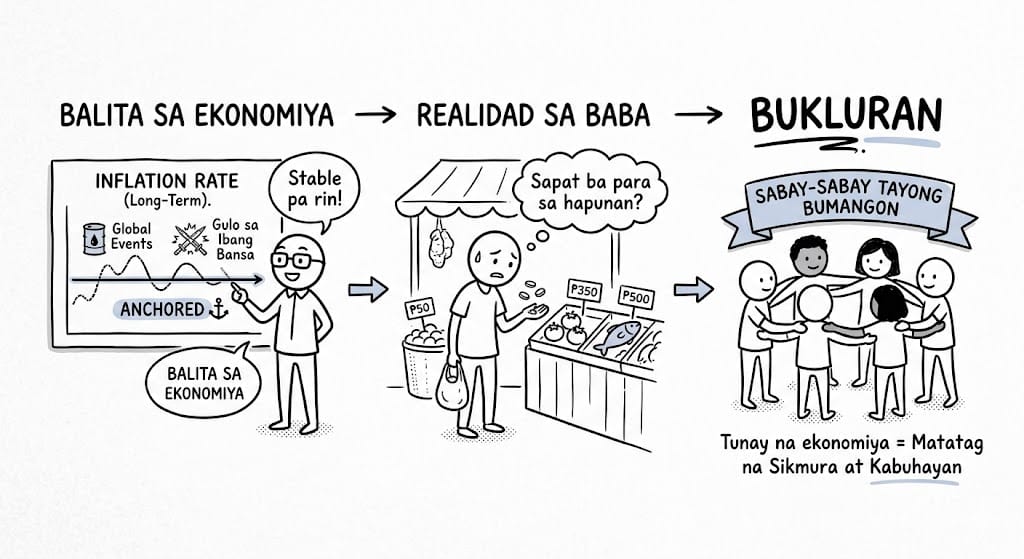
While a recent Bangko Sentral ng Pilipinas study shows that long-term inflation expectations remain stable despite geopolitical shocks, the day-to-day economic reality for underserved Filipino families remains heavily burdened by high prices.
Every afternoon, before the sun begins its slow descent over the crowded alleys of our communities, Aling Maria sits at her small wooden table with a worn-out notebook and a ballpoint pen. Her daily ritual has nothing to do with corporate accounting or macroeconomic forecasting, yet it requires an extraordinary level of skill. She is calculating how far five hundred pesos can go to feed a family of five for the next twenty-four hours. A few years ago, that amount allowed for a decent ulam and fruit for the kids. Today, it is a tight, stressful puzzle that often leaves the basket short of fresh vegetables.
For millions of ordinary Filipinos, the economy isn't measured in percentages or charts—it is felt in the weight of the market basket and the rapid shrinking of a hard-earned daily wage.
This disconnect between institutional data and lived reality became sharper this week with the release of a study by the Bangko Sentral ng Pilipinas (BSP) Research Academy. The central bank's discussion paper reported that despite severe economic shocks—most notably the spikes in global oil prices driven by conflicts in the Middle East—the country's long-term inflation expectations remain "anchored." In the language of economists, this means that professional forecasters, businesses, and markets still believe inflation will eventually stabilize within or near the government's target of 2% to 4% over the long haul.
To the financial sector, an "anchored" expectation is good news; it implies a shared confidence that the economic ship will eventually right itself. But if you look closer at the numbers, these expectations are hovering tightly around the upper bound of 3.5% to 4.5%. More importantly, actual headline inflation hit an aggressive 7.2% recently, driven by immediate energy crises and soaring commodity costs.
This is where the academic definition of inflation breaks down for the underserved. When a professional forecaster hears about an oil shock, they calculate multi-year recovery curves. When an ordinary jeepney driver or a market vendor feels an oil shock, they experience immediate, compounding anxiety. Will jeepney fares go up? Will the price of rice jump again tomorrow? How much less can we buy today to make sure the electricity bill gets paid?
The systemic truth that often gets lost in high-level economic reporting is that inflation acts as a regressive tax on those who can least afford it. While institutions look at long-term horizons, poor and working-class families live in the absolute present. For them, a temporary "shock" that lasts for six months isn’t just a line on a graph—it represents a definitive period of nutritional sacrifice, delayed healthcare, or a child missing a school term because jeepney fares became unaffordable.
At BUKLURAN, we believe that understanding these economic realities is the first step toward genuine community empowerment. True public service means looking beyond the comforting vocabulary of economic stability and listening directly to the ground. Our community programs do not view families as data points in an inflation report; we see them as resilient, hard-working individuals navigating a deeply unequal system.
When the tides of global markets cause prices to rise, BUKLURAN stands with the communities through localized food security initiatives, community-led livelihood support, and consumer awareness efforts. By providing practical, collective safety nets, we help neighbors pull together so that a spike in global energy prices doesn't translate to an empty plate at home. We don't just wait for long-term economic forecasts to materialize; we work to build communal resilience right now.
The resilience of the Filipino family is undeniable—Aling Maria will always find a way to stretch her budget, and our workers will keep grinding through the toughest shifts. But survival shouldn't have to be a daily miracle. As we look to the future, the goal must be an economy where stability is felt not just in the vaults of the central bank, but in the peace of mind of every household, at every dining table across the nation.

Power Our Mission, Shape the Future
We empower single parents, PWDs, youths, seniors, and stay-at-home parents through digital livelihood.
Help us build resilient communities.
BUKLURAN remains open to partnerships, sponsorships, and collaborative initiatives that create meaningful community impact.
Whether through funding, in-kind support, volunteerism, or shared services, your organization can help strengthen programs that serve underserved communities.
Do you want to take part in our free livelihood programs, scholarship assistance, and community resource pooling initiatives? Membership is completely free.
Join BUKLURAN!
Register, volunteer, and become a member today.