What the Global AI Investment Boom Means for Ordinary Filipino Families
This article examines the financial structure behind the global artificial intelligence (AI) boom in the United States and translates its economic implications for ordinary Filipino households. While high-tech investments seem far removed from daily life in the Philippines, major global financial disruptions can ripple through local employment, digital services, and household costs. The article provides background context, breaks down complex financial relationships into plain English, and provides practical, everyday guidance for families to maintain financial stability.
An September 2026 report by the Philippine Daily Inquirer analyzed the complex financial Web surrounding the global artificial intelligence (AI) sector in the United States. The report highlighted how tech giants, microchip manufacturers, and software developers are deeply interconnected through shared investments, equipment leasing, and massive financial commitments.
While high-stakes tech trading in foreign stock markets might sound like a distant concern, global economic shifts rarely stay overseas. When massive international sectors experience rapid growth or sudden corrections, the financial ripple effects can eventually reach overseas workplaces, domestic prices, and everyday household budgets in the Philippines.
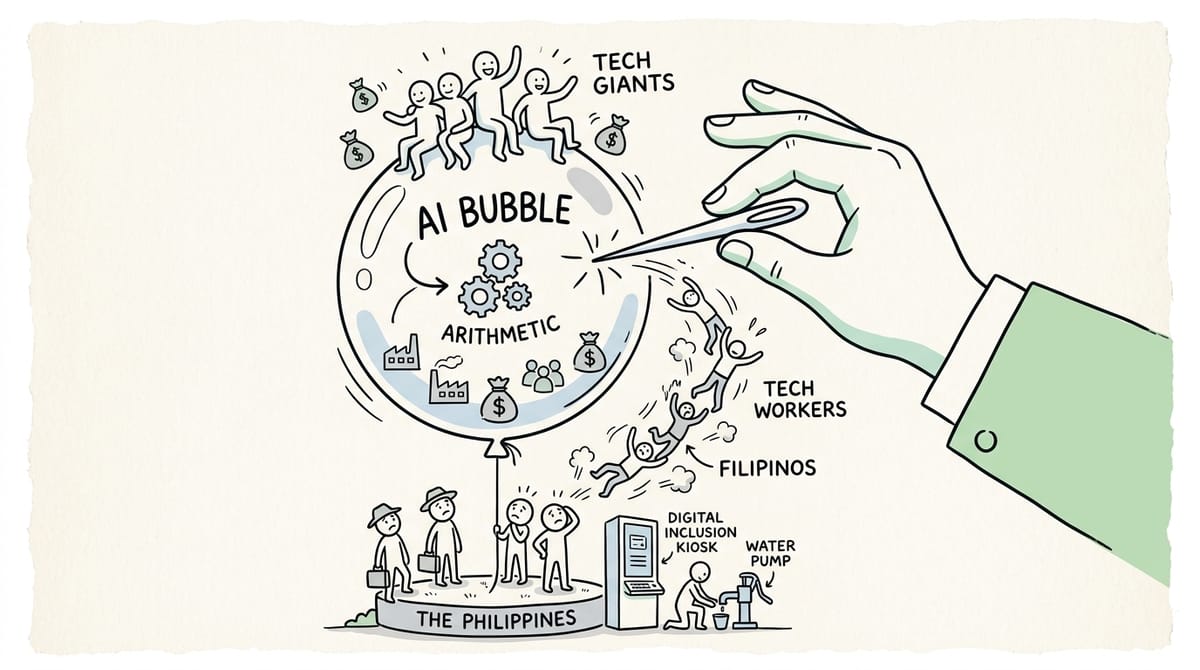
The Arithmetic Inside the AI Bubble
"Transactions within the enterprise ultimately net out to zero in cash terms. What's left is a single entity... making chips, borrowing money, building data centers, and hoping to get computing fees from real end-users."
What Is Happening in the Global AI Market?
The recent analysis points to a highly concentrated cycle of funding within the technology industry. Major corporate players are investing billions of dollars into AI infrastructure—buying specialized computer chips, leasing data center capacity, and funding software startups.
In simple terms, much of the money driving the AI expansion is moving in a circular path among a small group of very large companies:
- Hardware Producers: Companies that design and manufacture the powerful microchips required to train AI models.
- Infrastructure Providers: Cloud computing corporations that buy these chips to build massive data centers.
- Software Developers: Tech startups and firms that lease computing power from data centers to build consumer-facing tools.
Because these companies frequently invest in one another, fund each other's purchases, or rely on shared credit lines, analysts actively monitor whether the financial returns from actual software users will grow fast enough to justify the immense cost of the physical infrastructure.
Why Overseas Tech Trends Matter to Filipinos
It is easy to assume that financial risks in foreign technology markets only affect wealthy investors. However, the Philippine economy is deeply connected to the global tech ecosystem in several practical ways.
How Global Tech Shifts Reach Local Households
What the Headlines Leave Out
News coverage of financial markets often focuses on stock prices, corporate valuations, and complex accounting terms. What these reports rarely explain is how speculative investment cycles translate into everyday economic realities for working families.
When a major industry experiences rapid investment beyond its immediate revenue, two main outcomes usually occur over time:
- Market Adjustment: Companies recalibrate their spending, leading to cost-cutting, reduced hiring, or corporate restructuring.
- Infrastructure Integration: The physical infrastructure built during the boom remains, eventually lowering the long-term cost of technology once market prices stabilize.
Understanding this dynamic helps ordinary readers distinguish between short-term market noise and genuine long-term trends. A shift in foreign corporate spending is rarely an immediate crisis, but it serves as an early indicator for broader economic conditions.
Practical Steps for Household Financial Resilience
While individual families cannot control international financial markets, understanding global economic connections allows households to make practical, proactive decisions.
Build a Household Emergency Reserve
- Aim to set aside a small, consistent amount from monthly earnings to cover 3 to 6 months of essential living expenses.
- Prioritize liquid savings that can be accessed immediately during temporary employment transitions or unexpected health needs.
Diversify Personal and Livelihood Skills
- Avoid relying on a single specialized digital tool or platform for daily income.
- Focus on adaptable, core skills—such as basic project coordination, customer communication, and practical technical troubleshooting—that remain valuable across different industries.
Review Monthly Digital Expenses
- Audit recurring monthly subscriptions for software, streaming services, and online tools.
- Cancel unused digital services to free up margin in the family budget for daily necessities like food, utilities, and education.
Verify Financial Opportunities Carefully
- Be cautious of unregulated online platforms, aggressive investment schemes, or high-return promises claiming to profit from AI trends.
- Remember that legitimate economic participation relies on practical skills, direct service, or verifiable product distribution—never on guaranteed, effortless returns.
Strengthening Local Community Resilience
When global markets fluctuate, strong local community networks provide an essential safety net for working families. In communities across the country, grassroots organizations demonstrate how shared participation and practical coordination help households navigate broader economic uncertainties.
For example, community-based frameworks—such as the non-profit initiatives organized by BUKLURAN in District 5, Quezon City—focus on practical, self-sustaining support systems:
- Resource Pooling: Programs like the BUKLURAN HUB allow members to participate in voluntary, cooperative group purchasing for basic household commodities, helping families access essential goods below standard retail prices without relying on commercial debt or speculative schemes.
- Practical Skills Building: Educational workshops, such as the Bagong Simula and Kasanayan learning programs, provide community members with practical digital literacy, financial awareness, and hands-on technical skills to help individuals adapt to changing job markets.
- Education Support: Initiatives like the BUKLURAN Pabaon Program provide basic school supply packs and daily nourishment support to young students, ensuring that household economic pressures do not disrupt a child's foundational education.
By focusing on direct family support, functional education, and cooperative resource management, local communities build everyday resilience against distant economic shifts.
What to Watch Next
As global technology companies continue to navigate the costs of building advanced infrastructure, readers can keep an eye on a few straightforward indicators:
- Local Hiring Announcements: Pay attention to trends in the local IT-BPM sector regarding hiring rates and service expansion.
- Digital Service Pricing: Watch for changes in pricing structures or free-tier limits on commonly used software tools and e-wallet platforms.
- Export Data: Monitor general reports on Philippine electronics and semiconductor exports, which reflect broader demand in global hardware supply chains.
Staying informed about these indicators helps families plan ahead, adjust household spending thoughtfully, and focus on practical personal development.

Power Our Mission, Shape the Future
We empower single parents, PWDs, youths, seniors, and stay-at-home parents through digital livelihood.
Help us build resilient communities.
BUKLURAN remains open to partnerships, sponsorships, and collaborative initiatives that create meaningful community impact.
Whether through funding, in-kind support, volunteerism, or shared services, your organization can help strengthen programs that serve underserved communities.
Do you want to take part in our free livelihood programs, scholarship assistance, and community resource pooling initiatives? Membership is completely free.
Join BUKLURAN!
Register, volunteer, and become a member today.