What the Global Push for Philippine IT-BPM Means for Ordinary Families
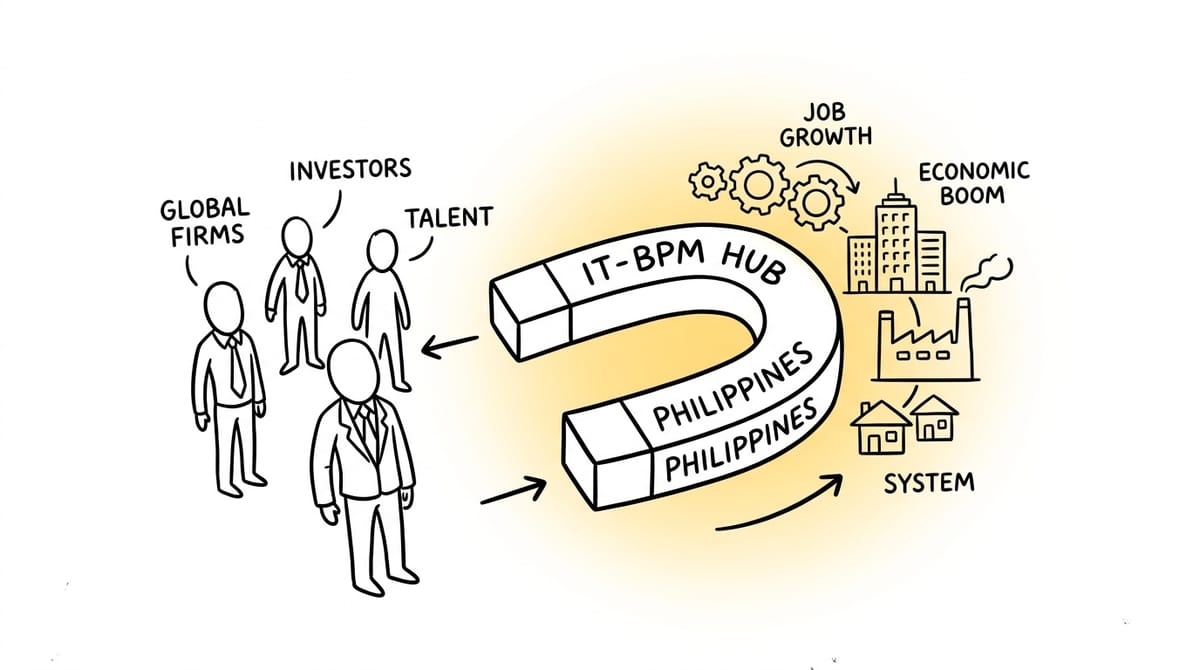
The IT and Business Process Association of the Philippines (IBPAP) is leading an alliance to court global enterprises from Australia, Japan, the Middle East, and the UK to locate or expand operations in the country. Aiming to hit up to $50.5 billion in revenues and 2.14 million jobs by 2028, the industry is pivoting from basic, capacity-based tasks to high-value, AI-enabled services across health, finance, and IT. This report details the economic potential, the risks for digitally under-prepared workers, and practical steps for Filipino households to benefit from this shift.
The IT and Business Process Association of the Philippines (IBPAP) is heading a strategic national alliance to pitch the country to major international enterprises. By courting firms across Australia, Japan, the Middle East, and the United Kingdom, the industry aims to secure up to $50.5 billion in annual revenues and create up to 2.14 million full-time jobs by 2028.
While expanding global investments into local shores is positive news for economic growth, the nature of these jobs is undergoing a transformation. The push is no longer focused solely on entry-level customer service representative (CSR) positions; it prioritizes complex, tech-driven, and specialized services. Understanding this transition is essential for Filipino households planning for future employment, education, and skill development.
IBPAP-Led Alliance Courts Global Firms to Locate in the Philippines
"Companies no longer choose locations based solely on cost. They choose places that can deliver resilience, capability and depth of talent. That is where the Philippines competes today."
What Happened?
In September 2026, details of an aggressive international outreach strategy led by IBPAP highlighted efforts to broaden the country's investor base beyond traditional North American markets. By engaging mid-market enterprises and global organizations in the UK, Australia, Japan, and the Middle East, industry leaders seek to expand operational footprints in high-growth sub-sectors.
The sector's updated targets aim for $43.3 billion to $50.5 billion in revenue by 2028. Rather than relying purely on high-volume hiring, growth is directed toward higher-value capabilities, including:
- Healthcare Information Management: Medical coding, claims processing, and clinical analytics.
- Banking, Financial Services, and Insurance (BFSI): Financial analysis, compliance monitoring, and risk management.
- Global Capability Centers (GCCs): In-house technology, engineering, and corporate operations hubs.
- Digital CX & Artificial Intelligence: Tech-assisted customer experience, cloud services, and data management.
Why It Matters
For decades, the BPO industry served as an accessible entry point for jobseekers, providing stable employment to fresh graduates and career-shifters alike. The current push signals a decisive shift from sheer headcount to specialized value creation.
As artificial intelligence automates basic transactional tasks, the jobs arriving from global firms require higher technical fluency, critical thinking, and industry-specific expertise. While this shift increases earning potential for qualified workers, it simultaneously elevates entry requirements across the board.
What the Headlines Leave Out
News of multi-billion-dollar targets and million-job projections often masks structural challenges that affect ordinary citizens:
- The Digital Divide: High-value IT-BPM roles require reliable high-speed internet, functional personal hardware, and digital literacy. Families in underserved or provincial areas lacking digital infrastructure risk missing out on these high-paying opportunities.
- The Automation Risk: Basic, repetitive voice roles are increasingly being handled by automated systems. Workers who do not upskill face job insecurity as companies transition to AI-assisted tools.
- Training Gaps: Academic institutions and vocational tracks often lag behind fast-evolving industry requirements, leaving students responsible for acquiring modern digital skills on their own.
How This Could Affect Filipinos
The expansion of global IT-BPM investments carries varied real-world implications across different groups:
- For Jobseekers and Students: Traditional entry-level roles are giving way to tech-focused positions. Students pursuing degrees in healthcare, finance, statistics, and computer science stand to benefit from higher starting salaries and diverse career paths.
- For Mid-Career Workers: Professionals in routine office roles must proactively learn digital tools, analytics, or domain-specific skills to stay employable as firms automate basic tasks.
- For Families and Local Communities: Increased foreign investment generates indirect employment—from local food vendors and transport operators to housing rentals. However, equitable distribution depends heavily on making tech education accessible in low-income communities.
What People Should Know
Navigating this changing landscape requires an understanding of where real opportunities lie and what qualifications are expected:
- Degrees Are Not Always mandatory, But Digital Literacy Is: Many high-value sectors value technical certifications, problem-solving capabilities, and software proficiency over specific formal degrees.
- Soft Skills Remain Critical: Even in AI-driven environments, distinctly human capabilities such as empathy, complex negotiation, critical judgment, and cross-cultural communication are highly sought after.
- Free Government Training Programs Exist: Government agencies like TESDA and DICT regularly offer fully funded courses in basic coding, digital marketing, virtual assistance, and data handling.
Practical Takeaways
To align with high-value job openings, individuals and families can take concrete steps:
- Audit Household Digital Tools: Assess whether youth or jobseekers in the home have access to basic hardware (such as functional laptops or tablets) and reliable internet connections.
- Leverage Free Upskilling Resources: Explore free online courses from platforms like Technical Education and Skills Development Authority (TESDA) Online Program or Department of Information and Communications Technology (DICT) DigitaljobsPH to build relevant tech skills.
- Focus on Niche Skills: Encourage students to gain familiarity with basic financial concepts, health coding fundamentals, or data analytics alongside English language proficiency.
- Verify Employer Credentials: When evaluating remote or hybrid BPO job offers from overseas firms, cross-check their legitimate operations through official Department of Labor and Employment (DOLE) or IBPAP advisories to avoid job scams.
What Happens Next
As global recruitment campaigns proceed, watch for:
- National Upskilling Initiatives: Track potential partnerships between government bodies and industry leaders offering tech training initiatives.
- Regional Infrastructure Developments: Monitor local government projects aimed at improving internet coverage and establishing IT hubs outside major metropolitan centers.
- Shift in Foreign Direct Investment (FDI) Trends: Observe whether non-US companies successfully establish long-term operations and create sustainable regional hiring centers.
The expansion of the Philippine IT-BPM sector holds significant economic promise. However, ensuring these opportunities uplift ordinary families requires deliberate investment in practical digital skills, education access, and community readiness.

Power Our Mission, Shape the Future
We empower single parents, PWDs, youths, seniors, and stay-at-home parents through digital livelihood.
Help us build resilient communities.
BUKLURAN remains open to partnerships, sponsorships, and collaborative initiatives that create meaningful community impact.
Whether through funding, in-kind support, volunteerism, or shared services, your organization can help strengthen programs that serve underserved communities.
Do you want to take part in our free livelihood programs, scholarship assistance, and community resource pooling initiatives? Membership is completely free.
Join BUKLURAN!
Register, volunteer, and become a member today.