When the Headset Goes Quiet: BPOs and AI
With BPOs adjusting their growth targets due to AI, what does the future look like for the millions of families relying on these jobs?

As the Philippine IT-BPM industry adjusts its long-term targets due to AI and global competition, everyday workers face the urgent challenge of shifting from basic tasks to higher-value, tech-driven roles.
It is 3:00 AM in a bustling business park in Metro Manila. Inside a brightly lit office floor, the air conditioning is cold, and the smell of instant 3-in-1 coffee hangs heavy. For over two decades, this has been the rhythm of life for millions of Filipinos. Young graduates, breadwinners, and working students have found a lifeline in the Information Technology and Business Process Management (IT-BPM) sector—more commonly known as the BPO or call center industry.
For many, a headset is not just a tool; it is the tuition fee of a younger sibling, the monthly maintenance medicine of an aging parent, and the rent for a modest apartment. But lately, a quiet anxiety has been creeping into the breakrooms. It is not just about the difficult customers on the other end of the line. It is about a new voice altogether—one that does not sleep, does not get tired, and does not require a salary: artificial intelligence (AI).
The Numbers Behind the Shift
The quiet anxiety on the office floor is now reflected in official industry projections. The Information Technology and Business Process Association of the Philippines (IBPAP) recently updated its industry roadmap, and the changes are a sobering wake-up call.
Previously, the industry had set its sights on reaching $59 billion in revenues and employing 2.5 million full-time workers by 2028. However, due to the rapid advancement of AI and tightening global competition, those targets have been significantly scaled back.
- The Best-Case Scenario: If things go exceptionally well, the industry hopes to reach $50.5 billion in revenues, employing 2.14 million workers.
- The Downside Scenario: If disruptions prove more severe, revenues may only reach $43.3 billion, with the workforce limited to 1.85 million.
What is most striking is a new phrase appearing in these reports: "AI-enabled workers." The industry is no longer just looking for warm bodies to answer phones. They are looking for people who can work alongside, manage, and troubleshoot AI systems.
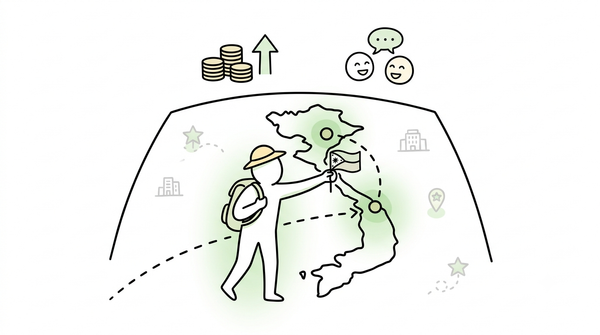
IBPAP President Jack Madrid pointed out that these changes are driven by a mix of factors. Aside from the sudden, massive leap in AI capabilities, there are changes in how global businesses buy services. On top of that, other countries are aggressively stepping up their game. Nations like South Africa, Egypt, Poland, Vietnam, Colombia, and Costa Rica are emerging as strong alternative hubs, making global investors take longer to decide where to put their offices. While India remains the global giant of BPO, the Philippines is feeling the squeeze from all sides.
Moving Beyond the Hype: What This Really Means
To understand what this means, we have to look past the technical jargon. AI is not going to completely wipe out BPO jobs overnight. What it is doing, however, is rewriting the job description.
Think of BPO work as a ladder. The bottom rungs are transactional tasks—things like resetting passwords, checking account balances, or routing calls. These are highly repetitive, script-governed tasks. Unfortunately, these are precisely the tasks that modern AI chatbots and virtual assistants can now handle instantly and at a fraction of the cost.
The top rungs of the ladder are high-value tasks. These require deep empathy, complex problem-solving, emotional intelligence, and critical thinking. If a customer is crying because their bank account was hacked and they cannot pay for their child’s hospital bill, an AI chatbot will struggle. A human, however, can de-escalate the situation, coordinate with multiple departments, and offer genuine comfort while solving the problem.
The challenge is that the bottom rungs of the ladder are disappearing. It used to be that a high school graduate with decent English skills could land an entry-level BPO job and learn on the go. Now, the entry point is much higher. The gap between what schools teach and what BPOs need is widening. If the industry is shifting toward "AI-enabled" roles, we must ask: Who is going to train the millions of workers who are currently stuck on those bottom rungs?
The Human Ripple Effect
The impact of this shift goes far beyond the corporate boardrooms and high-rise offices of Bonifacio Global City or Cebu IT Park. It stretches deep into ordinary Filipino households.
Consider the family structure in the Philippines. It is incredibly common for one BPO worker to support an entire household. When a call center agent’s job security is threatened, the safety net of their family threatens to tear.
[BPO Worker Income]
       │
       ├─► Younger Sibling's College Tuition
       ├─► Parents' Maintenance Medicine & Groceries
       ├─► Rent, Electricity, & Water Bills
       └─► Local Economy (Tricycle drivers, food stalls, convenience stores)
Furthermore, think of the local ecosystems that thrive around BPO hubs. The 24-hour convenience stores, the night-market food stalls (jollijeeps or carinderias), the tricycle and jeepney drivers who work the graveyard shift, and the security guards and cleaners who maintain the buildings. When BPO growth slows down or shifts, these micro-economies feel the chill immediately.
For young graduates, the BPO sector has long been the great equalizer—a place where a college degree was not always mandatory to earn a decent living. If entry-level positions dry up in favor of highly specialized, tech-heavy roles, we risk leaving behind the very segment of our youth who need these opportunities the most.
Looking to the Community
This massive shift highlights why grassroots, community-based development is more critical than ever. We cannot rely solely on large corporations to prepare our workforce for the future.
The changing landscape of work reflects why local, accessible efforts around basic digital literacy, computer access, and soft-skills training are so vital. When communities have access to free or affordable learning hubs, ordinary citizens—from tricycle drivers wanting to transition to online work, to mothers seeking home-based BPO roles—get a fighting chance to adapt. Grounding our response in the community ensures that the transition to an AI-driven economy does not leave our most vulnerable neighborhoods behind.
A Thoughtful Road Ahead
Technology has always promised to make our lives easier, but the transition period is rarely gentle. The reduction in the BPO industry's growth targets is not a sign of failure; rather, it is a realistic assessment of a world that is changing faster than our systems can keep up.
We are entering an era where the headset alone is no longer enough. The challenge for the Philippines is to ensure that our workers are not replaced by technology, but are instead empowered by it. As we look to the future, we must ask ourselves: in our rush to build a highly digital, AI-driven workforce, how do we make sure we do not lose the very warmth, empathy, and humanity that made the Filipino worker world-class in the first place?
Lahat tayo masaya kapag may bagong trabaho sa BPO, pero paano kung dahan-dahang nagbabago ang ihip ng hangin? Dahil sa tindi ng AI at bagong kompetisyon mula sa ibang bansa, binabaan ng BPO industry ang kanilang growth targets para sa mga susunod na taon. Ano ang mangyayari sa mga ordinaryong ahente, sa kanilang mga pamilyang umaasa sa kanila, at sa mga naghahanap ng trabaho?

Power Our Mission, Shape the Future
We empower single parents, PWDs, youths, seniors, and stay-at-home parents through digital livelihood.
Help us build resilient communities.
BUKLURAN remains open to partnerships, sponsorships, and collaborative initiatives that create meaningful community impact.
Whether through funding, in-kind support, volunteerism, or shared services, your organization can help strengthen programs that serve underserved communities.
Do you want to take part in our free livelihood programs, scholarship assistance, and community resource pooling initiatives? Membership is completely free.
Join BUKLURAN!
Register, volunteer, and become a member today.